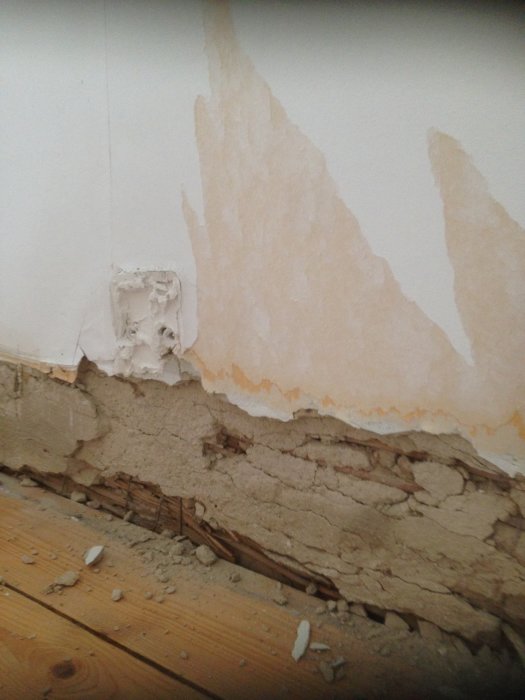
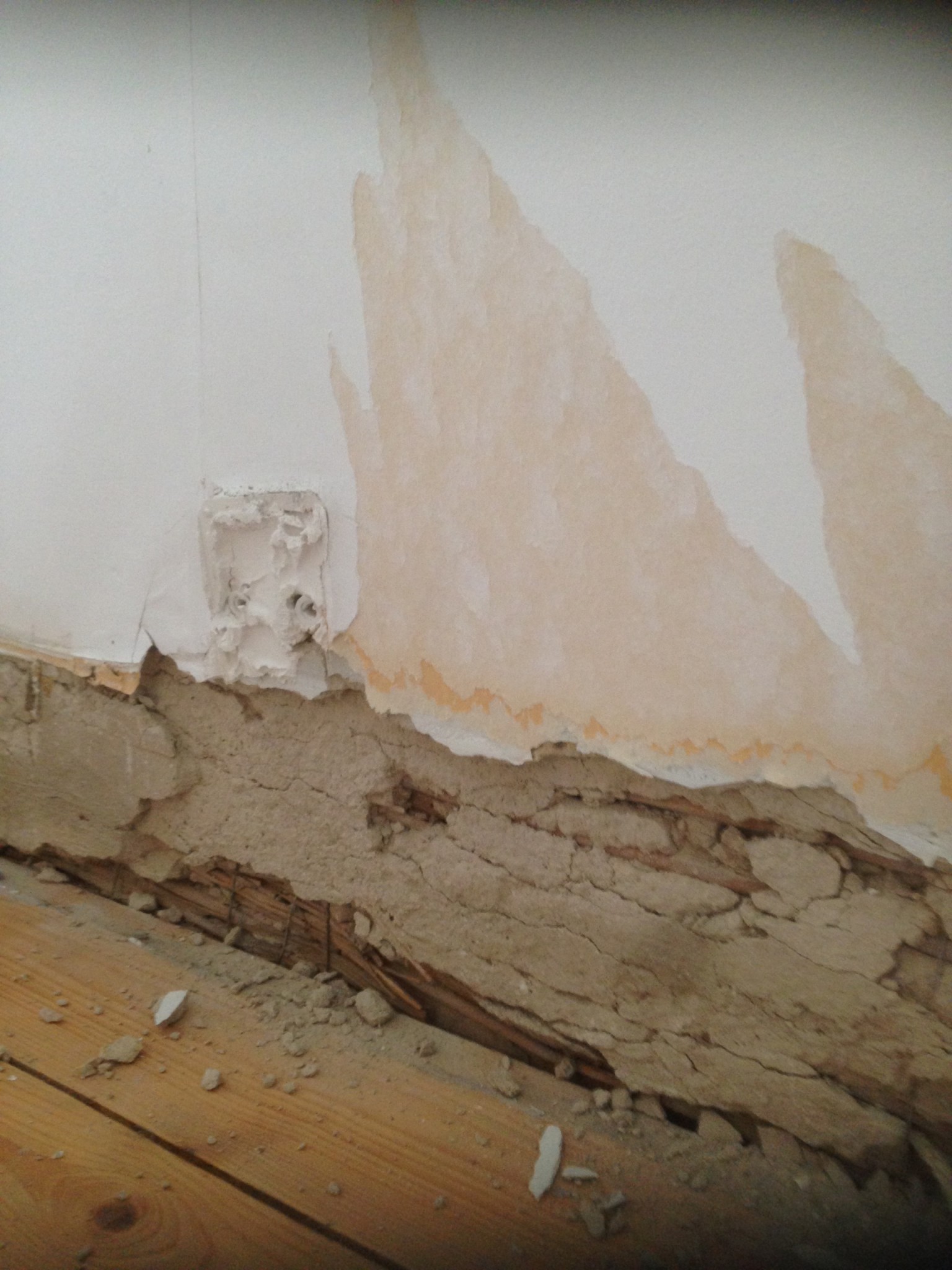
We live in an apartment in a house from the 1920s, a wooden house. When we removed the moldings that were on their last legs, some of the filler behind them came off. Behind the moldings, we could see the old insulation. We were originally planning to tear down all the old wallpaper (there are several layers), but now we're a bit hesitant since the filler feels so weak, just touching it makes it come off and fall to the floor. It creates a lot of dust and vacuuming. So the question is, how should we proceed? Skip tearing down the wallpaper and just fill it with filler? What should we do behind the moldings where there are bigger holes, is it possible to fill the holes with filler or is another product recommended?
Doesn't look like plaster but render on a straw wall. An alternative is to knock down all the render and remove the straw (probably attached with cardboard nails and wire) and clean up to the wooden wall, then put drywall on the walls.
But it's messy and dusty.
Otherwise, perhaps it can be repaired locally where the moldings were and skim coat the rest.
Thank you! We're quite new to this renovation world, didn't really know the difference between plaster and filler
Okay! Hmm, when we undertake a project, we like to do it wholeheartedly, so we're leaning towards knocking off all the plaster and removing the straw to put up plasterboards. But out of pure curiosity, what's hidden behind the plaster and straw? Is it brick? I'm pretty bad at insulation history.
With all respect for wanting to do it wholeheartedly, but it is dreadfully dusty and tedious to tear down such walls. So if you really don't have to, then fix what needs fixing and then patch it up. There are probably better places to put that energy.
That brings back old memories. I had boards behind the plaster where there was reed (attached with wire). If I remember correctly, there was no reed in my outer walls, this was in a brick house.
If there are boards behind it, the question is how straight the board wall is. I'm thinking about how easy it is to build a sufficiently flat wall with plasterboard. It might be possible to align/build a flat wall with OSB or plywood and then put up plasterboard. Unfortunately, there is probably only one way to know, which is to knock down the plaster. But the risk is that it will be quite a big job.
It seems very excessive to remove all the plaster, reed mats, etc., just because you want to wallpaper. It would also have been interesting to see the moldings you removed that were "on their last legs." Did they need to get rid of some old paint, be patched up, and repainted?
At the risk of sounding a bit patronizing, renovation doesn't have to mean tearing down everything old to replace with new. There was a reason people used plaster/clay on interior walls in the past - it was tight, provided good sound insulation, and gave a good surface to paint/wallpaper on. If I were you, I would try to repair the plaster with a suitable plaster mix (or maybe even gypsum plaster, which is easy to work with). If you feel that without wallpapering it is poor, get help from a painter who can either bind/isolate the old layers and, if necessary, do some skim coating. Starting over with a raw plank wall just creates unnecessary work, and there is nothing fundamentally better about a modern drywall compared to an old plastered wall
I have to agree with the above, it's a substantial job to knock down the plaster. The benefit of doing so in this case seems minimal. Mix a bucket of plaster to fill that hole, then go ahead and plaster/spread plaster on the wall.
If you absolutely feel you need a plasterboard wall to wallpaper on, throw on a 6mm rotgips. But there's really no point in doing so, and it won't be less work for you. Plastered walls have worked for the last 100 years, and it will work for you too.
Are you planning to install new baseboards? Save the old skirting boards so that you have them when you realize it looks odd with modern baseboards in an old house. If you then want to switch back, you won't have to do like I did and buy new ones for 100 kr/m at the building supply store.
Thanks for all the replies! We will sit and consider. The plaster is really in bad shape, just brushing against it is enough to make it fall off. The plinths had a lot of holes and several layers of plastic paint, which we tried to scrape off with a speed heater but eventually realized it would take too long. Instead, we're buying new ones for 70 SEK/m from a great carpentry shop. In the same style as the original
Before doing anything drastic, try adding some plaster. It might cost around a hundred for a bag. Alternatively, hire a painter to take a look. If you start chiseling away at the plaster, you'll have a guaranteed major task ahead of you, and it will mean living in a war zone for a couple of weeks before it's done.
To get the plaster to adhere, I would go over it with a soft brush or something to remove all loose bits, and then spray with a spray bottle.
That is called rendering when it's outdoors, but I think it's called something else when it's indoors.
I recently tore down such a wall in the basement from -33. In my case, the wall consisted of standing planks with a reed net on it. The reeds were fastened with wire and small nails. The plaster was then attached to the reeds.
As others have written, it will be very dusty if you choose to remove the plaster. I would have hesitated to do that in a living space.
What's on the other side of the wall? Neighbor or more of your apartment? In my case, the plank wall was partly sparse under the plaster, and I can imagine that plastering was done in the past, among other things, to seal the wall.
Talked to my partner and my partner's dad who is a bit more knowledgeable about this stuff. We are leaning towards applying plaster where it is detaching and patching the wallpaper. However, not the entire wallpaper as we want to keep the cost down and do most of it ourselves, just patch where there are a lot of imperfections (the previous owners had wallpapered carelessly). Then maybe just a new layer of paint or perhaps new wallpaper. I think it'll turn out well, I don't have the energy for a huge amount of work which it sounds like it would otherwise have been.
Excellent conclusion. If you find broad spackling difficult, you can go for wall-cover, which is a thick renovation wallpaper that conceals many imperfections. Easy to apply and then you paint directly on it.
Why not just screw drywall with slightly longer screws?
And if you have old electrical, you can modernize a bit by first screwing battens, then OSB and drywall, and have the electrical wiring run in the wall!
Vi vill skicka notiser för ämnen du bevakar och händelser som berör dig.