
15,549 views ·
16 replies
16k views
16 replies
Parquet or walls first?
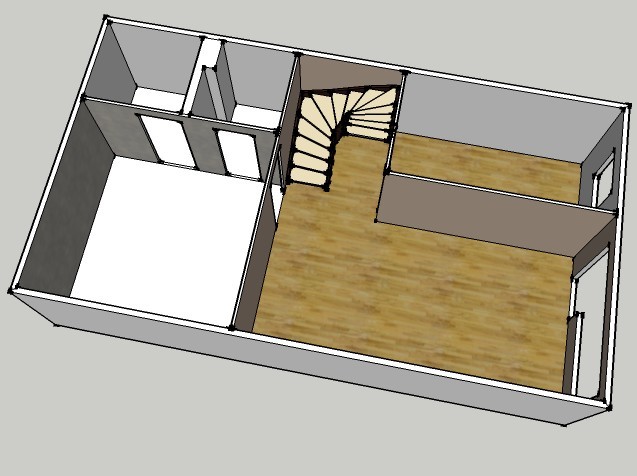
I am planning to renovate the lower floor. Tear down 2 walls, put up 2 walls, and lay new flooring everywhere. The question is in which order to do it. Obviously, tear down walls first, but then I would prefer to lay the new parquet over the entire area and then put up the walls. I understand that it's recommended to have a floating floor to avoid cracks or humps, but I'm wondering how significant that is in my case since I intend not to have any thresholds, so the floor will be continuous. See the pictures, and you'll probably understand me better.
As I see it, I have 2 options with different advantages.
1. First, build the walls and then lay the new parquet around the walls. The floor will then be as loose as possible. It involves a lot of measuring and cutting around frames and corners. If you want to remove any wall in the future, the floor will need to be tidied up somehow.
2. First, lay the floor over the entire area and then put up the walls. The floor will then be fixed roughly in the middle of the room and across the middle of that middle... eh! Just see the picture. The advantage is that you can remove the walls in the future if you want a large room. (Assuming you haven't damaged the floor with too large screw holes. I've seen two other threads that have addressed this issue.) It's solid concrete both below and above, so no problem if you were to put up tensioned studs or similar.
What do you think I should do?
As I see it, I have 2 options with different advantages.
1. First, build the walls and then lay the new parquet around the walls. The floor will then be as loose as possible. It involves a lot of measuring and cutting around frames and corners. If you want to remove any wall in the future, the floor will need to be tidied up somehow.
2. First, lay the floor over the entire area and then put up the walls. The floor will then be fixed roughly in the middle of the room and across the middle of that middle... eh! Just see the picture. The advantage is that you can remove the walls in the future if you want a large room. (Assuming you haven't damaged the floor with too large screw holes. I've seen two other threads that have addressed this issue.) It's solid concrete both below and above, so no problem if you were to put up tensioned studs or similar.
What do you think I should do?
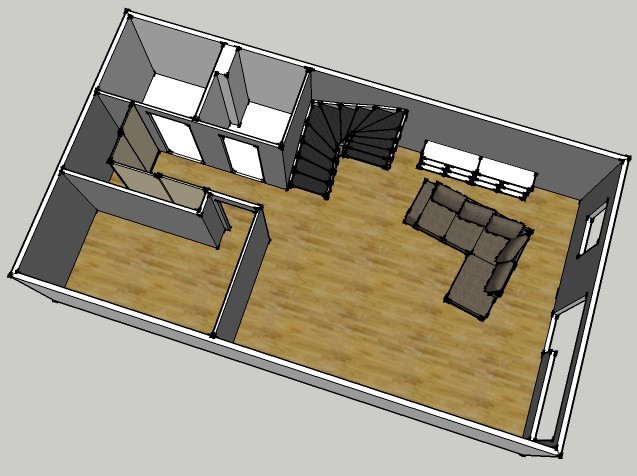
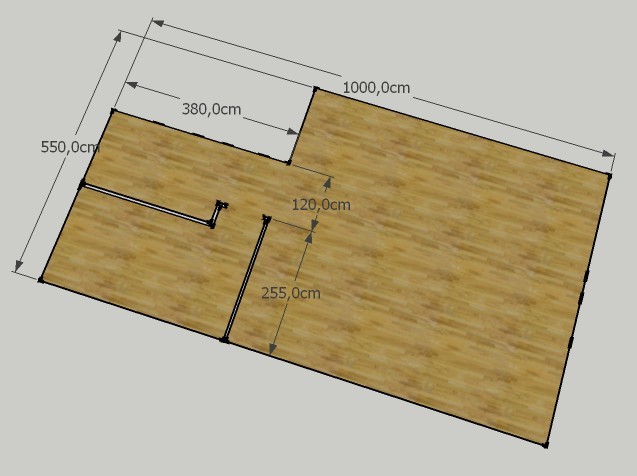
How big is the room then? As I see it, you can't lay such a large parquet floor completely anyway, is it some kind of click parquet floor? It's likely to separate somewhere when it tries to move, and it will move and needs to move.
I would build around walls in any case.
Best regards, Peder
I would build around walls in any case.
Best regards, Peder
Yes, it's click parquet. On the large area to the right in the picture, there's currently 3-strip oak parquet that has been there since '76 when the house was built. I don't believe the room would be too large. By the way, you have the measurements on the photo.
Can't you build walls that don't lock the floor?
Can't you build walls that don't lock the floor?

If I remember correctly, you should account for a movement of 1mm per meter for parquet. So, it involves a 10mm movement in your floor. It feels like movement joints along the length would be needed. If it had been shorter distances, I would have laid the floor and then framed with a metal stud with felt on it, and drilled large holes in the parquet for the screw down into the slab. Then the floor can move under the walls.
builder henke, you might have some theory behind your opinion. Just thinking something feels a bit weak as an argument... I think.
Larsa, 1mm per meter I have also heard, and calculated on, but an expansion joint for 10 meters shouldn't be necessary. Compare that to the wooden floor they laid at work just over a year ago where they placed an expansion joint after about 12m.
The picture shows how it looks today and has looked for 25 years. Then the wall was built directly on the floor, and several neighbors (townhouses) have removed the wall to get a larger living room. I have no idea what the standards were like in 1976, but they probably knew something back then.
If no one comes up with a better argument, I might defy your suggestions and lay the floor before I raise the walls. The ability to remove the wall in the future with an undamaged floor weighs a bit. I read in another thread that pine flooring should be fixed on one side to get control over how it flows, it should be about the same here, just in two directions.
It will be a few weeks, maybe months before it needs to happen. We'll see if the situation changes by then.
Larsa, 1mm per meter I have also heard, and calculated on, but an expansion joint for 10 meters shouldn't be necessary. Compare that to the wooden floor they laid at work just over a year ago where they placed an expansion joint after about 12m.
The picture shows how it looks today and has looked for 25 years. Then the wall was built directly on the floor, and several neighbors (townhouses) have removed the wall to get a larger living room. I have no idea what the standards were like in 1976, but they probably knew something back then.
If no one comes up with a better argument, I might defy your suggestions and lay the floor before I raise the walls. The ability to remove the wall in the future with an undamaged floor weighs a bit. I read in another thread that pine flooring should be fixed on one side to get control over how it flows, it should be about the same here, just in two directions.
It will be a few weeks, maybe months before it needs to happen. We'll see if the situation changes by then.
How far you can lay without an expansion joint varies from floor to floor, it should be stated in the instructions that come with the floor. I have been informed that the maximum is 12 m, but that does not apply to all floors, only the "best" ones, so check that before you lay it.
A theoretical possibility is to glue the baseboard to the wall in the parquet, so the wall can move with the wall a few mm if necessary without it affecting anything. Hard to say without knowing all the conditions, but that's probably what I would have done if there's a thought of possibly demolishing the wall in the future.
Have reviewed the instructions carefully now, and the maximum length/width of the room is 8m in width and 20m in the plank's length direction. I interpret those dimensions as meaning the plank swells/shrinks mostly in width.
Link to instructions: http://www.barlinek.se/instruktion.pdf
builder henke, do you mean that the floor is pinned by the weight of the wall and joints appear when the humidity drops and the planks shrink?
If so, I have an idea about letting the floor float around a fixed point, but it may work better in theory than in practice.
It might be that it's not an option to build the walls on the floor, but I simply want to understand why. That's just in my nature.
Link to instructions: http://www.barlinek.se/instruktion.pdf
builder henke, do you mean that the floor is pinned by the weight of the wall and joints appear when the humidity drops and the planks shrink?
If so, I have an idea about letting the floor float around a fixed point, but it may work better in theory than in practice.
It might be that it's not an option to build the walls on the floor, but I simply want to understand why. That's just in my nature.
I interpret the instruction the same way as you, 20 m in length should be possible according to the instructions, which is 8 m longer than what "everyone" has said so far, and you have a max of 10 m, so it should work. Since only a 15 mm expansion joint is needed according to the same instructions, Larsa's idea is not so bad, with a metal strip at the bottom that is screwed into 30 mm holes so the floor can float a bit under the wall if it wants to.

If you lay a click-lock, floating floor it's an easy thing to rearrange it in the future; all you need then is a few boards saved. Build them into the wall, so you know where they are when you need them.Relaxia said:
