
9,371 views ·
15 replies
9k views
15 replies
Overlapping of reinforcement mesh

Hello!
We have excavated the foundation in our small cottage to pour a slab instead.
We did all the preparation by the book with 20 cm of well-compacted and leveled gravel, 30 cm of insulation foam with staggered joints, and then we poured a 10 cm thick layer on top with underfloor heating pipes and all the works!
The slab is 12 x 4.8 m with an interruption for a large chimney foundation in the middle of the house. The finished slab is about 50 cm above the ground outside and the entire pour has been done within the existing masonry stone foundation with an insulating barrier to prevent cold drafts.
My concern is about the reinforcement! We have not overlapped the reinforcement mesh, the meshes are quarter mesh and are only edge to edge. Should I be worried??
We have excavated the foundation in our small cottage to pour a slab instead.
We did all the preparation by the book with 20 cm of well-compacted and leveled gravel, 30 cm of insulation foam with staggered joints, and then we poured a 10 cm thick layer on top with underfloor heating pipes and all the works!
The slab is 12 x 4.8 m with an interruption for a large chimney foundation in the middle of the house. The finished slab is about 50 cm above the ground outside and the entire pour has been done within the existing masonry stone foundation with an insulating barrier to prevent cold drafts.
My concern is about the reinforcement! We have not overlapped the reinforcement mesh, the meshes are quarter mesh and are only edge to edge. Should I be worried??
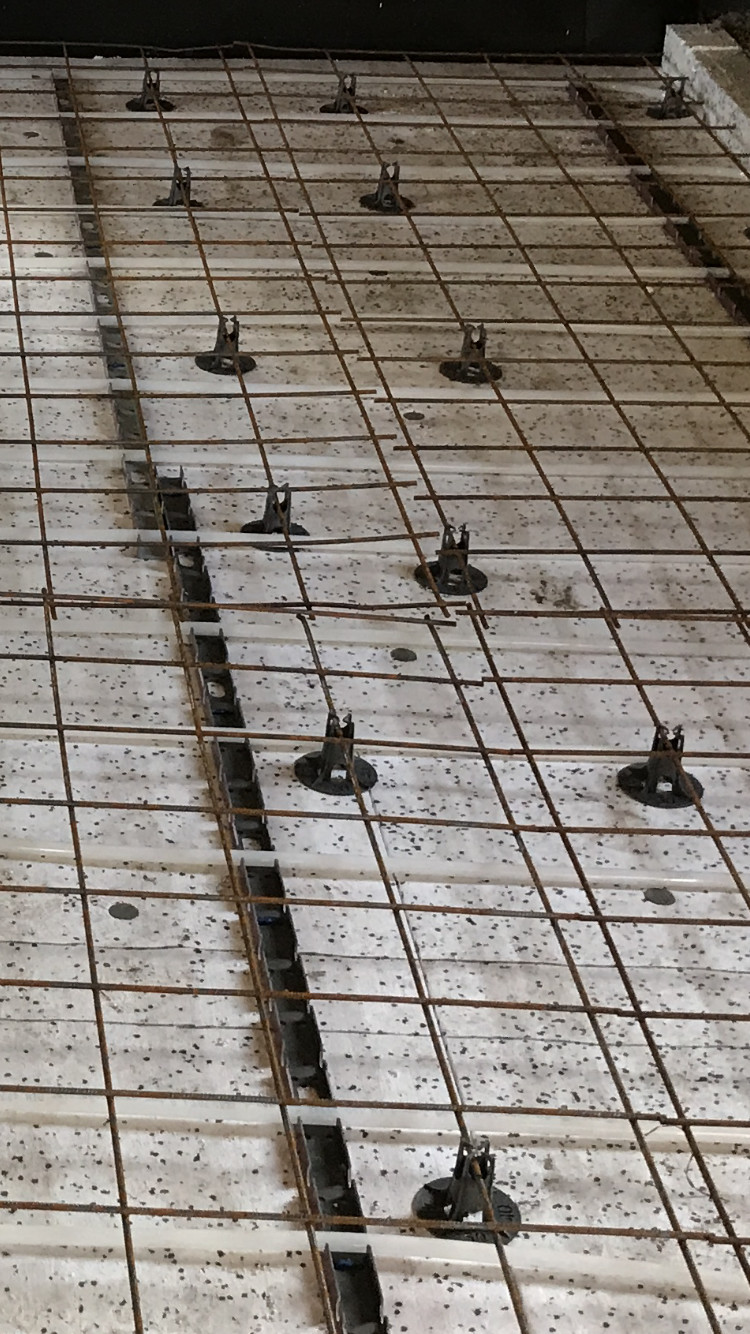




The question is really what the slab will be used for. From a purely construction standpoint, it is basically unreinforced. Most likely, not much will happen. From what I understand, the ground conditions are good and the slab is not really load-bearing.
But that said - if I, against all odds, were in your position, I would not sleep soundly.
When did you pour? It would most likely have cracked anyway.
But that said - if I, against all odds, were in your position, I would not sleep soundly.
When did you pour? It would most likely have cracked anyway.
We poured with 40-day concrete two weeks ago.C C.Lundin said:The question is really what the slab will be used for. From a purely constructional point of view, it is essentially unreinforced.
Probably not much will happen. From what I understand, the soil conditions are good and the slab is essentially non-load bearing.
But with that said - if I, against all odds, was in your position, I wouldn't sleep peacefully.
When did you pour? It would most likely have cracked anyway.
If it cracks or when it cracks, is there a risk of vertical displacements? If so, is there a risk for the water hose?
I don't think you need to worry. If I've understood correctly, it's just an indoor room. Very small loads. So if it cracks, it's when the concrete cures/hardens. But I also don't think it's a matter of large, through-going cracks. Water and cover the slab properly during the first few days so it cures slowly. That way, you reduce the risk of cracks. If it still cracks, it can be resolved afterwards in various ways.
Good to hear! No exactly, they are very small areas as I said and there are no load-bearing walls that burden the slab.A AG A said:I don't think you need to worry. If I understand correctly, it is just a room indoors. Very small loads. So if it cracks, it's when the concrete cures/hardens. But I also don't think there will be any large, through cracks. Water and cover the slab properly, during the first few days so the slab cures slowly. That reduces the risk of cracks. If it still cracks, it can be fixed afterward in various ways.
One way to avoid cracks that can affect the plastic mat could be to lay a layer of self-leveling compound over the surface with a weaker reinforcement mesh in the compound. It's not about bearing any loads here. So even a chicken wire as reinforcement would probably help somewhat.

Cracks can occur during the curing time or later, for example in the winter when the house is cold-set. This is because the concrete shrinks as it cures, but also due to temperature changes.
It can happen in 5, 10, or 20 years. The best scenario is several cracks with a small crack width. Worse is a crack with a larger crack width.
If you know exactly where the joint is, you can saw a crack indicator down to 1/3 of the slab's height. Then you have a neat and clean joint, which can be filled with sealant. However, if you don't know where the joint is (and it can be enough to guess wrong by 5 - 10 cm), then the joint serves no function, and you may get a crack somewhere else.
However, if the house is always heated, the concrete slab should always have a temperature between 10 and 25 degrees, and it won't be as exposed to temperature shrinkage.
It can happen in 5, 10, or 20 years. The best scenario is several cracks with a small crack width. Worse is a crack with a larger crack width.
If you know exactly where the joint is, you can saw a crack indicator down to 1/3 of the slab's height. Then you have a neat and clean joint, which can be filled with sealant. However, if you don't know where the joint is (and it can be enough to guess wrong by 5 - 10 cm), then the joint serves no function, and you may get a crack somewhere else.
However, if the house is always heated, the concrete slab should always have a temperature between 10 and 25 degrees, and it won't be as exposed to temperature shrinkage.
In the 50s and 60s, lots of houses were built where the basement floor completely lacked reinforcement. Most of them have worked fine. Considering the small load that will be on your floor, I don't think there will be any problems. And since it's already too late to change, there's no point in losing sleep over it.