
3,473 views ·
8 replies
3k views
8 replies
Open up brick wall for window section
Hello everyone,
We have a house built in 1933. Two floors and a basement.
The structure has double brick walls.
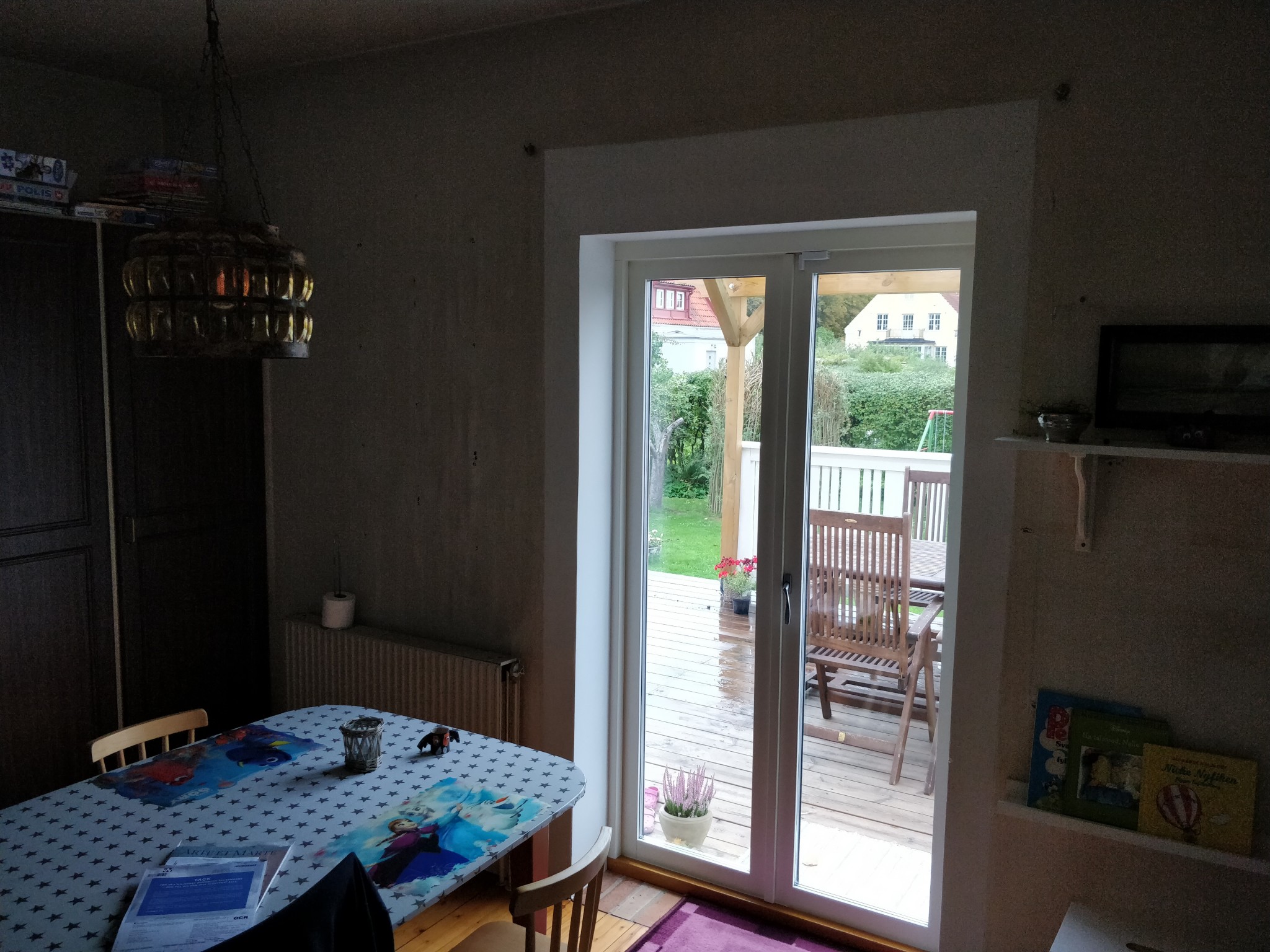
In connection with an upcoming kitchen renovation, we plan to open up the exit from the kitchen to the deck and install a possibly sliding window section.
My question is about the best way to brace the wall while removing the part that will be opened up so that it doesn't collapse from above? And how to best install beams at the top without removing the bracing?
See the picture. The wall should be opened up as far as where the paper roll stands on the radiator, and the opening should be higher than it is today.
Grateful for good suggestions!
We have a house built in 1933. Two floors and a basement.
The structure has double brick walls.
In connection with an upcoming kitchen renovation, we plan to open up the exit from the kitchen to the deck and install a possibly sliding window section.
My question is about the best way to brace the wall while removing the part that will be opened up so that it doesn't collapse from above? And how to best install beams at the top without removing the bracing?
See the picture. The wall should be opened up as far as where the paper roll stands on the radiator, and the opening should be higher than it is today.
Grateful for good suggestions!

My spontaneous answer is like Stefan Löfven's: Forget it! Creating such a large opening in a load-bearing wall structure is a complicated, large, and expensive undertaking. You need to involve both an architect and a structural engineer. When I see the surrounding environment through the windows, I guess that it also requires a building permit, which you should not take for granted. The risk of distortion is obvious. Instead, consider alternative solutions through light (visually speaking) extensions.

Then you need to present significantly more information about the house as it looks today, especially an elevation drawing but preferably also a floor plan and section drawing. The basis for my previous post is mainly that I suspect the result will not be good.
Such a large opening must be secured by installing a steel beam. Such a beam requires supports, which can either consist of the existing brick wall or new columns whose loads must then be transferred down to the foundation. The methodology (and beam dimensions) depends on how tall the wall is. If it is a 1 1/2-story house where the wall only reaches up to the mezzanine, it may be easier to dismantle the wall above the opening, insert the beam, and rebuild. If it is a 2 or 2 1/2-story house, the wall needs to be temporarily supported with steel beams above the level where the new permanent beam will lie. All measures lead to quite significant damage to the masonry. If the façade is plastered, it can be restored without major visible changes, but if the façade consists of face brick, it is almost impossible to make it look good.
Difficult if not impossible to temporarily relieve the wall since it is presumably a timber frame that cannot be supported. The method will probably be to install the steel first, it should work without a column but a structural engineer needs to calculate the brick support. Also, whether the foundation can handle the load redistribution.
One might possibly fit a steel beam from each side, outside and inside. One at a time. Not easy, a complicated process of carving out to fit the first beam, then demolishing the other half and placing the second beam.
One might possibly fit a steel beam from each side, outside and inside. One at a time. Not easy, a complicated process of carving out to fit the first beam, then demolishing the other half and placing the second beam.
The choice of methodology greatly depends on the actual conditions. One can suspect from the window view that it is quite an old building, with a foundation that is difficult to assess.
Click here to reply