
2,520 views ·
15 replies
3k views
15 replies
Different levels of pillars, warped bearer beam and floor
Hello! Is it possible to save these beams and if so, what is the best approach?
Conditions
Vacation home from '76
10*5 meters
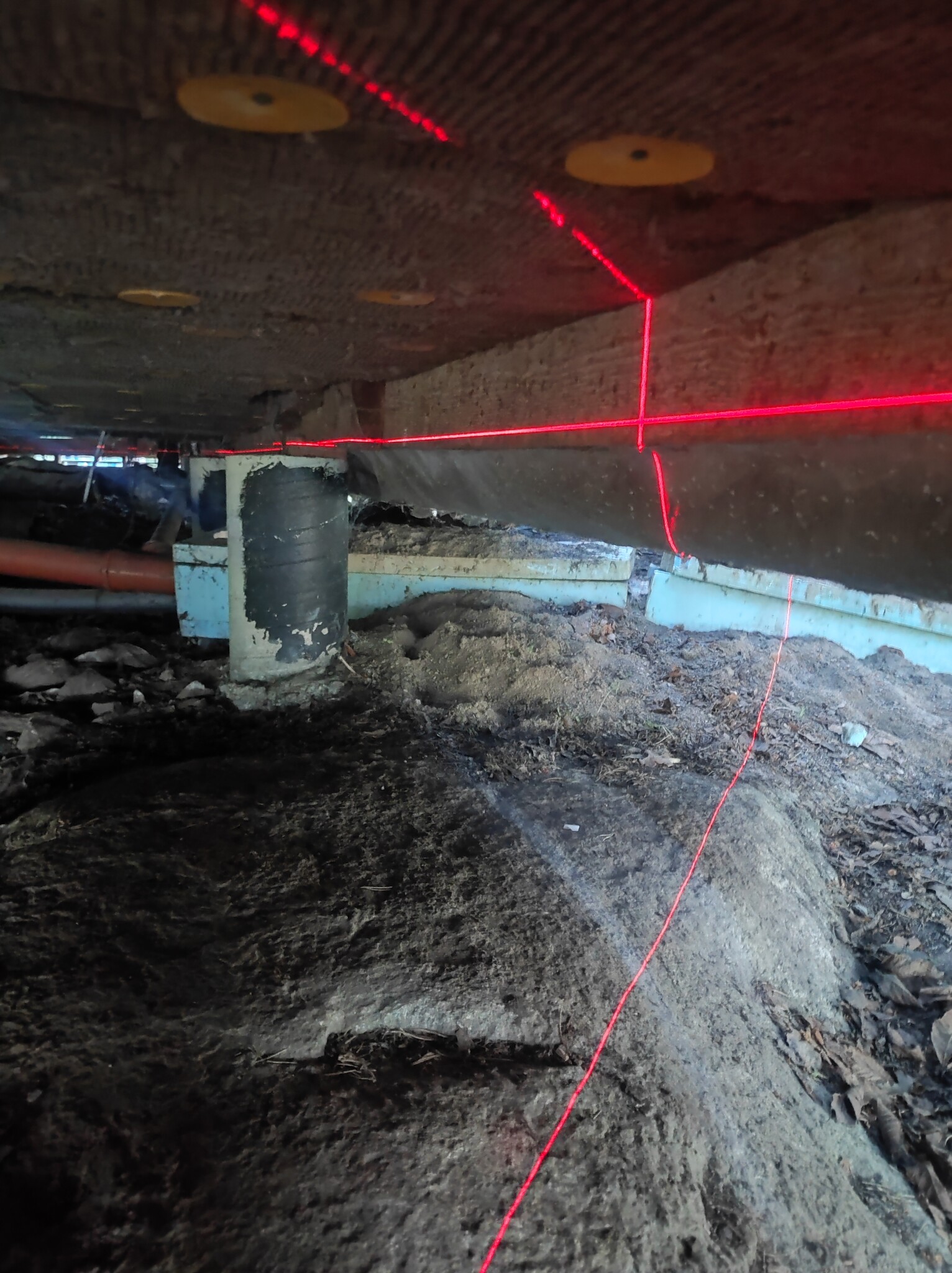
250 mm posts that stand on bedrock, cc 2.5 m. 3 rows of posts with 5 posts in each row. (Cc 2.5 m) Large level difference on the posts, about 95 mm between the highest and lowest post. They are also not fully vertical; I think they were poorly cast.
On the posts are beams with dimensions of 50*150 mm that are spliced overlapped. (Cc 2.5 m) These sag down between the posts about 3 cm.
On the beams lies the floor joist 130*50
(Cc 60 cm) The floor inside is not level and is uneven in most directions.
It is very cramped underneath in some places, 50-30 cm up to the floor joist. So it will be very cramped to get in with a rotary hammer if one were to fasten new rebar and cast new posts.
How do I solve this in the best way?
How can I solve the posts? Currently, it's wedged underneath in several places. Just thinking that you can see with the naked eye that they are not vertical, is it just to make new posts next to the old ones? How can one solve the issue when it's so cramped that you can't get underneath with a rotary hammer?
Use block and wedge under the last bit?
I've read that you can lift the beam with a jack and replace it with a new one. Just thinking that I will need to lift up the house quite a bit since I need heavier beams than the ones currently there. The idea was to use a 90*180 laminated beam; does that seem reasonable?
Finally, I wonder about the floor joist? Does it also need to be replaced, or will the floor be straighter if I fix the beams?
According to the wood guide, 145*45 can handle 4.83 m, thinking that 130*50 might be equivalent and should be sufficient?
I’m attaching some pictures where I'm trying to show the level difference on the posts and how the beams are sagging.
I hope someone can provide some guidance on how I should think.
Best regards, Anders
Conditions
Vacation home from '76
10*5 meters
250 mm posts that stand on bedrock, cc 2.5 m. 3 rows of posts with 5 posts in each row. (Cc 2.5 m) Large level difference on the posts, about 95 mm between the highest and lowest post. They are also not fully vertical; I think they were poorly cast.
On the posts are beams with dimensions of 50*150 mm that are spliced overlapped. (Cc 2.5 m) These sag down between the posts about 3 cm.
On the beams lies the floor joist 130*50
(Cc 60 cm) The floor inside is not level and is uneven in most directions.
It is very cramped underneath in some places, 50-30 cm up to the floor joist. So it will be very cramped to get in with a rotary hammer if one were to fasten new rebar and cast new posts.
How do I solve this in the best way?
How can I solve the posts? Currently, it's wedged underneath in several places. Just thinking that you can see with the naked eye that they are not vertical, is it just to make new posts next to the old ones? How can one solve the issue when it's so cramped that you can't get underneath with a rotary hammer?
Use block and wedge under the last bit?
I've read that you can lift the beam with a jack and replace it with a new one. Just thinking that I will need to lift up the house quite a bit since I need heavier beams than the ones currently there. The idea was to use a 90*180 laminated beam; does that seem reasonable?
Finally, I wonder about the floor joist? Does it also need to be replaced, or will the floor be straighter if I fix the beams?
According to the wood guide, 145*45 can handle 4.83 m, thinking that 130*50 might be equivalent and should be sufficient?
I’m attaching some pictures where I'm trying to show the level difference on the posts and how the beams are sagging.
I hope someone can provide some guidance on how I should think.
Best regards, Anders


Last edited:
Yes, oh my, that's quite a challenge.
The easiest way is probably to tear up the floor from the inside and then rebuild it. That way, you can cast new plinths and set straight joists to your heart's content.
I doubt it's possible to level that within the next century, especially as you say it slopes in all possible directions — it would have been difficult enough if it only sloped in one direction.
The easiest way is probably to tear up the floor from the inside and then rebuild it. That way, you can cast new plinths and set straight joists to your heart's content.
I doubt it's possible to level that within the next century, especially as you say it slopes in all possible directions — it would have been difficult enough if it only sloped in one direction.

Yes, then it's probably easier to tear it all down and build everything again?ricebridge said:
Yes, that's quite a challenge you've got there.
The easiest thing might be to tear up the floor from the inside and then rebuild it. Then you can cast new pillars and set straight joists to your heart's content.
I doubt it's possible to level that in the next century, especially since you say it slopes in all possible directions — it would have been hard enough if it only sloped in one direction.
Hmm. Wonder if the easiest thing really is to rip up the entire floor. You have a house that has stood for almost 50 years. Do you have any signs that the sloping has increased over the years? Or has it always been equally uneven - not entirely unlikely. If the latter, do you really need to worry about the plinths? Is it just an annoyance that the indoor floor slopes, can't you just lay a new floor inside that you level?
Have only lived here for barely 2 years so can't really say but there was a good slope on the floor when I moved in. What also worries me is that one of the bearing beams is very close to the edge of the plinth row. It's just inside the plinth. Then I'm a little worried that the bearing beams are sagging down too?S stugfar said:Hm. Wonder if the simplest thing is really to tear up the entire floor. You have a house that has stood for almost 50 years. Do you have any sign that the slope has increased over the years? Or has it always been equally uneven - not entirely unlikely. If the latter, do you really need to be worried about the plinths? If it's just an annoyance that the indoor floor is sloping, can't you just lay a new floor inside that you level up?
I don't know if it's reassuring, but the floor in my summer house slopes quite a bit in part of the house due to different heights on the first and second pier rows, even though it’s been properly shimmed with various planks between the piers and beams. The floor slope hasn't increased or decreased in about 8 years. Neither have the piers - which are tilted every which way - begun to tilt more or less.Anders Bylund said:
I've only lived here for just under 2 years so I can't really say, but there was already a slope on the floor when I moved in. What also worries me is that one of the beams is very close to the edge of the pier row. It's positioned just inside the pier. Then I'm a little worried that the beams might also be sagging?
I believe a house often remains where it stands. Even if a beam is slightly crooked on a pier, and it tilts a bit, it's unlikely the beam will just slip off like that or that the pier will start to tilt more after 50 years.
And beams do sag. Although it seems a bit long at 2.5 m for those beams, 3 cm doesn't seem abnormal to me at least.
Perhaps start tracking more carefully with markers here and there? And start thinking about adjusting the interior floor if it doesn't move over the course of a year (you'll want to measure during different seasons since wooden houses can shift throughout the year).
No, I don't think they'll collapse tomorrow, but it's something that needs to be addressed over time. Plus, the wife wants me to build on one section and add a second floor to part of this structure, which feels a bit...😅S stugfar said:Don't know if it's comforting, but the floor in my vacation home tilts quite well in part of the house due to different heights on the first and second row of plinths, even though it's shimmed properly with various planks between the plinths and the support beams. The floor tilt hasn't increased or decreased at least in about 8 years. Nor have the plinths - which tilt this way and that - started tilting more or less.
I think a house often stays where it is. Even if a support beam is a bit crooked on a plinth, and it tilts a little, it's unlikely that the support beam will just slip off or that the plinth will start tilting more after 50 years.
And support beams bend. Then again, 2.5 m seems a bit too long for those support beams, but 3 cm doesn't seem abnormal at all in my head.
Maybe start having more careful monitoring with markings here and there? And start thinking about adjusting the inner floor if it doesn't move over the course of a year (you'll want to measure over different seasons since wooden houses can move
Well, with such extensive plans, it becomes important for someone to calculate whether the existing structure can support an additional floor. From everything you've listed so far, it doesn't seem to me that you need to worry until such a renovation becomes relevant. It rather feels quite normal.
If you are very interested in such things, there's a lot to read on träguiden.se:
https://www.traguiden.se/konstruktion/
Yes, the plan was to start this summer with it, but I have to try to fix the support beams first.S stugfar said:Well, with such extensive plans, it's important that someone calculates if the existing structure can support an additional floor. From everything you've listed so far, it seems to me like you don't need to worry until such a renovation becomes relevant. It feels pretty normal.
If you're really interested in such things, there's a lot to read at träguiden.se:
[link]
Is it normal for the support beams to sag 3 cm between the pillars?🤔
Grateful for the answers so far, it seems like casting low square pillars and then laying leka on them is the best option.
3 cm is not unusual, but your potential problem arises when you load the joists with a new floor. In the link I sent you, you can find more about deflection. Also, search here in the forum for the user justusandersson and you will find a lot of valuable and interesting information.
Yes, there's a lot to read there but it's not so easy for the average person to figure out what to use for sizing.S stugfar said: