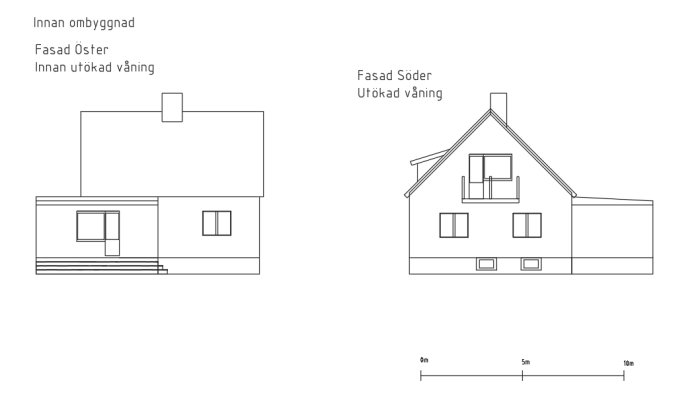
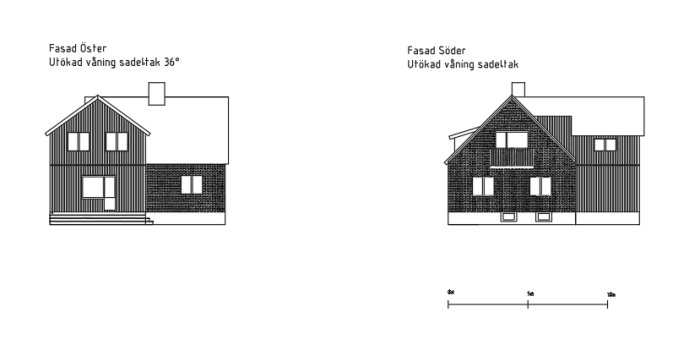
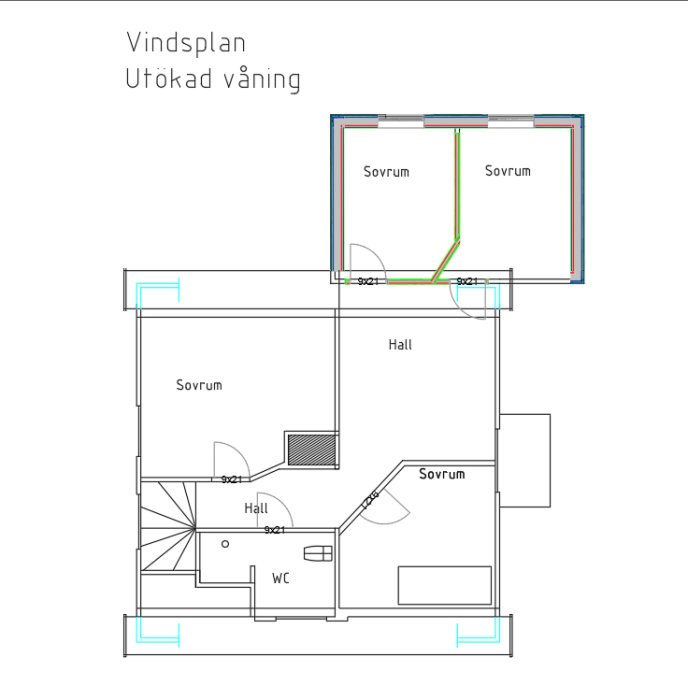
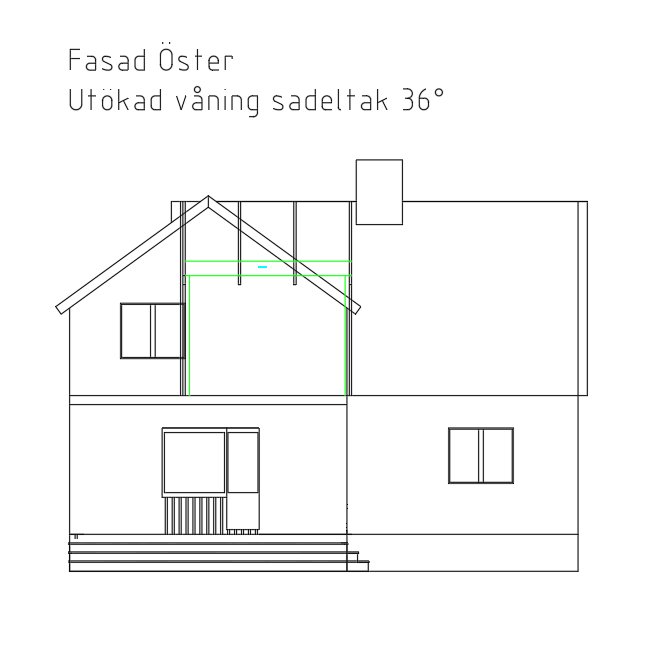
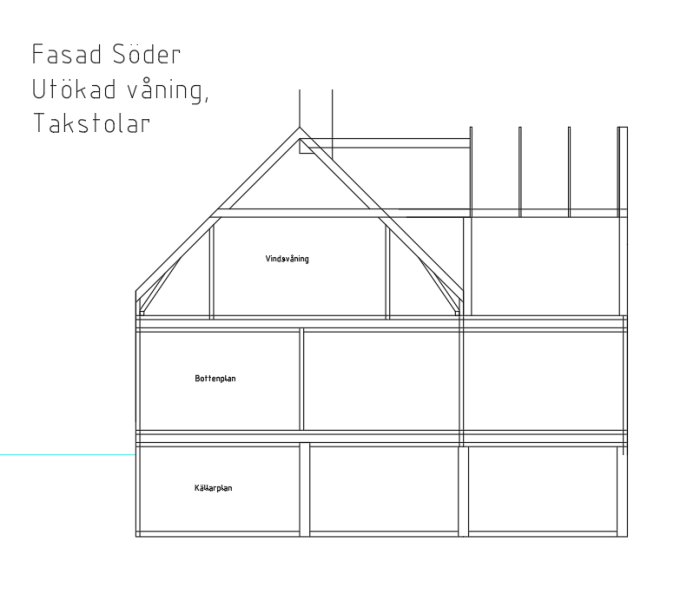
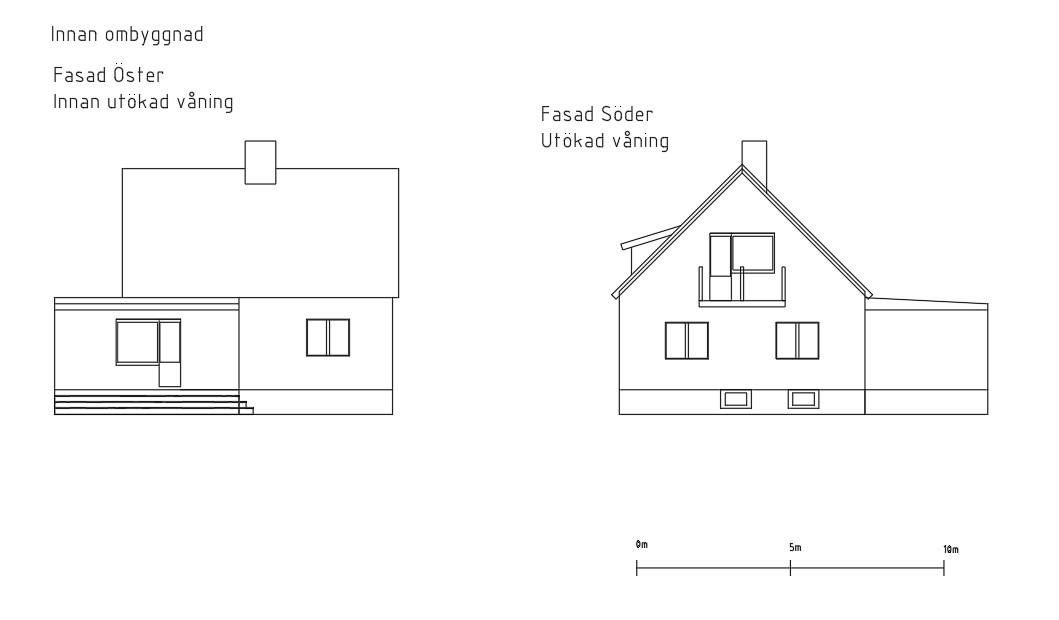
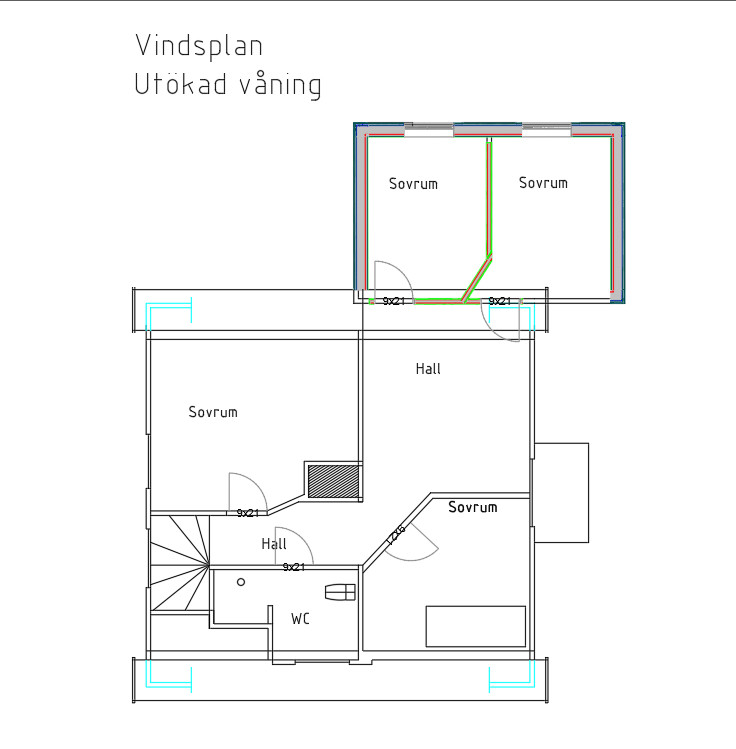
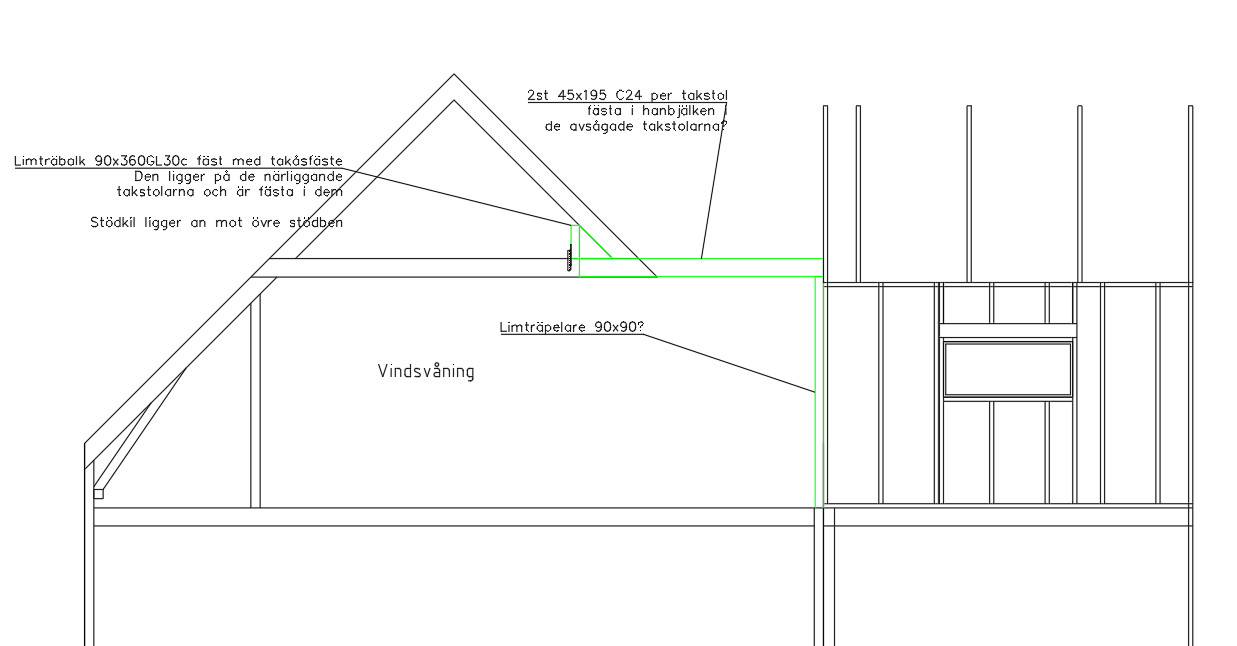
We are in the phase of adding another floor to our already existing extension. The main house is a 1 1/2 story (8.5x8.1m) house built in 1950. An extension (4x6m) was added in 1970 on one floor. Now we are going to build up a floor to get two more rooms. To open up to the two new rooms, we will need to substitute two roof trusses (Cut the support legs). I am considering the procedure and what might need reinforcement.
In my view, a glulam beam or equivalent is laid over the collar beams on the cut and adjacent (trusses. I have tried to calculate the glulam beam (90x415 GL30c, could this be correct? Used the formula 5qL^4/384EI) to support the load but am also considering whether the point load would be too high on the existing outer wall as the adjacent trusses have to share the load from the cut trusses.
Primarily, it is the shortened high legs that need to be switched off. A bit more information is needed to be able to calculate it. However, I would like to question the utility of the measure. You are turning a usable space on the upper floor into a hallway. With the help of a dormer, you can get two extra bedrooms on the upper floor without this large and expensive renovation.
It is primarily the cut rafters that need to be adjusted. Some more details are needed to be able to calculate it. However, I would like to question the usefulness of the measure. You are transforming a usable space on the upper floor into a hallway. With the help of a dormer, you can get two extra bedrooms on the upper floor without this large and expensive renovation.
Hello,
Thanks for the input and response. Yes, I have received these guidelines from our municipality on how designs should look both externally and internally, so a dormer has been considered. We live in a "50s idyll." The lower floor is already extended and we wanted to create a space for the children on the upper floor, as well as three rooms in total. In that part of the house, there is a large room.
Some dimensions, if anything is missing:
- The trusses are made of 3"x7", the parts I can see. They are placed c/c 1200
- We live in snow zone 2.5
- I'm not entirely sure about the exterior walls, it might be a standing plank wall, it looks like it when I've been inside the attic.
- The floor joists 2"x8" are c/c 600 and rest on the main wall.
- Today's dormer is currently supported with a 3"x8" beam that rests on the collar beam.
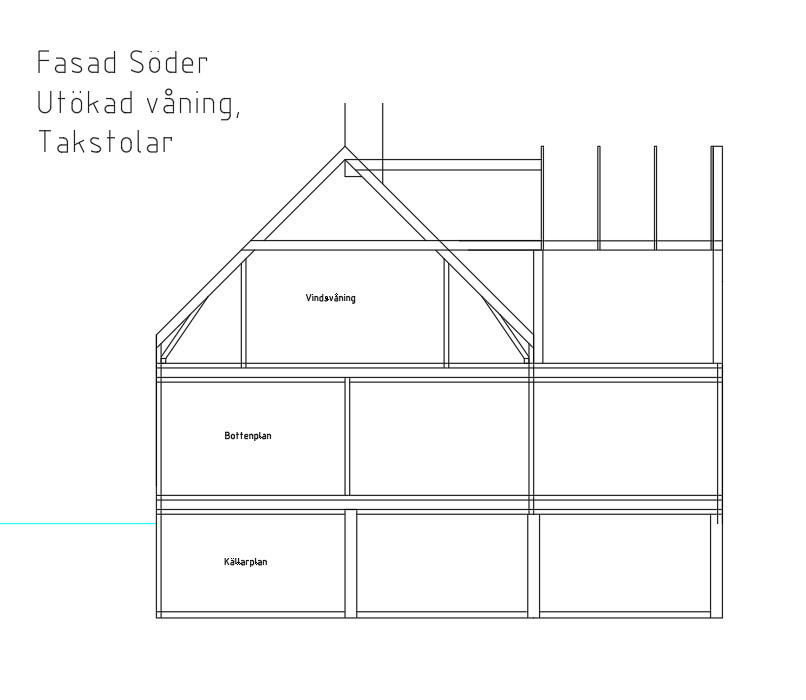
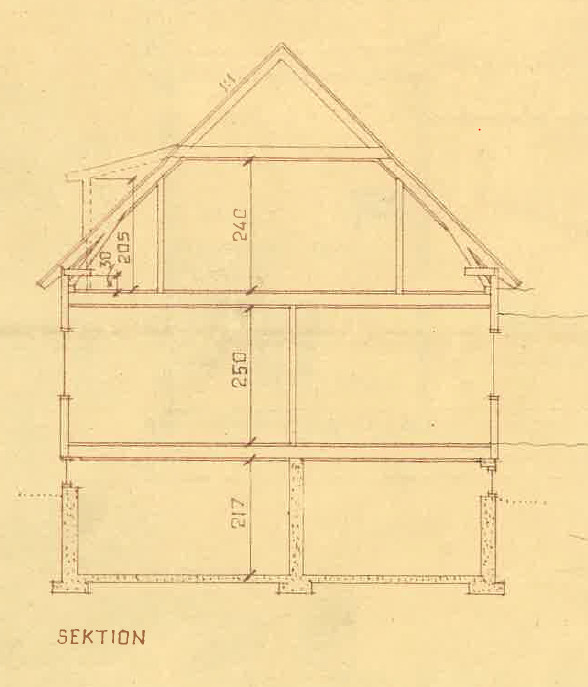
Sending the original drawing
Or is it enough to just connect the cut-off roof trusses with the adjacent roof trusses?
Yes, plus reinforcing the lower parts of their diagonal supports. The sectional drawing (original) indicates that it is a plank frame, which is not a disadvantage in your case.
Yes, plus you reinforce these high legs at the bottom. The sectional drawing (the original) indicates that it is a plank frame, which is not a disadvantage in your case.
Thanks for the response! Is a 56*270 beam enough if you move it to cover a few more trusses?
Is it enough to screw-glue construction plywood to reinforce the high legs?
56x270 has about 25% of the stiffness of a 90x360!
I saw that the deflection increased significantly with such a thin beam. It will have to be 90x360 or a steel beam for the same forces. Thanks for the help!
Click here to reply
Vi vill skicka notiser för ämnen du bevakar och händelser som berör dig.