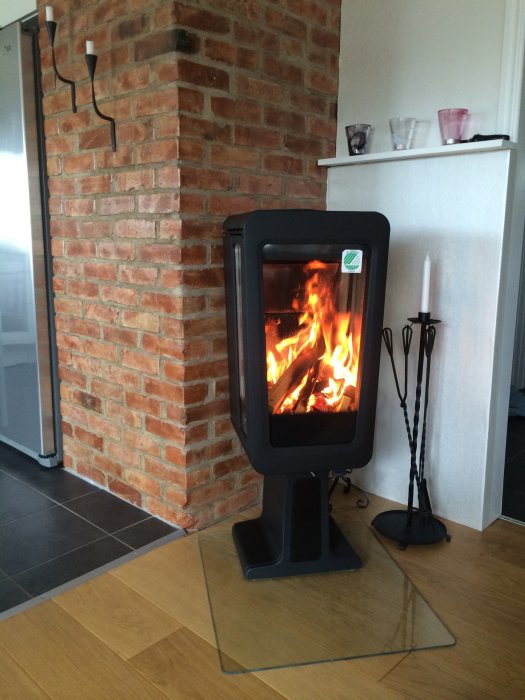
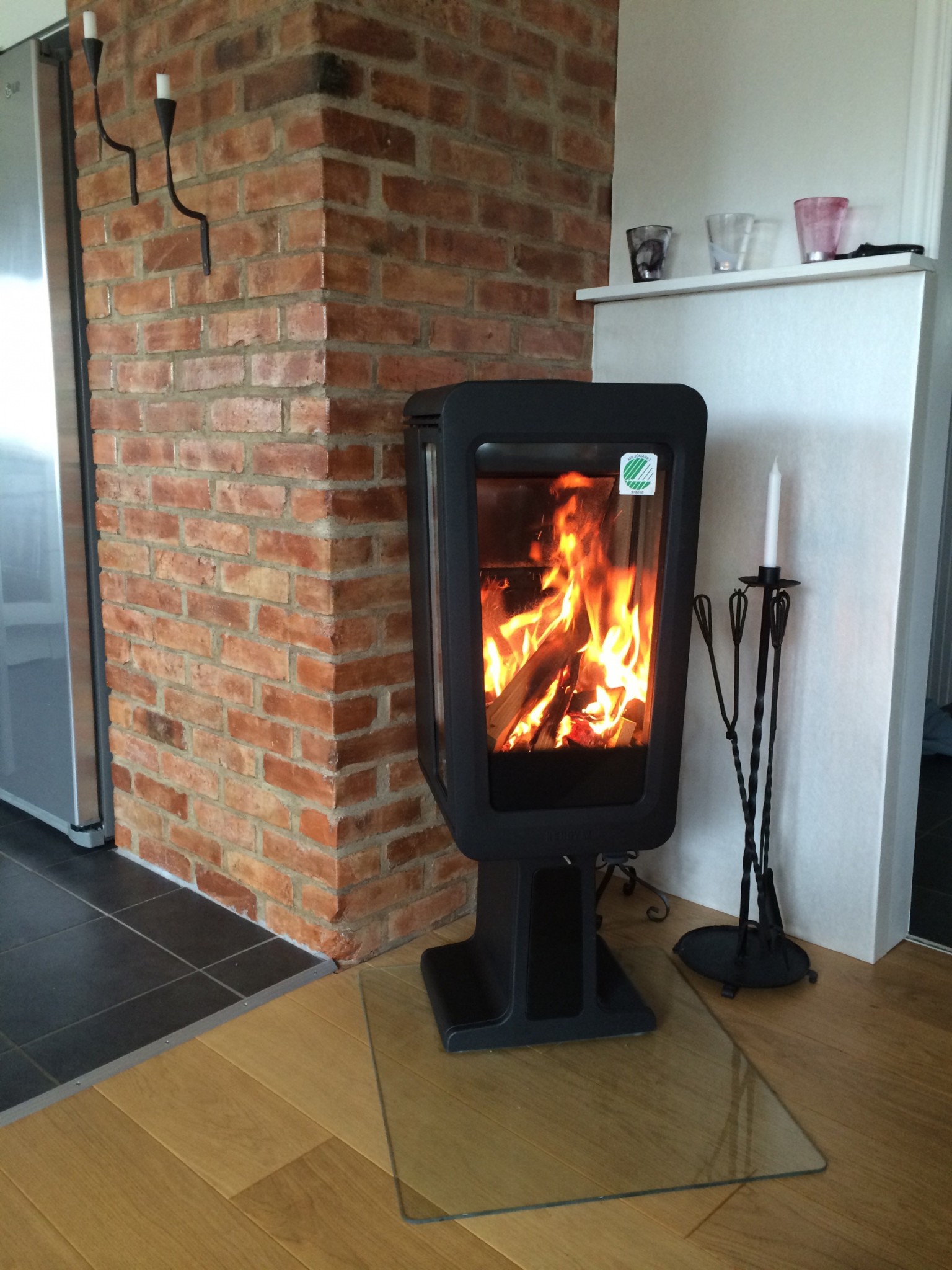
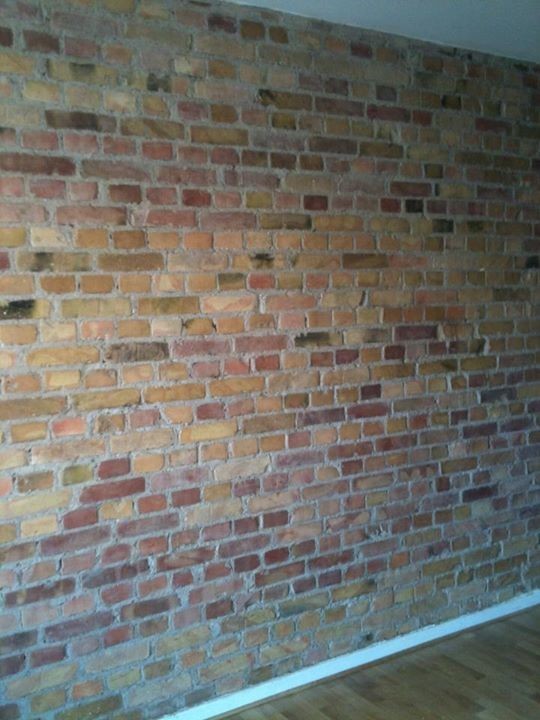
...yes as the title states. We have exposed a chimney/bare brick wall and are considering how we should treat it to resist splashes and become a bit less dusty... I know that actions are irreversible, and therefore I would like some opinions on how you have done and thought.
- lacquer
- brush with silicate binder
- leave as is
- other?
Then you must have it plastered; otherwise, you risk a burning ban. Check the rules with the chimney sweep.
Otherwise, it's likely not the bricks themselves that dust but possibly bad joints? In that case, I would have routed out the joints and re-grouted, and then washed with a mild acid solution. (Note: must be pre-watered thoroughly) and rinsed afterward.
No burning, and if it turns out that it is not sealed during pressure testing, we will install a liner. Probably it is the joints that are dusty but to mill them out and re-joint "is too late"... I am not going to do it because of the copious dust it would entail. Good tip but as mentioned too late for us.
My wife went over our chimney breast with the coarse filler from Byggmax and made some patterns, maybe not the prettiest, but we had the problem that grout fell onto the floor...
I should add that we have pipes in ours, so there won't be any direct temperature changes... otherwise, filler might not be the best choice.
I exposed the brick wall in our bedroom and treated it with a mixture of linolja and balsamterpentin. Then I sprayed this on with a plant sprayer and let it soak for a while. I wiped away the excess with a cloth, but there wasn’t much. It produces virtually no dust while maintaining a nice sheen the whole time. However, it probably doesn't protect against stains, but that's not an issue in our case. Lacquering brick looks cheap to me, a little pizzeria warning.
We have brought out the wall because we like the look. So to plaster/spackle it is not what we aim for aesthetically.
Then I definitely think you should go with linolja. We did it over 3 years ago and it still looks just as nice. However, it smells like oil for quite a while after and like solvents for the first few days, so ensure good ventilation.
Lacquered ours with concrete oil (nuretanolja). Looks shinier in the picture than in reality. Plaster on the outside is not needed at all. The pipe used is cast-in-place and everything is approved/pressure tested by the chimney sweep.
How did you mix? How much linseed oil and how much turpentine?
Our wall was approximately 14 m2 and I believe I mixed 1:2, i.e., one part turpentine and two parts oil, but I don't remember exactly. If you're going to spray it, it needs to be thin enough to do so. In total, less than 2 liters of oil were used.
Yes, you can varnish matte, but it still doesn't give the same type of finish as using oil. I'll see if I have a picture of our wall on my phone.
Edit
This picture is from the day after the oil treatment, and the wall still looks virtually identical.
I am in roughly the same situation and have two short sides in an opening that I've exposed brick in. Due to old and crumbly mortar, I've removed 25mm of mortar and now plan to repoint. The plan is then to wash with hydrochloric acid to remove lime residues from the plaster. But now I've found this video https://www.youtube.com/watch?v=58JYI_7u94k where they use formic acid and only 1.5%. I have technical hydrochloric acid at 30% :x
Which acid should I use to avoid discoloration?
Should I wash before applying the new mortar or after?
roland53 said:
In that case, I would have routed out the joints and repointed, then washed with a weak acid solution. (NOTE must be pre-watered generously) and rinsed afterward.
Now I have perked up my ears a bit to understand Danish a little better, and what the Danes call "Murersyre" is not formic acid but rather a very diluted hydrochloric acid. So then it's just a matter of diluting my 30% to 1.5%. But the question of the choice of joint compound, as well as how clean it should be between the stones before setting the new joint, remains.
falkn, what do the walls look like now? Are they damp or dry in appearance? I have previously varnished bricks, and they become very glossy and have a lot of shine. Now I'm going to make a new wall but I don't want it to be too "red," rather more matte.
Vi vill skicka notiser för ämnen du bevakar och händelser som berör dig.