
3,117 views ·
28 replies
3k views
28 replies
Mullbank with Hasopor and clay-plastered stone foundation - landscape fabric or not?
Hello!
I'm at a loss and am looking for those of you with experience in modern rubble trench foundations and clay mortar.
We have a log house from the 1700s that stands on a dry-stone foundation. The old rubble trench is excavated, and we have laid a layer of macadam directly on the soil throughout the house.
We have now started to seal the stone foundation from the inside. Filling all small holes with stones and then sealing with clay mortar. The idea is to fill the entire foundation with Hasopor up to floor level.
I have read extensively about whether to lay a geotextile fabric or not at the bottom before filling with foam glass. This is where my question comes in. We have laid a layer of macadam to level the bottom and because it felt like it creates a small distance to the ground. In my opinion, it should be possible to just fill up with foam glass on top of that, considering its properties.
I have been in contact with Hasopor, and they recommend laying a diffusion-tight fabric at the bottom before placing the foam glass. This is to prevent ground moisture from traveling upwards in the construction.
We have drained (ditches with gravel and perforated pipe) on the side of the house that is most critical for water (ground level is quite high). Downspouts are also connected to this and lead to a soakaway pit.
It feels wrong to lay a tight layer at the bottom of the house. Both because I don't want to bring in plastic more than necessary and because I'm afraid that moisture might find its way to the edge of the plastic and dampen the clay-sealed stone foundation. I would prefer not to have to take up the floor in the future because it has gone awry
I'm very confused. Please share your experiences!
I'm at a loss and am looking for those of you with experience in modern rubble trench foundations and clay mortar.
We have a log house from the 1700s that stands on a dry-stone foundation. The old rubble trench is excavated, and we have laid a layer of macadam directly on the soil throughout the house.
We have now started to seal the stone foundation from the inside. Filling all small holes with stones and then sealing with clay mortar. The idea is to fill the entire foundation with Hasopor up to floor level.
I have read extensively about whether to lay a geotextile fabric or not at the bottom before filling with foam glass. This is where my question comes in. We have laid a layer of macadam to level the bottom and because it felt like it creates a small distance to the ground. In my opinion, it should be possible to just fill up with foam glass on top of that, considering its properties.
I have been in contact with Hasopor, and they recommend laying a diffusion-tight fabric at the bottom before placing the foam glass. This is to prevent ground moisture from traveling upwards in the construction.
We have drained (ditches with gravel and perforated pipe) on the side of the house that is most critical for water (ground level is quite high). Downspouts are also connected to this and lead to a soakaway pit.
It feels wrong to lay a tight layer at the bottom of the house. Both because I don't want to bring in plastic more than necessary and because I'm afraid that moisture might find its way to the edge of the plastic and dampen the clay-sealed stone foundation. I would prefer not to have to take up the floor in the future because it has gone awry
I'm very confused. Please share your experiences!
Regardless of whether you lay a cloth (it might make sense to lay a vapor barrier anyway), you can now place a drainage pipe at the bottom of the hasopor. We laid a loop when we had to redo the foundation and floor here.
The idea is to be able to insert a temperature and humidity sensor Some Time In The Future, and if the need arises, be able to perform some form of drying, like circulating the same air through the loop but allowing it to pass through a dehumidifier in the house.
The idea is to be able to insert a temperature and humidity sensor Some Time In The Future, and if the need arises, be able to perform some form of drying, like circulating the same air through the loop but allowing it to pass through a dehumidifier in the house.
I have chosen to go without a fabric at the bottom, but I think it also depends on the conditions. We have very well-drained soil plus "real" drainage. If there was a high moisture load, I would have considered laying fabric, but as you say, it is very important that it is sealed against the foundation so that the moisture load does not become high there.
How thick is the layer of hasopor you get?
Does the stormwater really go into the drainage? In that case, you should separate them.
How thick is the layer of hasopor you get?
Does the stormwater really go into the drainage? In that case, you should separate them.
I hadn't laid a completely airtight fabric. If condensation forms, for example, because the moisture barrier is against the cold side, or due to leakage or spillage, that water can't go anywhere with an airtight plastic sheet at the bottom.
A fabric is reasonably only needed if there's a large pressure of water vapor in the ground. Another reason to recommend an airtight fabric is that it might make it possible to have sealed and moisture-sensitive floors, i.e., particle boards and vinyl flooring, as well as unventilated sealed furniture with a floor skirting - like IKEA, and that the need for sufficient ventilation decreases.
Old houses never had an airtight fabric at the bottom, instead, the small ground moisture that existed was ventilated away through the floorboards (the gaps). Houses weren't built on marshland. The ventilation was naturally good due to leaks and especially because fires were used daily for heating and cooking. Fires and warm chimneys are large thermally driven ventilation "fans".
With modern comfort/energy/convenience requirements, no one can guarantee that it will work smoothly for 50 years without maintenance. Mold and sick building syndrome are the risks that no home builder or material supplier wants to be associated with. Therefore, they "cover all bases." Even if this "covering all bases" is also untested and may very well be counterproductive.
The earlier advice with moisture and temperature loggers is very good. There should be several, placed at different levels and locations, all positions precisely measured. Then you get a very good picture of how it works and the prevailing conditions. It should even be possible to calculate the risks in some moisture calculation program.
A fabric is reasonably only needed if there's a large pressure of water vapor in the ground. Another reason to recommend an airtight fabric is that it might make it possible to have sealed and moisture-sensitive floors, i.e., particle boards and vinyl flooring, as well as unventilated sealed furniture with a floor skirting - like IKEA, and that the need for sufficient ventilation decreases.
Old houses never had an airtight fabric at the bottom, instead, the small ground moisture that existed was ventilated away through the floorboards (the gaps). Houses weren't built on marshland. The ventilation was naturally good due to leaks and especially because fires were used daily for heating and cooking. Fires and warm chimneys are large thermally driven ventilation "fans".
With modern comfort/energy/convenience requirements, no one can guarantee that it will work smoothly for 50 years without maintenance. Mold and sick building syndrome are the risks that no home builder or material supplier wants to be associated with. Therefore, they "cover all bases." Even if this "covering all bases" is also untested and may very well be counterproductive.
The earlier advice with moisture and temperature loggers is very good. There should be several, placed at different levels and locations, all positions precisely measured. Then you get a very good picture of how it works and the prevailing conditions. It should even be possible to calculate the risks in some moisture calculation program.
That was a good tip. Is it a standard perforated drainage pipe you have used?kashieda said:
Regardless of whether you lay a cloth (it might be sensible to at least lay a vapor barrier) you can now lay a drainage pipe at the bottom of the hasopore. We laid a loop when we had to redo the foundation and floor here.
The idea is to be able to feed down a temperature and humidity sensor Sometime in the Future, and if the need arises, be able to run some form of drying, like circulating the same air through the loop but letting it pass through a dehumidifier in the house.
What type of foundation do you have, meaning what is the house structure standing on?E Elspet said:I have chosen to go without fabric at the bottom, but I think it depends on the conditions as well. We have very well-drained soil plus "proper" drainage. If there is a high moisture load, I would consider laying fabric, but as you say, it's very important that it becomes tight against the foundation so that the moisture load doesn't become high there.
How thick is the layer of Hasopor you're getting?
Does the stormwater really go into the drainage? You should separate them if so.
The person at Hasopor I have been in contact with explained that ground moisture doesn't work like air in vapor form. I'm pasting the explanation I received here:
"Ground moisture doesn't work like air in vapor form. Humidity always tries to equalize between different areas, meaning if you have a foundation with higher humidity than in the house, the air will want to move into the indoor climate. Ground moisture, however, does not search around along the plastic at the bottom to find an opening. So you don't need to worry about ground moisture collecting along the stone footing."
Despite this, I still feel torn about laying in a tight bottom fabric. Especially considering the clay in the stone footing.
The plan is to have waterborne loops for heating on the lower parts of the timber walls later, so there will be no "heat" in the floors or foundation to help dry out. I hope any moisture can still travel through the wooden floors.
It is excavated differently due to stones and other factors. I estimate that there will be a maximum of 50-60 cm and at least 30 cm of foam glass.
Regarding the stormwater, I described it poorly. The stormwater is connected to a pipe that leads to a soakaway. The drainage pipe lies in another trench that slopes in the opposite direction.
Thank you for your heads up!
Thank you for your input. The goal is to keep everything in the house that goes diffusion open, adapting it to its construction so it can last over our lifetime and preferably much longer.Oldboy said:
I wouldn't put a completely sealed sheet. If there is condensation, for example due to the moisture barrier being against the cold side, or leakage or spills, that water can't go anywhere with a sealed plastic sheet at the bottom.
A sheet is reasonably only needed if there is a lot of water vapor pressure in the ground. Another reason for recommending a sealed sheet is that it might then be possible to have tight and moisture-sensitive floors, such as chipboard and vinyl, as well as unventilated tight furniture with baseboards - like IKEA, and the need for sufficient ventilation decreases.
Old houses never had a sealed sheet at the bottom, instead, the little ground moisture that was there was ventilated away through the floorboards (the gaps). They didn't build homes on marshland. The ventilation was naturally good due to leaks and not least because fires were daily lit for warmth and cooking. Fires and warm chimneys are large thermally driven ventilation "fans".
With modern comfort/energy/convenience requirements, no one can guarantee that it will work for 50 years completely trouble-free without maintenance. Mold and sick building syndrome are the risks that no home builder or material supplier wants to be associated with. Therefore, they "cover all bases." Even if "covering all bases" is also untested and can very well be counterproductive.
The earlier advice with moisture and temperature loggers is very good. There should be several and positioned at different levels and places, with all positions carefully measured. This gives a very good picture of how it works and the conditions that exist. It should even be possible to calculate the risks in some moisture calculation program.
But when you have limited experience yourself and get different recommendations, you waver a bit with some things.
I think just as you say that many material suppliers want to cover their backs. I got that feeling in this case.
Then there are so many individual aspects at play, so I understand there isn't a definite answer.
We have quite compact clay soil here, and the house is partially on rock (we realized this when trying to lay the water pipe into the house).
I think the plot location was chosen with care since it's on a small elevation.
Before we took over, the house had been unheated for over 30 years. Several layers of vinyl flooring had in one part contributed to ruining almost the entire floor in a room. There was mycelium on the boards. In the other end of the house, there was just one layer of linoleum laid, and the floors underneath were fine. In the bench underneath, the material was also dry and fine. So there we saw what the sealed could cause.
Regarding water vapor from the ground, I've been monitoring how the crushed stone looks for about 8 months. In winter, there were large areas where the stones were dark from moisture. Sporadically dry. It changed during spring to the opposite, mostly light and dry but sporadically dark, especially in the morning.
Attaching pictures from January. Is this "normal" and not something to place too much importance on, you think?
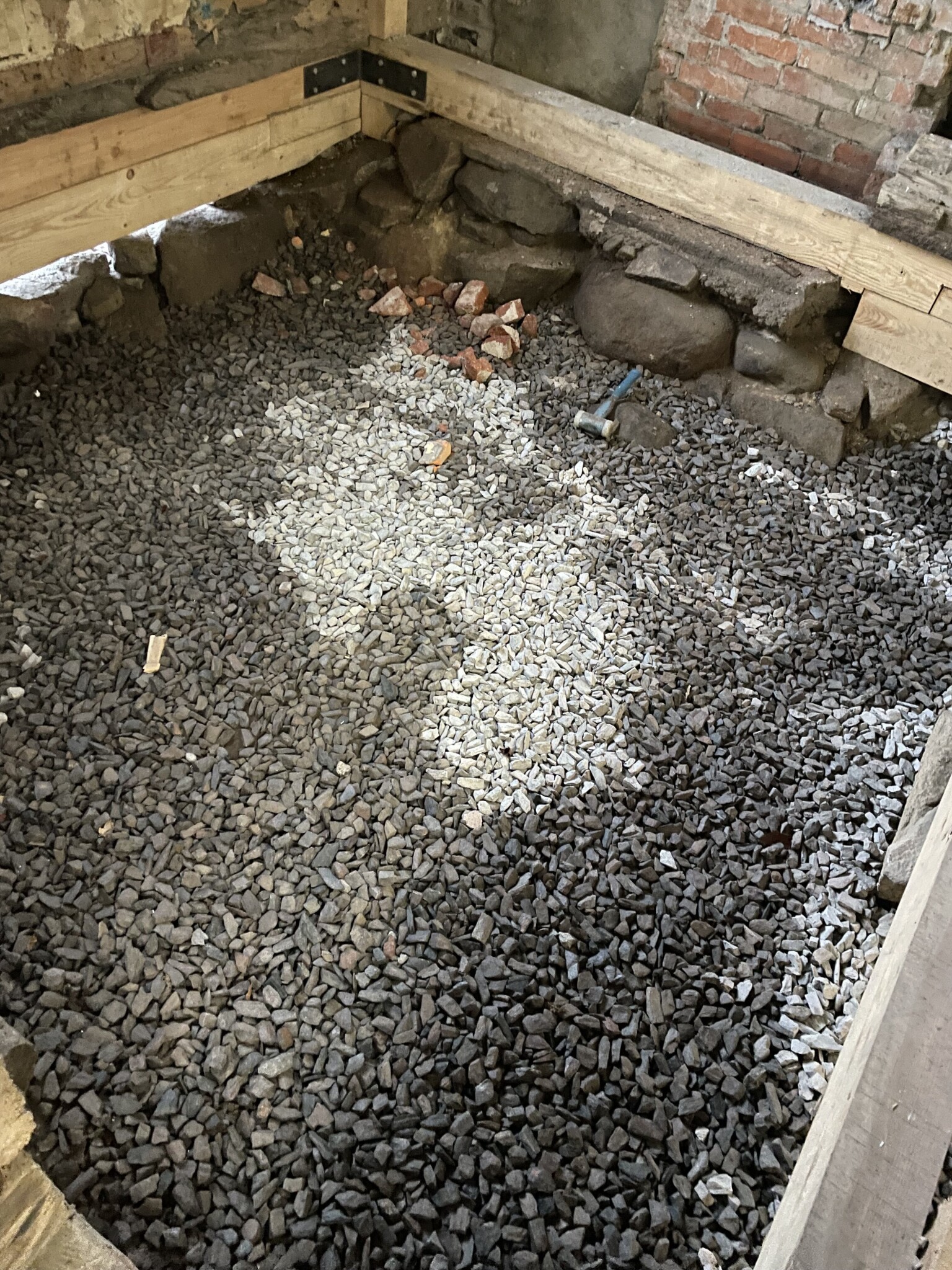
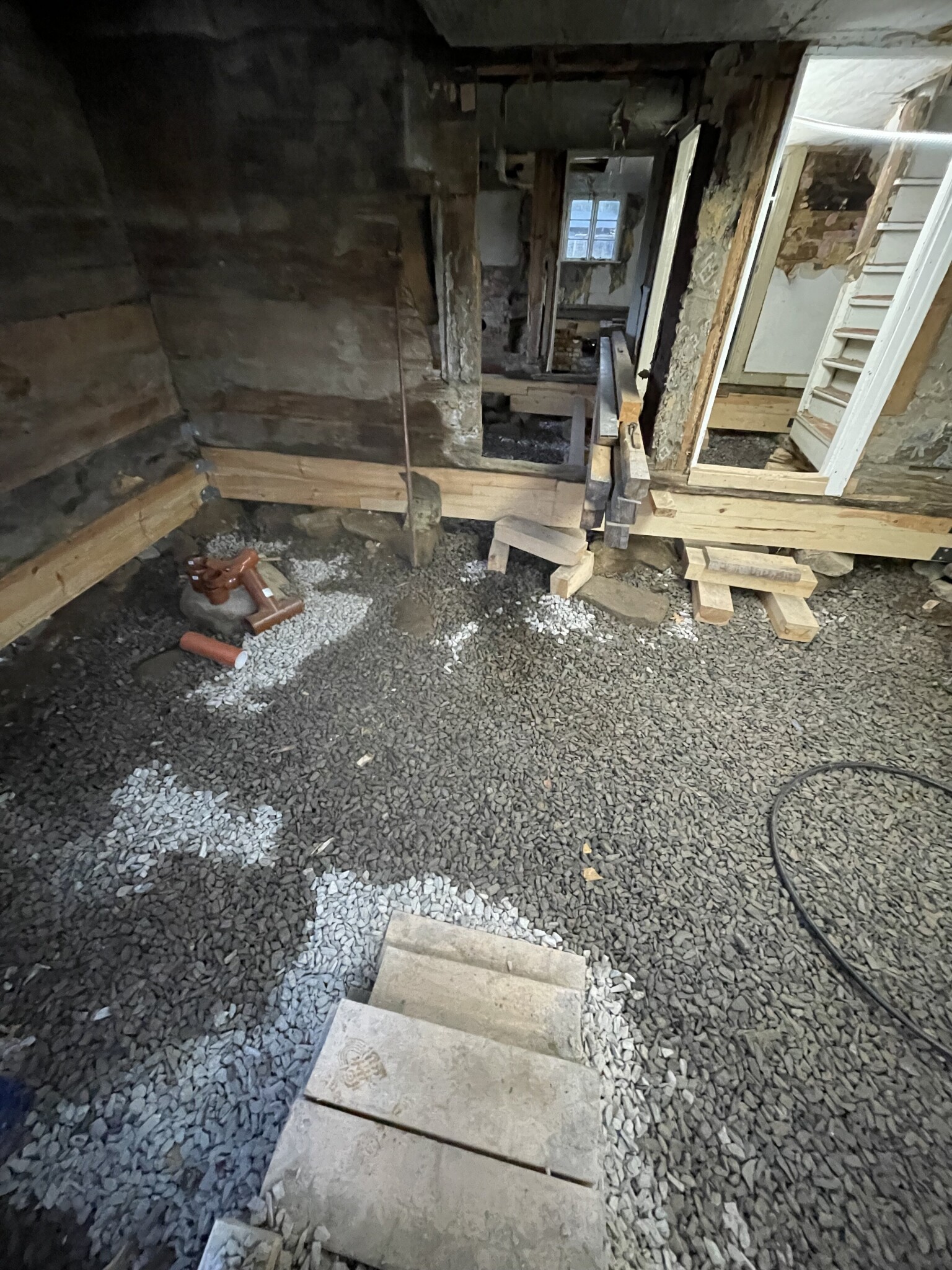
Oh, it might be relevant to see if it's possible to address the source.
That is, is it meltwater flowing in, or is there something else contributing to all that?
Just covering it up doesn't feel optimal.
That is, is it meltwater flowing in, or is there something else contributing to all that?
Just covering it up doesn't feel optimal.
At our old cottage, it's a natural stone foundation that we've sealed internally with clay mortar, extra carefully against the sill.ottotorsten said:
What foundation do you have, meaning what is the house body resting on?
The person at Hasopor I have been in contact with explained that ground moisture does not function like air in vapor form. I'll paste the description I received here:
"Ground moisture doesn't work like air in vapor form. Humidity always tries to equalize between different areas, meaning that if you have a foundation with higher humidity than the house, the air wants to move up into the indoor climate. Ground moisture, on the other hand, doesn't seek around along the plastic at the bottom to find an opening. So you don't need to be afraid that ground moisture will gather along the foundation stones."
As I said, I still feel torn about installing a sealed bottom layer, especially considering the clay in the foundation stones.
The plan is to have waterborne loops for heating on the lower part of the log walls later, so there won't be any "heat" in the floors or the foundation to help dry out. I hope that any potential moisture can still travel through the wooden floors.
It's excavated at varying depths due to stones and other factors. I estimate it will be a maximum of 50-60 cm and at least 30 cm of foam glass.
Regarding the stormwater, I described it poorly. The stormwater is connected to a pipe that leads to a dry well. The drainage pipe is in another trench sloping in the opposite direction.
Thanks for your heads up!
Now we are building a new house (or moving an old one, but still) and have to meet new building requirements, so there's a sturdy concrete slab with a leca wall, and then limestone on the outside to fit in. Leca is also much easier to seal.
Unfortunately, I'm not well-versed myself in how ground moisture works, I've only read the manufacturer’s installation instructions for ground fabric.
You have much more moisture than we do, but whether that is a problem or not, I don't know... But isn't there a thin layer of macadam?
I never had moisture breakthrough on the macadam even in the basement part which is over 2 meters below ground level, but then there is also at least 20 cm of macadam and well-drained moraine.
I am going to apply a layer of clay plaster on top of the Hasopor before laying the floor to even out the moisture level and prevent drafts.
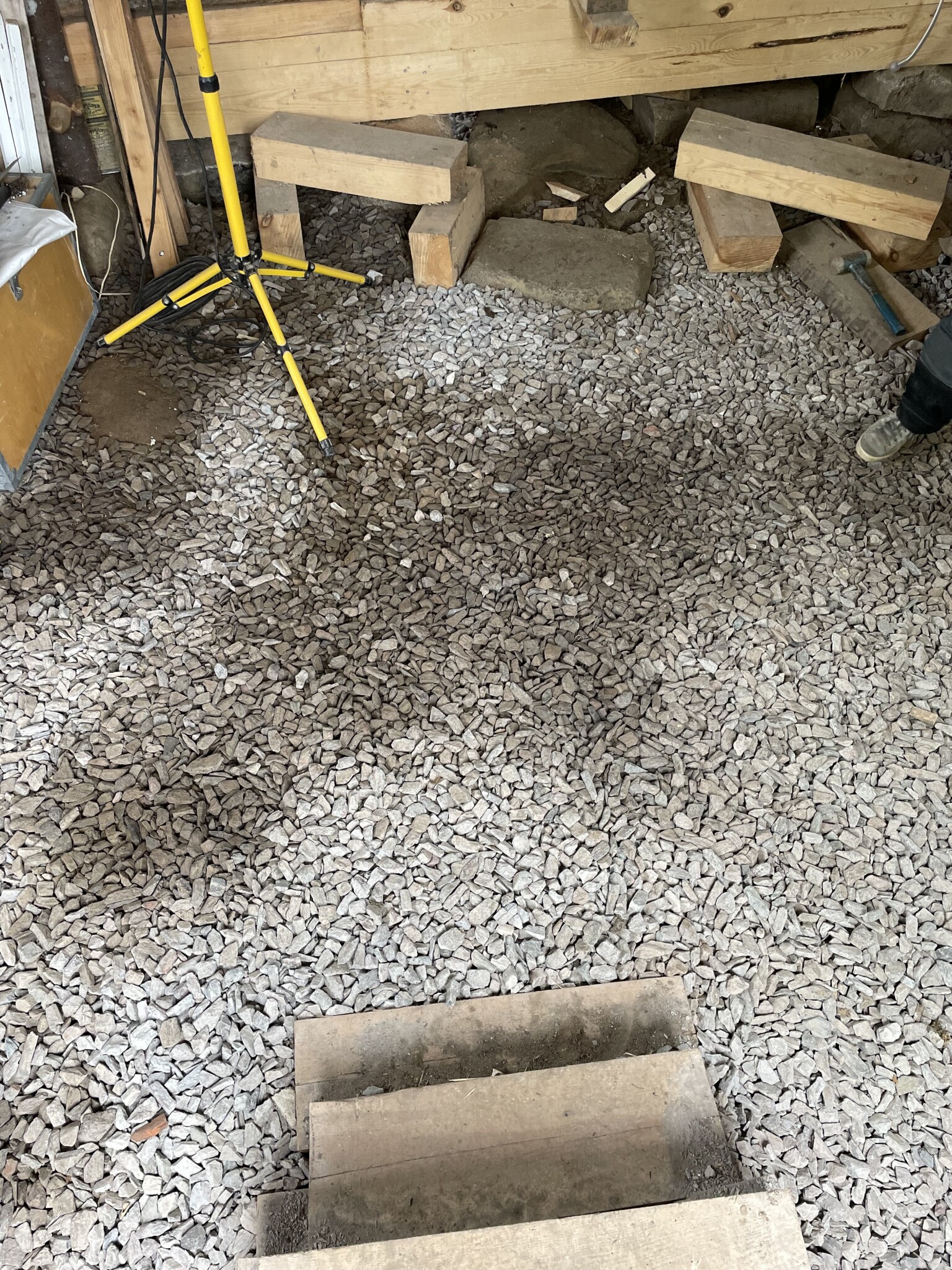
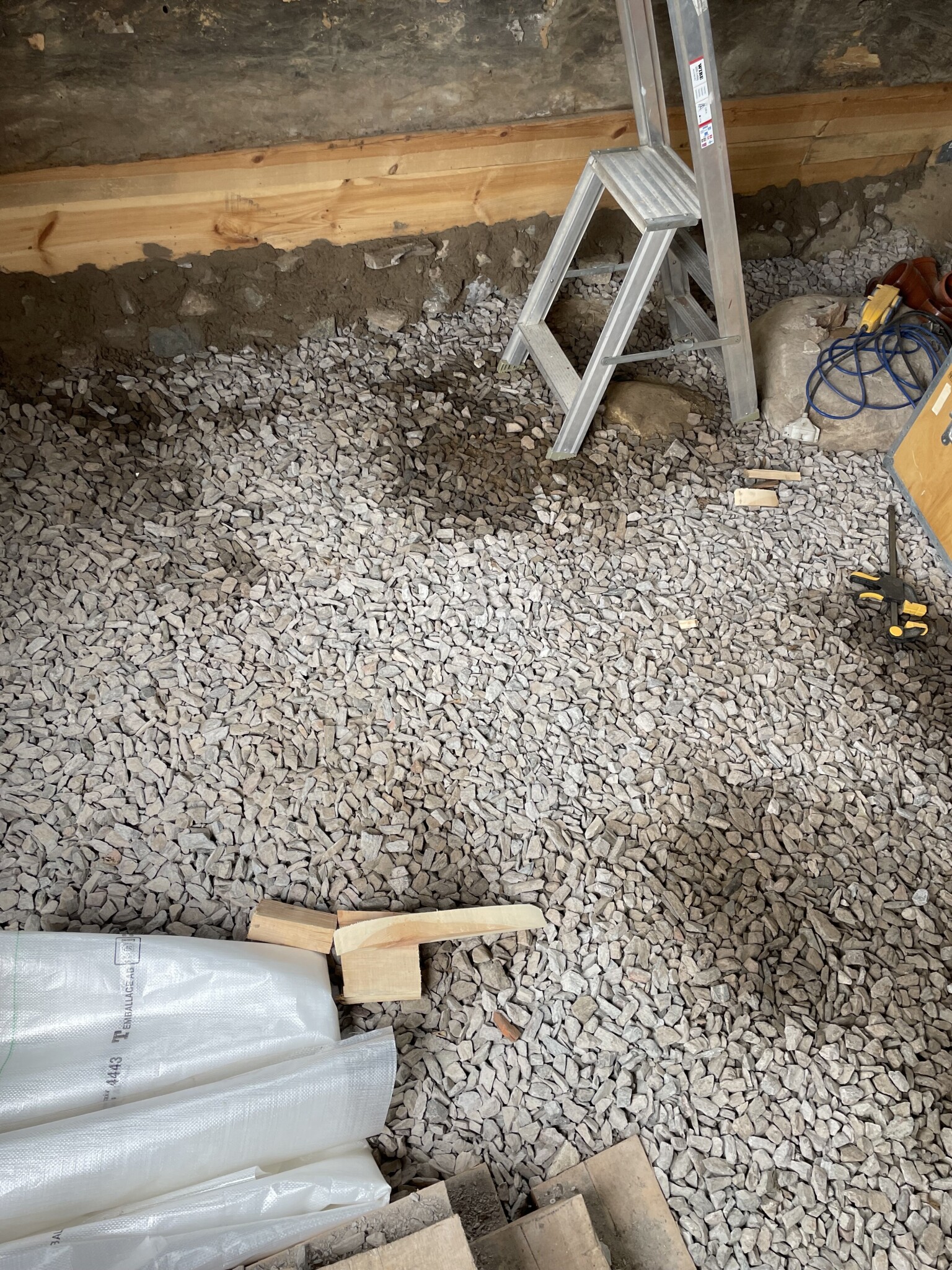
I don't know where it comes from or how it occurs. As mentioned, I've put down drainage pipes on the "most critical side" of the house. And the roof water is also being directed away.Dowser4711 said:
I also don't feel like covering this with plastic. I imagine it's better to put the foam glass directly on the gravel and that it will improve when the house is "sealed" and heated. But as mentioned, I'm not sure.
I understand. No separation from the sill beam, the clay is in direct contact with the wood? Sounds convenient with the leca and it will probably look great with limestone on the outside.E Elspet said:At our old cottage, there is a natural stone foundation that we have sealed with clay inside, particularly carefully against the sill beam. Now we are building a new house (or moving an old one but still) and have to meet new construction requirements, so there is a solid concrete footing with leca wall, then limestone on the outside to match. Leca is much easier to seal as well.
Unfortunately, I have poor knowledge myself of how ground moisture works and have only read the manufacturers' installation instructions for geotextile.
You have much more moisture than we do, but I don't know if it's a problem or not... But isn't it a thin layer of gravel? I never had moisture penetration on the gravel even in the cellar part that is over 2 meters underground, but then there is also at least 20 cm of gravel and well-drained moraine soil. I will apply a layer of clay plaster on top of the hasopor before laying the floor to even out the moisture level and prevent floor drafts.
Yes, it is a very thin layer of gravel we have laid. Definitely sounds like the conditions are different. How nice that you have it dry!
I also think we will apply a layer of clay plaster on top as you describe. The drainage pipe you have laid, is it just pulled up to floor level and embedded in the clay mortar or? Many questions, but I am grateful for all answers that can help clarify my picture