I have a frame truss and I'm considering moving the support beam, thereby reducing the knee wall. According to the guide, it should be fine, but am I calculating correctly?
My house:
is 8m wide
has a roof pitch of 45 degrees
is located in snow zone 1.5
has tile roofing, with wood shingles underneath
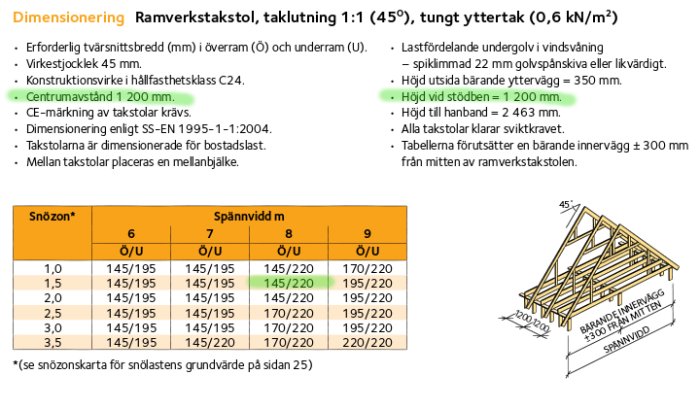
so if I look here:
then:
top chord (Ö) should be min. 45x145mm
bottom chord (U) should be min. 45x220mm
height at support beam 1200mm
It's an old house, so currently the top chord is 100x120mm, bottom chord 100x195mm. The center distance is approx. 950-1000mm between the trusses. Height to collar beam is approx. 2300mm. And the wall of the knee wall (which I actually don't think is load-bearing) is 1700 mm.
Now finally the question!
Flexural rigidity, i.e., (b * h^2) / 6, of the existing top and bottom chords exceeds the minimum stated in the guide:
(Ö) 45x145mm = 156cm^3 < 100x120mm = 240 cm^3
(U) 45x220mm = 363cm^3 < 100x195mm = 634 cm^3
Can one then conclude that it's okay to move the support beam a bit from a height of 1700mm to a new height of 1350mm? It is within the 1200mm stated in the guide, and if I'm calculating correctly, the top/bottom cords are stronger than the stated minimum.
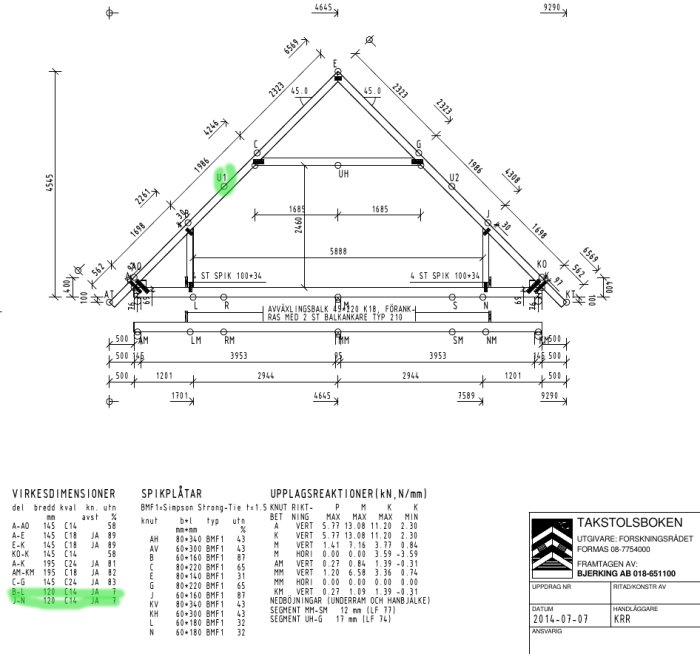
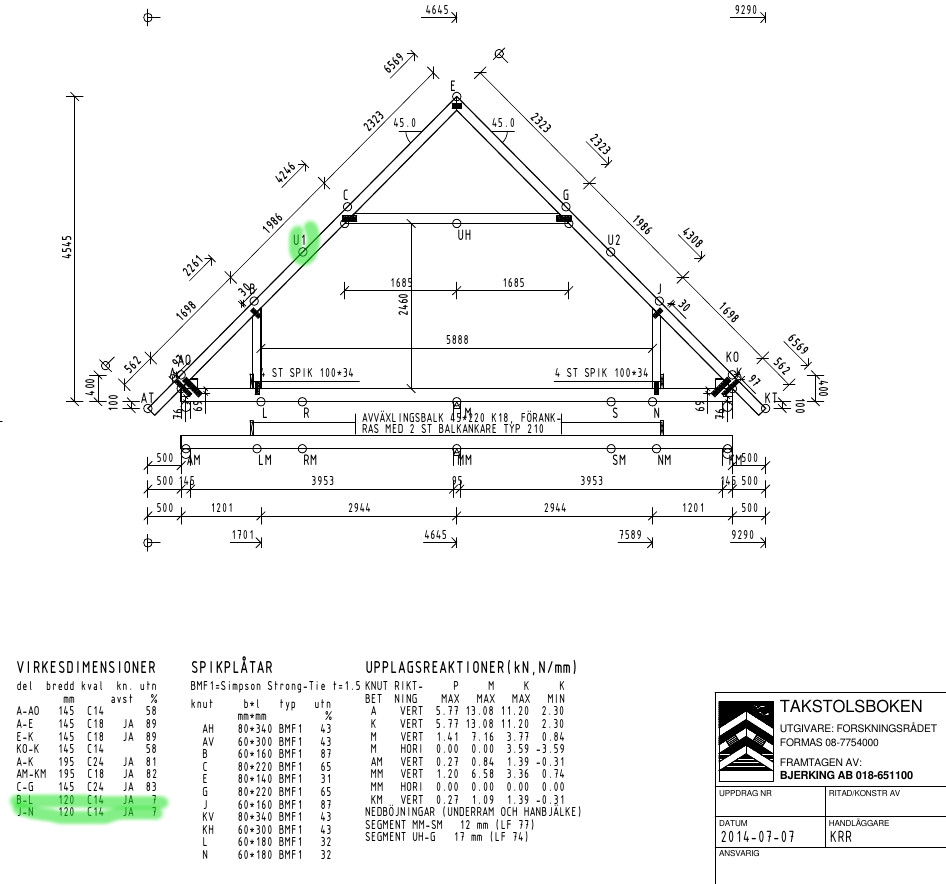
Got hold of the Takstolsboken 2010 (hooray! for the library) and entered some measurements into the accompanying program. Got this result:
The braces (B-L) and (J-N) have a utilization rate of about 7% when placed at a height of 1200mm. Unfortunately, they can't be moved in the program.
Hmmm.... :|
The question now is:
do my old upper frames of 100x120mm have the same or better properties than the 45x145mm used in Lathunden and Takstolsboken
is there a risk that the upper frame will buckle if I move the braces to a height of 1350mm -- I can imagine there will be a different stress on the point U1.
Does anyone know if 100x120mm is generally equivalent to 45x145mm?
As I see it, you have been very meticulous in researching and gathering facts for your intended job, which is really good; if only more people did so. You have closer-set rafters than in the examples, and I think we can consider the dimensions to be at least as strong in the existing structure. Your small horizontal movement of the support beams by 350mm should be completely negligible in this context (it is still situated far up towards the upper part).
That's how I see it for what it's worth; I wouldn't have hesitated in the slightest.
Thank you very much, GK100, I'm trying to gather as much information as possible. With roof trusses, it can get expensive if not done correctly
Additionally, I realize now that I made a mistake in the first post. The existing knee wall and support legs have a height of 2000mm -- it's on the other side of the room that it's 1700mm.
This means I want to move it about 700mm horizontally, but it should still be okay according to the calculations from the Takstolsboken and Lathunden.
Furthermore, if you look at the knee wall, it's built with some 70x75mm vertical studs, spaced at approximately 1000mm, with tongue-and-groove boards on one side only. The studs are on the floorboards (thickness 28mm), i.e., no runner/header beam, and they are only nailed to the floor -- not directly to the bottom plate. On the inside, the top plate has planed tongue-and-groove boards, and the studs are nailed to these. As far as I can see, they are also not nailed to the top plate (but it's a 1930s house, where I sometimes find ridiculously long nails )
So, it might be a bit questionable to call the studs support legs, but the wall of course has a stabilizing effect.
My gut feeling says it shouldn't be a problem to move the wall, but opinions are of course very welcome.
I can basically just write as before, see it as completely hassle-free. If you now also set the supports as correct legs and then panel wall on top of that, well good becomes better. Maybe someone else has something to add but it has been sparse in the thread.
Haven't gotten around to it yet , but was just in the attic from where you can take a look at the top frames.
They're now 80 years old but still look really good. A few shrinkage cracks, but nothing dangerous. And they aren't spliced at the height of the support legs/knee wall -- that's what I wanted to double-check.
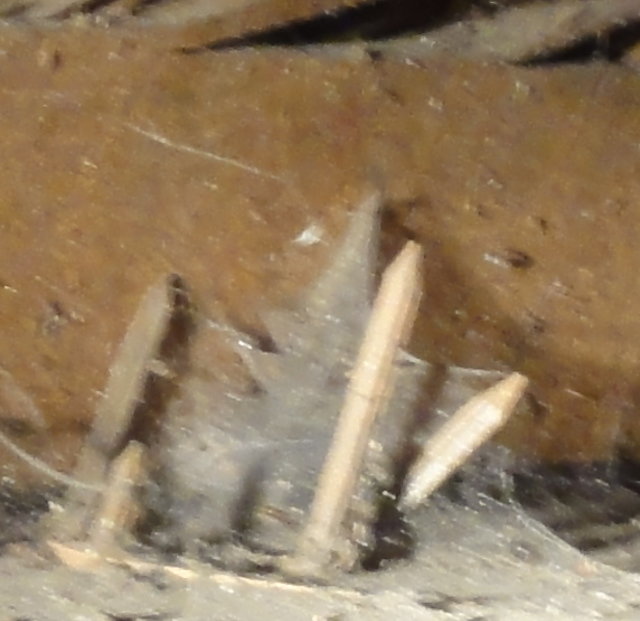
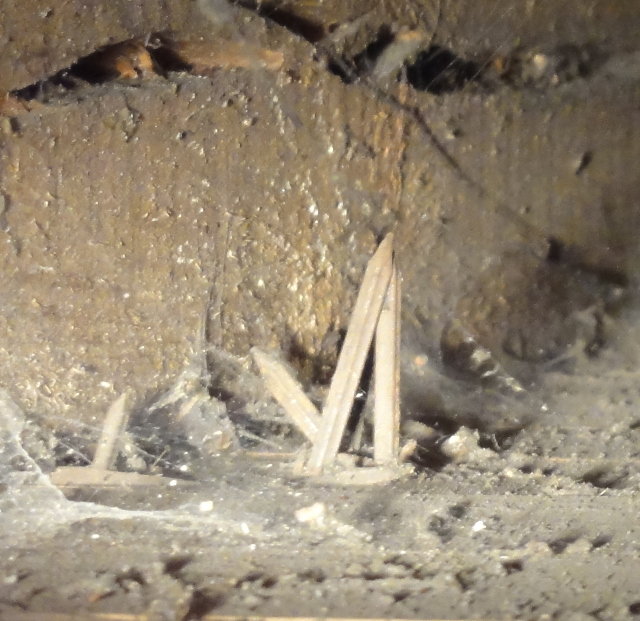
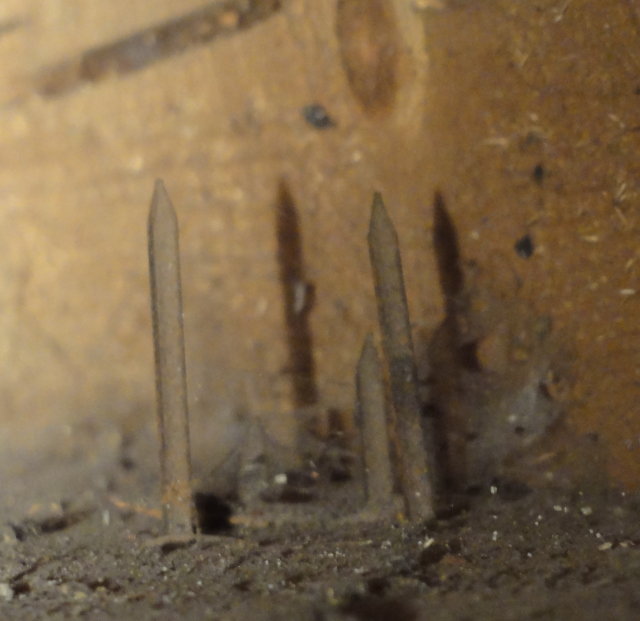
I also found where they nailed the support legs into the inner panel:
Pretty close, but still next to the top frame... Maybe because the top frame is rock hard to nail into -- that might be the biggest problem in this project
Click here to reply
Vi vill skicka notiser för ämnen du bevakar och händelser som berör dig.