
5,943 views ·
10 replies
6k views
10 replies
Mortar that comes loose. What am I doing wrong?
As the title says.
Started building a wall with solid brick last fall for a greenhouse.
Didn't finish, so it's been fairly unprotected over the winter.
I can remove everything except the layer against the concrete sole very easily.
The mortar has basically detached from all the bricks.
The bricks are still intact and nice.
What has happened?
Is it just moisture and frost that caused this?
Or did I mess up when building?
It's not very tempting to build it all up and have it look the same next spring.
I can take some pictures if it would help, but I think this must be a standard issue with masonry?
Started building a wall with solid brick last fall for a greenhouse.
Didn't finish, so it's been fairly unprotected over the winter.
I can remove everything except the layer against the concrete sole very easily.
The mortar has basically detached from all the bricks.
The bricks are still intact and nice.
What has happened?
Is it just moisture and frost that caused this?
Or did I mess up when building?
It's not very tempting to build it all up and have it look the same next spring.
I can take some pictures if it would help, but I think this must be a standard issue with masonry?
Images are not wrong.
But you build a brick wall.
Then you can plaster the brick wall, as it sounds like you did, and it comes off.
Or has the entire masonry you built collapsed?
Images are not wrong
But you build a brick wall.
Then you can plaster the brick wall, as it sounds like you did, and it comes off.
Or has the entire masonry you built collapsed?
Images are not wrong
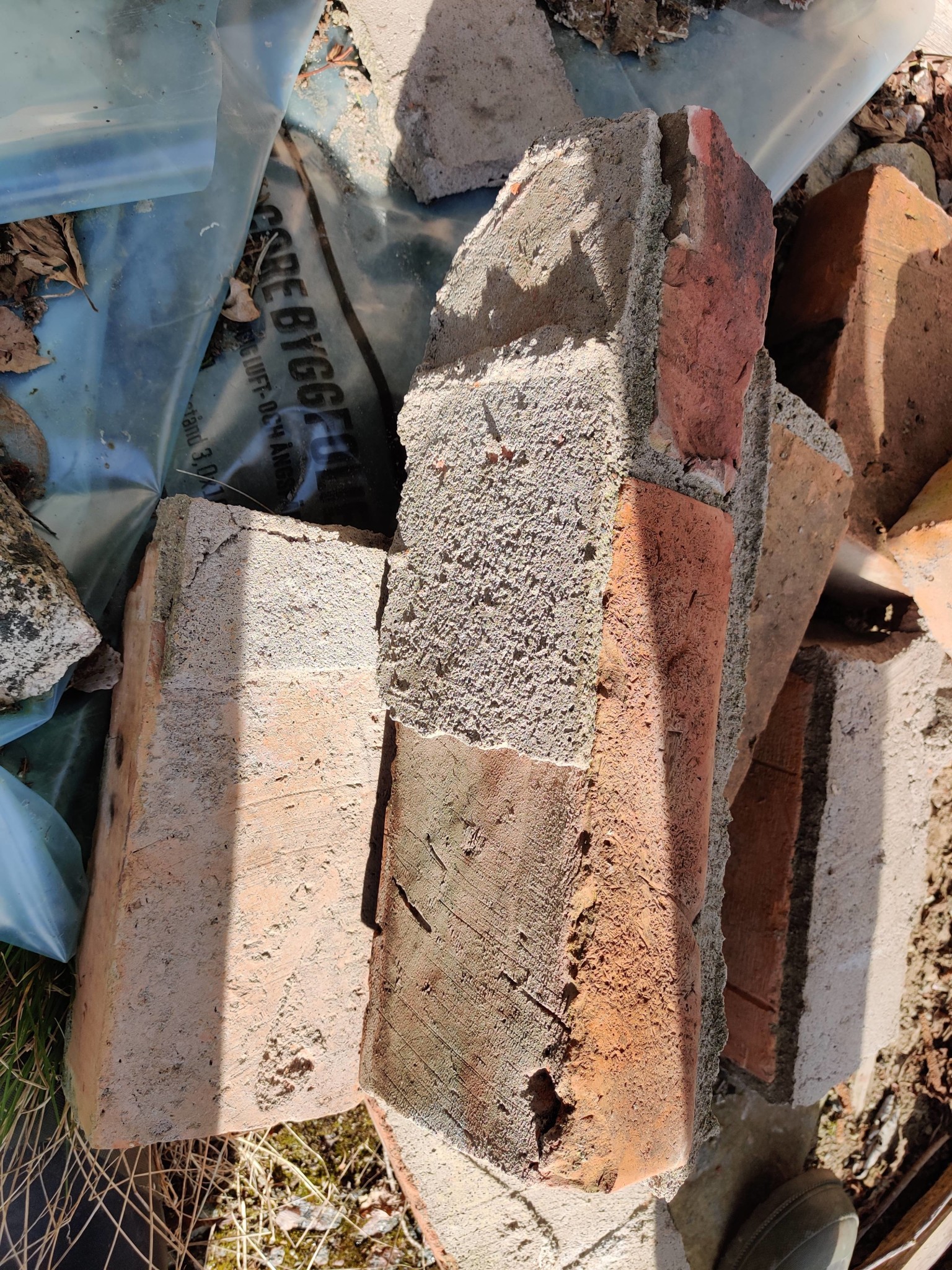
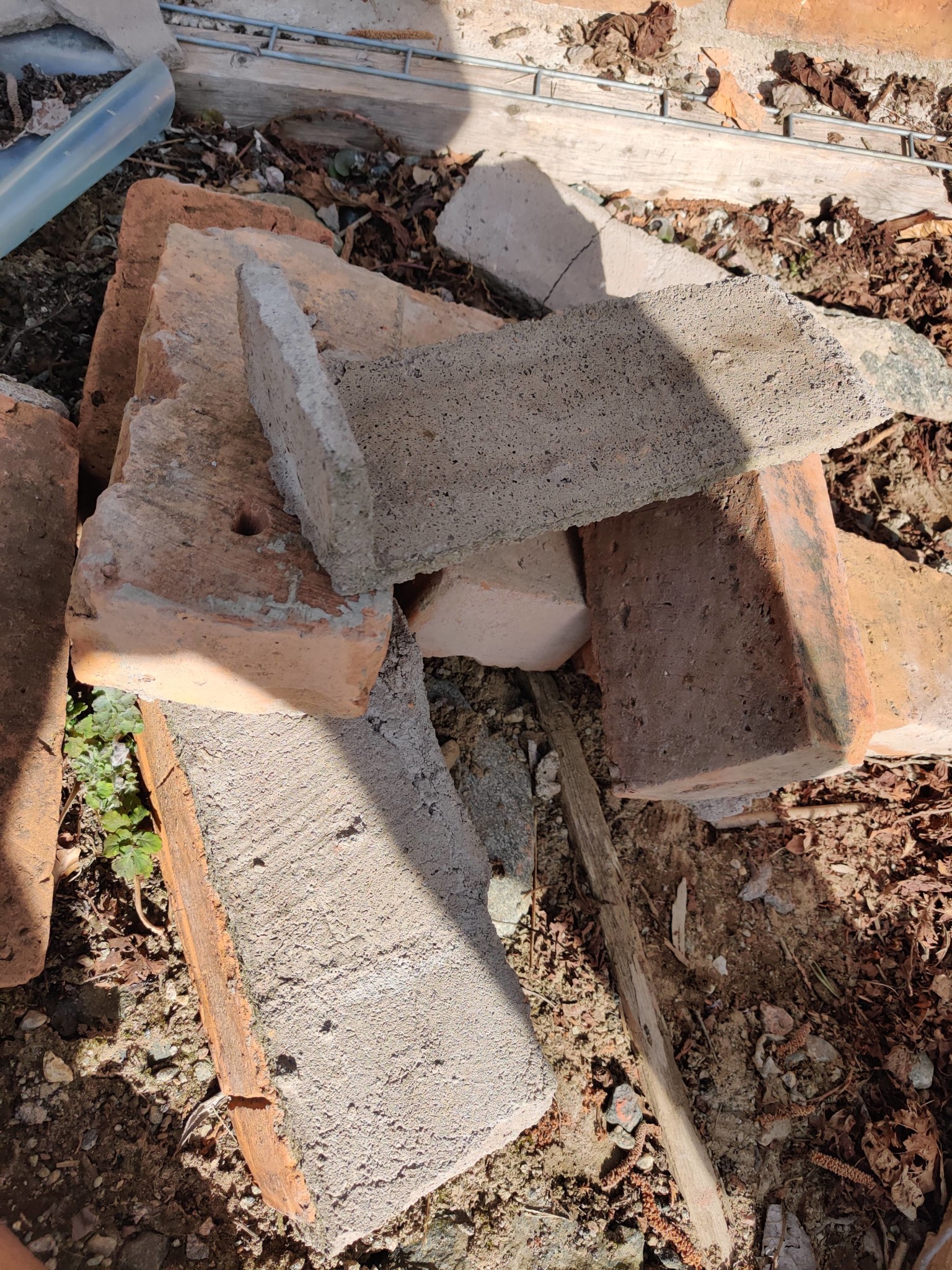
That's how it looks. It was supposed to be a wall for a greenhouse.
I have laid some concrete blocks right next to it with the same mortar, and they are holding together as they should.
Even the stones that are directly mortared to the concrete base are holding well.
Too little mortar? Meaning I had to compress the mortar too much.
I soaked the stones before I laid them up.
Suspect you have used too little mortar. You should have quite a lot of mortar, and then press the stones together firmly. Alternatively, smear mortar onto the wall, as well as on the stone to be placed. If a stone is dry or wet, you must "smear" the mortar thoroughly onto the stone. Otherwise, there is a high risk that it won't adhere.
So you can apply bruk to both the wall and stone separately? That could be an alternative method that is easier for me.
Regarding wet/dry stone. Does it matter? Or should it be "just right" moist?
Regarding wet/dry stone. Does it matter? Or should it be "just right" moist?
Yes, that's usually the easiest way to ensure the mortar adheres as it should.J Johan Sjöro said:
A dry stone immediately absorbs the moisture from the mortar closest to the stone. It is important to work the mortar in thoroughly.
The same goes for an overly wet stone. The stone is saturated and cannot "absorb" the mortar. In this case as well, you need to work the mortar in extra thoroughly.
Maybe it was too warm and dry when you were bricklaying?
As an amateur, I often take all the extra precautions I can think of.
Last time I was bricklaying, I wetted all the stones the day before and covered the masonry with plastic when I was done.
A suitably loose mortar as well and coated all sides with mortar before laying the stones.
A professional probably has a better sense of what is required in each given case.
As an amateur, I often take all the extra precautions I can think of.
Last time I was bricklaying, I wetted all the stones the day before and covered the masonry with plastic when I was done.
A suitably loose mortar as well and coated all sides with mortar before laying the stones.
A professional probably has a better sense of what is required in each given case.
Yes, it was quite warm when the work was being done, so that might definitely have something to do with it. I covered it with plastic on one occasion (maybe the first layer, which would explain why that one is intact).Huddingebo said:
Maybe it was too warm and dry when you were doing the masonry work? As an amateur, I often take all the extra precautions I can think of. Last time I did masonry, I soaked all the stones the day before and covered the masonry with plastic when I was finished. I also used well-mixed mortar and applied it to all sides before laying the stones. A professional probably has a better sense of what is required in each case.
I find it difficult as an amateur to know what's considered "belt and suspenders" when it comes to masonry. But covering properly is perhaps what was mostly lacking here.
Not home right now so can't test, but quite hard. Doesn't crumble like hard sand at least.A Alexn72 said:
Not very long from when the mortar was mixed. I've only mixed one bag at a time.
Watered a little, but maybe not enough.
Anyone who can give me a "belt and braces" method for building this?
Thankfully, I only laid about 10 stones, so not much lost. However, I do get a bit anxious when I have to try again.
And is there a good way to test that you've succeeded that doesn't involve waiting until next year?
In the worst case, you might have to hire someone who knows what they're doing, but it would be fun to get it right myself
Thankfully, I only laid about 10 stones, so not much lost. However, I do get a bit anxious when I have to try again.
And is there a good way to test that you've succeeded that doesn't involve waiting until next year?
In the worst case, you might have to hire someone who knows what they're doing, but it would be fun to get it right myself
Click here to reply
Similar threads
-
Vad ska jag göra när murbruket rasar i kakelugnen?
Hemma hos -
Mortar releases basement
Building Materials and Construction Technology -
Vad gör jag åt att färgen släpper?
Fasad -
Bits släpper vid borrning, vad gör jag för fel?
Verktyg & Maskiner -
Vad göra med platta på mark där putsen på sockeln släpper?
Grund & Markarbeten