
Hello
This question has surely been discussed here before, but I have not managed to find a suitable answer.
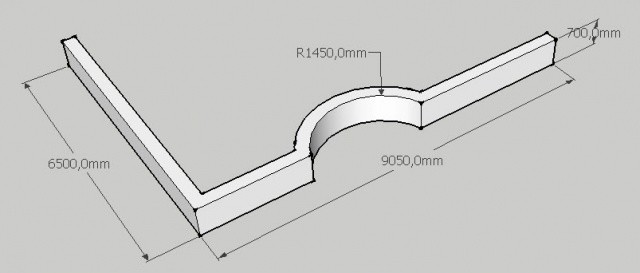
This spring, I will be casting a wall that is about 70cm high and 30cm wide.
It will be at an angle (see image)
I will first cast a foundation and then make the formwork for the wall itself.
Now, I need to make a radius at one point in the wall.
I am a bit unsure about the best way to do this and what material should be used.
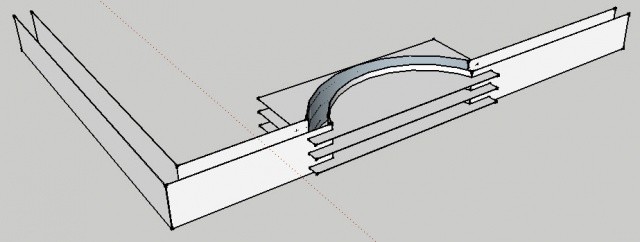
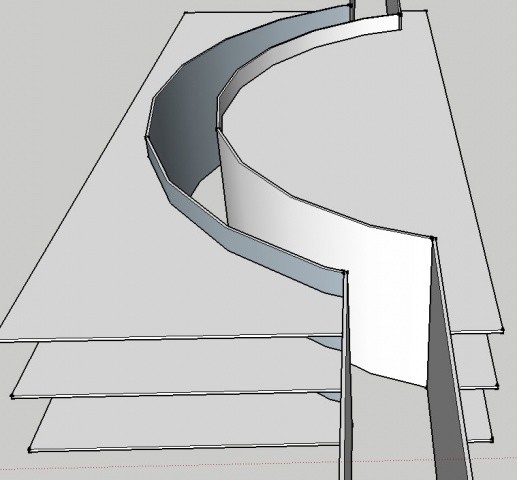
I am attaching an image of how the wall should look and how I plan to build the formwork.
Should I use 12mm form plywood for the curved part or some type of hardboard that is easier to bend?
Please give me some good advice, I would be grateful.
Best regards,
Anders
This question has surely been discussed here before, but I have not managed to find a suitable answer.
This spring, I will be casting a wall that is about 70cm high and 30cm wide.
It will be at an angle (see image)
I will first cast a foundation and then make the formwork for the wall itself.
Now, I need to make a radius at one point in the wall.
I am a bit unsure about the best way to do this and what material should be used.
I am attaching an image of how the wall should look and how I plan to build the formwork.
Should I use 12mm form plywood for the curved part or some type of hardboard that is easier to bend?
Please give me some good advice, I would be grateful.
Best regards,
Anders
You are on the right track, I see from the pictures. I'm not sure if you can bend formplyfa like that, but the trick is to saw grooves with a circular saw, maybe halfway or 2/3 into the plyfa on the "back side," quite closely, so you can bend it. Search a bit online, and you will surely find examples of this. Or, as you say, masonite, but then you might have to set pretty closely with "radius pieces" as support.
You also don't need whole sheets for support, just cut out "bananas" with maybe 200mm width or so. Then you can get a bunch out of each sheet. To make them a bit more stable, you can glue together 2-3 pieces, making it a bit thicker as well.
Build a small jig with a jigsaw or a router on an arm and a sheet underneath as support, where you attach the piece to be sawed (or routed), then you can make many pieces easily and quickly. Change the radius by simply altering the length of the arm. Let it stick out a bit past the center and move it there, with the saw/router fixed at the end.
I hope you understand my perhaps a bit abbreviated explanation.
You also don't need whole sheets for support, just cut out "bananas" with maybe 200mm width or so. Then you can get a bunch out of each sheet. To make them a bit more stable, you can glue together 2-3 pieces, making it a bit thicker as well.
Build a small jig with a jigsaw or a router on an arm and a sheet underneath as support, where you attach the piece to be sawed (or routed), then you can make many pieces easily and quickly. Change the radius by simply altering the length of the arm. Let it stick out a bit past the center and move it there, with the saw/router fixed at the end.
I hope you understand my perhaps a bit abbreviated explanation.


I also think you're on the right track with the form-cut plywood.
On those, I would have chosen to place vertical råspont and covered it with moistened masonite to get a smooth surface.
On those, I would have chosen to place vertical råspont and covered it with moistened masonite to get a smooth surface.
thomasx
Thanks. I am also worried that it might be difficult to bend the board, it is also available in 9mm thickness. Maybe I should consider using one and sawing grooves in it. Could do a test on that.
mycke_nu
I initially thought about building and plastering the entire wall, but I have dropped that idea, so unfortunately it's not an option.
larsbj
I have never thought about the idea of vertical råspont.
It's not bad at all.
Then two boards with cut-out radius might be enough, followed by vertical råspont covered with masonite.
Then I should get a strong construction that can withstand the forces.
The wall won't be so high, so it should be sufficient.
Thanks. I am also worried that it might be difficult to bend the board, it is also available in 9mm thickness. Maybe I should consider using one and sawing grooves in it. Could do a test on that.
mycke_nu
I initially thought about building and plastering the entire wall, but I have dropped that idea, so unfortunately it's not an option.
larsbj
I have never thought about the idea of vertical råspont.
It's not bad at all.
Then two boards with cut-out radius might be enough, followed by vertical råspont covered with masonite.
Then I should get a strong construction that can withstand the forces.
The wall won't be so high, so it should be sufficient.
Hello.
I have formed radii in a board using just masonite. I screwed several layers (four, I think) and it became very strong. Make sure to screw from the inside so that the screw doesn't get cast into the board.
I have formed radii in a board using just masonite. I screwed several layers (four, I think) and it became very strong. Make sure to screw from the inside so that the screw doesn't get cast into the board.
I don't know if you glued between the layers with masonite, but if you do, it becomes really super strong and rigid.csam11 said:
There is a type of masonite that should be usable for what you are planning to do. It has grooves sawed on the back so it is easy to bend. I don't know what it's called, but if you go to a hardware store, they will know what you are talking about.
CSAM
The hardboard is probably only about 4mm thick, so did you use screws that only went in 3mm, or did you let them go through and then cut them on the inside or how did you do it?
thomasx
Gluing is not a bad idea at all.
If using hardboard, should it be oil-treated or what is recommended?
The hardboard is probably only about 4mm thick, so did you use screws that only went in 3mm, or did you let them go through and then cut them on the inside or how did you do it?
thomasx
Gluing is not a bad idea at all.
If using hardboard, should it be oil-treated or what is recommended?
The problem I see with that is that you will face quite large forces if you plan to do a casting, and you should bear in mind that the pressure you apply needs to withstand the same forces as if you had a 2m high water column in the mold, so these are not small forces. Normally, one tries to avoid casting higher than 40 cm in a go, as this corresponds to a 1m water column.
But my idea is to take "råspont" and attach them to something like decking timber that you have cut in a radius, so you get 3-4 "råspont" on such a piece and let them overlap each other so that the piece with the radius sits on a whole "råspont" which is supported by a radius from another package. Kind of putting them together in parts of three and three, and then setting a "råspont" between them and screwing on as many new radius pieces as you attach to all pieces. This is to have many attachment points to handle the forces that will arise. So you attach 2x4" inwards towards the center point so it becomes like a fan and anchor it into the ground from a point about 10cm up and one from the top (from each so you use 20 pieces of "råspont," you will get 10 stays towards the center from the bottom and top and maybe one from the middle, but with a 2x4" that distributes the forces from at least three different radius pieces, one high and one low towards the anchoring should be enough).
(You don't want it to start bending when you cast, as you will first notice it after you have removed the mold, and then it's too late). If the vertical supports go a bit above the mold, you can use that to support the outer radius, but how much support you need depends on how high you intend to cast at a time. Once you have the base in the mold, you set up masonite in it and release agent on it.
Otherwise, it might be an idea to take a sheet metal and weld vertical L-profiles and supports that you screw into them. You can then determine the radius through the length of the supports and the anchoring point. Whether it is easier or harder depends on what you can do and have access to.
But my idea is to take "råspont" and attach them to something like decking timber that you have cut in a radius, so you get 3-4 "råspont" on such a piece and let them overlap each other so that the piece with the radius sits on a whole "råspont" which is supported by a radius from another package. Kind of putting them together in parts of three and three, and then setting a "råspont" between them and screwing on as many new radius pieces as you attach to all pieces. This is to have many attachment points to handle the forces that will arise. So you attach 2x4" inwards towards the center point so it becomes like a fan and anchor it into the ground from a point about 10cm up and one from the top (from each so you use 20 pieces of "råspont," you will get 10 stays towards the center from the bottom and top and maybe one from the middle, but with a 2x4" that distributes the forces from at least three different radius pieces, one high and one low towards the anchoring should be enough).
(You don't want it to start bending when you cast, as you will first notice it after you have removed the mold, and then it's too late). If the vertical supports go a bit above the mold, you can use that to support the outer radius, but how much support you need depends on how high you intend to cast at a time. Once you have the base in the mold, you set up masonite in it and release agent on it.
Otherwise, it might be an idea to take a sheet metal and weld vertical L-profiles and supports that you screw into them. You can then determine the radius through the length of the supports and the anchoring point. Whether it is easier or harder depends on what you can do and have access to.

Is it a retaining wall you are casting? If the "inner" angle is not visible, maybe you can make a recess in styrofoam? It should be significantly less work anyway.
Yes, I trimmed the screws by hand. I used "regular" hardboard about 4mm without glue, without grooves. Shiny side against the concrete. As mentioned, it becomes very strong when you screw layer by layer. Now my radius is underground, but when I removed the form, I saw that it was a nice surface. I agree that you will get very large forces at the bottom of the form, but it's "just" a matter of bracing properly. (a lot of work...) You'll have the strongest bottom if you form the footing wide enough to shoot or screw a 2"4 at the bottom, which you then attach the form inside. That way, at least the bottom part of the form doesn't move.
Should one treat the masonite in any way so that it releases when dismantling the form?C csam11 said:Yep, I trimmed the screws by hand. I used "regular" masonite about 4mm without glue, without grooves. Shiny side towards the concrete. As mentioned, it becomes very strong when you screw layer upon layer. Now my radius is below ground, but when I dismantled the form, I saw that it was a nice surface. I agree that you will have very large forces at the bottom of the form, but it's "just" a matter of bracing properly. (a lot of work...) The base becomes strongest if you shape the footing wide enough so that you can fasten a 2"4 in the bottom to which you attach the form inside. That way, at least the lowest part of the form won't move.
Click here to reply