
18,003 views ·
25 replies
18k views
25 replies
Failed casting, how to fix

We had a couple of guys here to cast a staircase, slab, and to build and plaster the wall at our basement entrance. They seem to know their masonry and plastering, but today when I tore down the casting mold for the stairs, I wasn't happy...
The surface of the molded parts is full of holes due to poor vibration (I suspect, as I wasn't present during the casting). No tread is okay because the form for the riser above each step has left a 45 mm groove about 3-4 millimeters deep on each step.
This is a result I would have expected if I had done the job myself and that's why I outsourced this task. Now to my question, can the treads be surface treated by grinding them flat and the risers be surface treated by spackling/plastering them?
The surface of the molded parts is full of holes due to poor vibration (I suspect, as I wasn't present during the casting). No tread is okay because the form for the riser above each step has left a 45 mm groove about 3-4 millimeters deep on each step.
This is a result I would have expected if I had done the job myself and that's why I outsourced this task. Now to my question, can the treads be surface treated by grinding them flat and the risers be surface treated by spackling/plastering them?
Last edited:
I haven't had the chance to talk to them yet. I just want to be a bit prepared on what options one might consider to fix it. I realize that there's a sliding scale of measures from not doing anything about the errors to tearing down and redoing the casting from scratch.

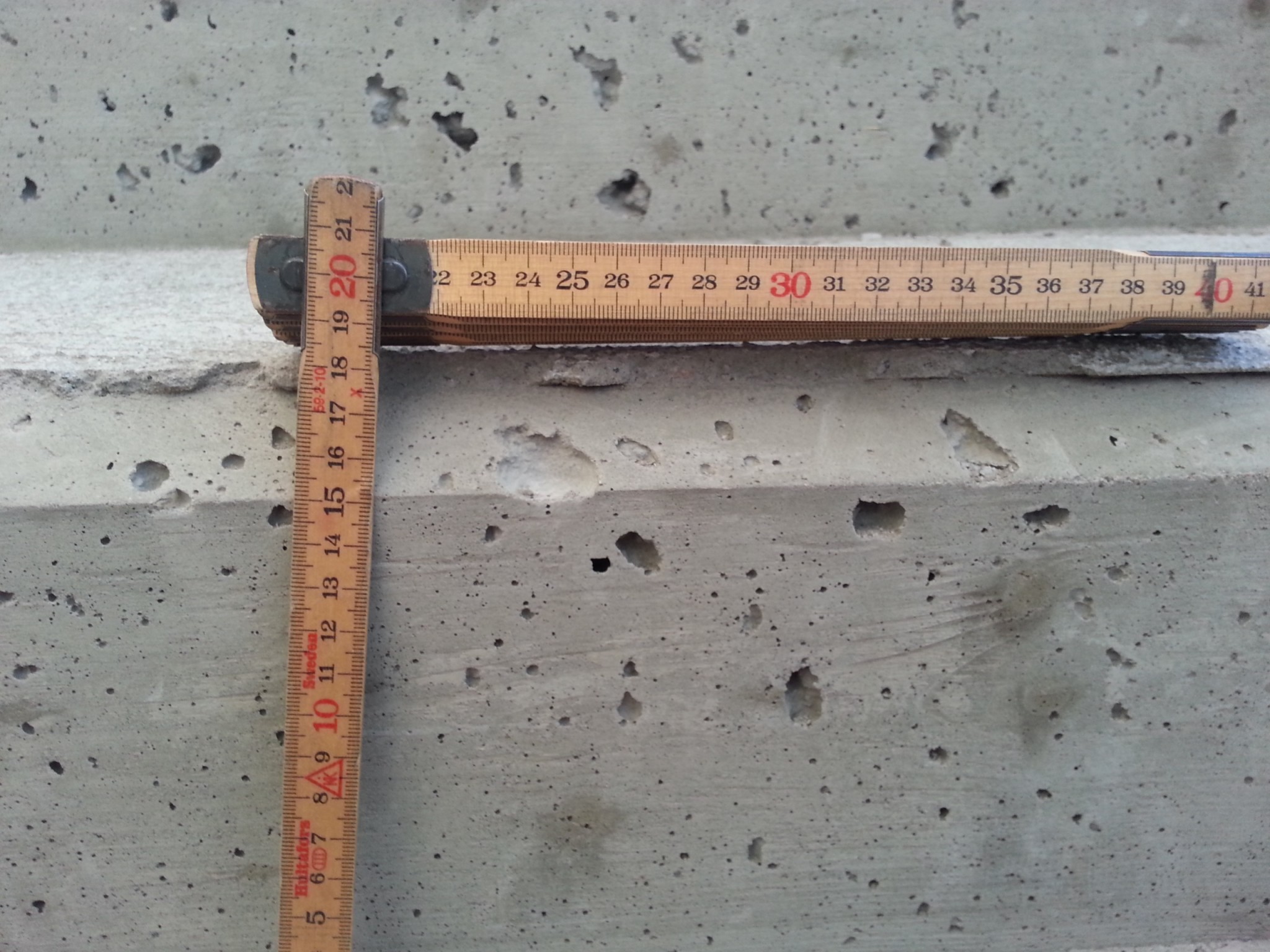


What was the intention with the casting?
If the intention was for the stairs to be covered with something, then the appearance of the concrete is not of much importance as long as the dimensions are correct.
However, if the stairs are supposed to have a "raw concrete" look, then the work is just plain terrible.
If the intention was for the stairs to be covered with something, then the appearance of the concrete is not of much importance as long as the dimensions are correct.
However, if the stairs are supposed to have a "raw concrete" look, then the work is just plain terrible.
As seen in image no. 2, all risers in the staircase look the same; they can't have vibrated at all. However, as someone completely inexperienced in casting, I don't know if this can be fixed; the holes are mostly cosmetic flaws that may perhaps be addressed with plaster or filler.
The faulty treads (image 1) will accumulate standing water, and I simply cannot accept that, but the question is whether it is possible to level or sand such surfaces?
The faulty treads (image 1) will accumulate standing water, and I simply cannot accept that, but the question is whether it is possible to level or sand such surfaces?
No cladding is intended, but it could actually be a good alternative in this situation (which the builders should cover both work and materials for). Your comment actually lightened my bad mood a bit. Thank you!vojma said:What was the intention of the casting?
If the intention was to cover the staircase with something, then the appearance of the concrete is not of great importance as long as the dimensions are correct.
However, if the staircase was meant to have a "raw concrete" look, then the work is just terribly badly done.


With a regular grinding wheel with a diamond cup, you grind off the peaks. Then it might be somewhat difficult to get it perfectly flat with a handheld small grinder, but good enough for a concrete staircase, I'm quite sure you can achieve that.
It is clear that professionals did not do the job! First, confront them and ask them to fix the stairs! The tread's groove is due to not having sawed the riser's plank at an angle on the underside so that the surface could be evened out all the way to the riser. A professional would know that. In the long run, it's best to chip down enough to be able to shape and recast. An alternative could be something like Ardex A46 for patching. However, the stairs will become "patchy" since it has a different color. But as mentioned, address it with those who did the job first. Get a quote on what it would cost to fix the stairs from another company and withhold payment of that amount if they refuse to fix the stairs!
This is how it should look when the stairs are properly done. When we mold and cast, we always remove the mold the same day and scrub/float the stairs. If you remove the mold too late, it's very difficult to float out air holes, etc. Most things can be fixed, but yours looks really bad. I would have chipped it away and redone it. A46 is not a good solution. Partly because it becomes patchy. Then there's the looming risk that after each winter you'll have to patch the stairs due to frost damage. Just a lot of hassle. Do it over, do it right. Hope it works out.

