
I am in the process of renovating a bathroom, and I will also be moving a door slightly, which means the frame will be against material it hasn't been against before. On one side, there are no issues, as I will build up about 20 cm, so there will be studs covered with wet room board. But on the other side, it's a bit trickier. The walls consist of 70mm hard (and I mean HARD...) concrete, and from previous experience, I'm not too keen on attaching the door frame directly into the concrete, as that would spell trouble since the concrete cracks incredibly easily if you try to drill and screw into it from the short side, especially with dimensions like frame screws.
So my idea is to make the opening 45 mm wider than the module measurement to be able to press something sensible in there to screw into.
But the problem then is what? The smoothest option is, of course, a 70x45 that you place nicely level and fasten in 6-7 places to the wall with small but effective plugs of some careful diameter, and then you can screw the frame directly into the stud after pre-drilling according to standard norms, etc.
But the problem then is that I suddenly have a wooden stud right in the bathroom, which isn't very popular if you're an insurance company or something else unpleasant.
What are my options? Fitting in a 45*45 that you cover with a thin strip of wet room board toward the bathroom and some gypsum or spare wet room board toward the hallway? Is it sufficient in that case to cover it on the inside (toward the bathroom), or should you also cover it on the short side (toward the frame) and then fold around wet room foil or edge strip according to the manufacturer's instructions?
Or have I completely missed an obvious solution? Some composite stud that withstands moisture and can be screwed into that I can just fit and all my worries will be gone perhaps?
I can't possibly be the first in the country with this dilemma, big thanks in advance for the tips!
So my idea is to make the opening 45 mm wider than the module measurement to be able to press something sensible in there to screw into.
But the problem then is what? The smoothest option is, of course, a 70x45 that you place nicely level and fasten in 6-7 places to the wall with small but effective plugs of some careful diameter, and then you can screw the frame directly into the stud after pre-drilling according to standard norms, etc.
But the problem then is that I suddenly have a wooden stud right in the bathroom, which isn't very popular if you're an insurance company or something else unpleasant.
What are my options? Fitting in a 45*45 that you cover with a thin strip of wet room board toward the bathroom and some gypsum or spare wet room board toward the hallway? Is it sufficient in that case to cover it on the inside (toward the bathroom), or should you also cover it on the short side (toward the frame) and then fold around wet room foil or edge strip according to the manufacturer's instructions?
Or have I completely missed an obvious solution? Some composite stud that withstands moisture and can be screwed into that I can just fit and all my worries will be gone perhaps?
I can't possibly be the first in the country with this dilemma, big thanks in advance for the tips!
Hello,
It's just a matter of setting the 70-rule as you intended and cladding it with plywood+gypsum on the inside towards the bathroom and OSB+gypsum on the outside. Then the wall will be about 12 cm thick, which fits well with a standard frame that is 118 mm.
Or am I missing something obvious?
It's just a matter of setting the 70-rule as you intended and cladding it with plywood+gypsum on the inside towards the bathroom and OSB+gypsum on the outside. Then the wall will be about 12 cm thick, which fits well with a standard frame that is 118 mm.
Or am I missing something obvious?
Yes, you're missing that the wall is 70 mm thick in total, and it needs to connect with a wall that is 70 mm thick.Henkan Sundberg said:

The door frame is also made of wood, right? If there's a stud just as thick right next to it, it shouldn't matter? If you're putting a waterproofing membrane on the concrete wall, you should continue it over the stud.Y yens said:
Then you just need to use a smaller stud and the problem is solved. However, I don't think it's approved according to säker vatten to have walls that thin. I assume you're going to have tiles on the walls? See the attached image from säkervatten.seY yens said:
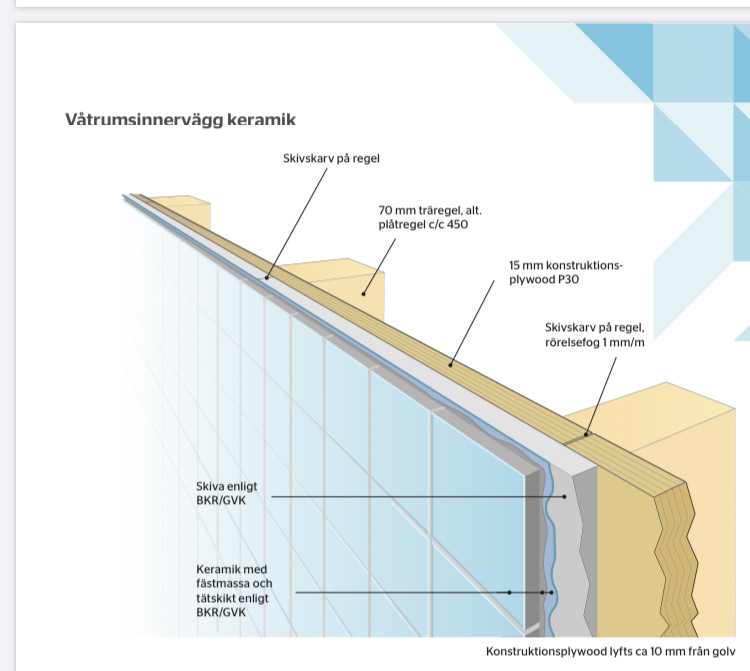
So it would be impossible to close up or move a door opening in a house with interior concrete walls and get it approved, unless you put up new concrete walls? That sounds incredible.
Yes, of course, I would wrap the waterproof membrane around the stud in that case. It's even possible to extend it onto the frame if desired, but I suspect that's harder to do well. But then I would be embedding organic material in the wall closest to the bathroom, which I was hoping to avoid.useless said:
Ok, yes, that might not be a bad idea. I'll simply have to keep that in mind, to aim for stopping flush where the stud ends inside the room. Then it has two sides open (one towards the frame and one out towards the hall outside) and should be able to breathe, etc. Thanks!
The idea is not to do it at all, but it is scary when you read all the rules and instructions from hordes of different regulatory authorities. I just want to do it right...


A simple solution: Set up the door frame/door where you want it, and fill with PUR foam.
It will sit well, and it becomes water-resistant.
Make sure the frame is not compressed by the foam by wedging between the door and frame while the foam cures.
It will sit well, and it becomes water-resistant.
Make sure the frame is not compressed by the foam by wedging between the door and frame while the foam cures.