
18,992 views ·
18 replies
19k views
18 replies
Air gap in low-sloped roof without flow at ridge and without ridge vents?
Does it work to have an air gap in low-slope roofs (yes, say 5 degrees or something) without airflow at the ridge and without ridge vents? That is, the air gap is only open at the eaves at the bottom. Air can flow freely in each section from the eaves, up to the ridge, and back down to the same eaves again, but cannot blow through from one eave to another due to obstacles at the ridge, and not out via gable vents either.
Does this work in the case where using cellulose insulation, on a roofing felt or metal-covered roof?
In some places, I have even read that an air gap can make it worse in cases where using cellulose insulation, and in other places, it says that you should have an air gap regardless of whether cellulose insulation is used or not.
Does this work in the case where using cellulose insulation, on a roofing felt or metal-covered roof?
In some places, I have even read that an air gap can make it worse in cases where using cellulose insulation, and in other places, it says that you should have an air gap regardless of whether cellulose insulation is used or not.

Having it closed at the ridge but with a connection from the eaves on one side via the ridge to the other side might possibly work. But I interpret it as you're thinking the air will take the right lane up, turn at the ridge, and then take the left lane back to the same eaves? I don't think that has much effect.
Can you tell me more about what the roof looks like?
Can you tell me more about what the roof looks like?
But then you have airflow from one eave to the other at least.S swirve said:
The question is how it will be in a situation like I described in the thread start, where the air gap is "blocked" at the ridge. Then there won't be any airflow from eave to eave on the other side.
So the question is if it's enough to just have an opening in the eave, and then it's a "dead end" at the ridge... so the air can flow there and no further. No vents, nothing, just sealed off.
Yes, that's a bit what I mean, although in practice it's not about right and left lanesBernieberg said:
 ... but in principle, yes. Open at the eave, and the air can move up and down, but not in a circulation where the eave is only the air intake.
Yes, that's kind of what I was thinking too. Single-pitch roofs must be quite airtight in that way, right? Or do they drill through the rafters? That doesn't sound very good either...Rickard.ag said:
And you can't have vents with such low pitches when you have roofing felt or standing seam roofing.
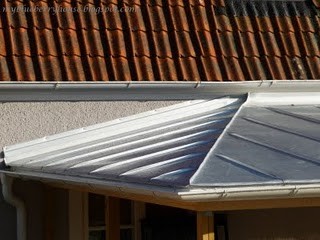
No, the fact that it doesn't work like that in practice is precisely the problem. There is nothing driving any air exchange.Martin_B said:
Is it a shed roof on a standalone building, or what are you building?
But what the heck am I actually discussing here. I have seen several houses with even mineral wool insulation right against the roof decking, and they've stood for decades without any problems whatsoever. Granted, they have gable roofs with underlay felt and then tiles, but still.
So I can imagine that you could actually place cellulose insulation directly against the roof decking and it would still be fine in the end.
So if you just create an air gap of about 25mm from the eaves to the ridge, where it then stops, it should theoretically still be completely sufficient without creating any problems whatsoever.
So I can imagine that you could actually place cellulose insulation directly against the roof decking and it would still be fine in the end.
So if you just create an air gap of about 25mm from the eaves to the ridge, where it then stops, it should theoretically still be completely sufficient without creating any problems whatsoever.
We have built a veranda with precisely that kind of roof. Built out a parapet with distance from the timber frame so that the air gap connected with the space behind the parapet. Air gap all the way from the eaves up behind this parapet and exits hidden behind the wooden panel above. Then you pull up the roofing felt and sheet metal on the parapet.
It is an extension being planned. Right now it's a friend who is building, whom I'm helping a bit, but I intend to do a similar extension in the future (the only thing that works in my case), so it might become relevant for me as well.
But that only works with mono-pitched roofs in that case. The question is how to do it with other options. At the same time, it's not always that people have wood facades. The person who will be building on has brick, as do IWe have built a veranda with exactly such a roof. Built out a curb with distance from the timber frame so that the air gap was connected to the space behind the curb. Air gap all the way from the eave up behind this curb and emerges hidden behind the wooden panel above. Then you pull up paper and sheet metal on the curb.
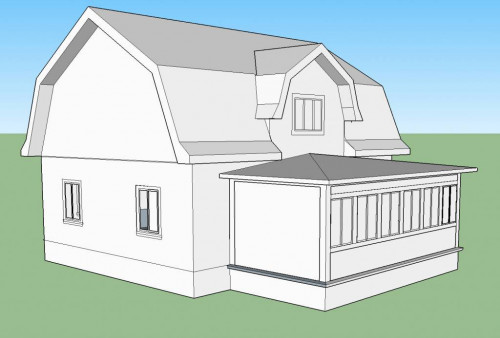
Here are some different options (that I have found on the internet and am pasting in as illustration):
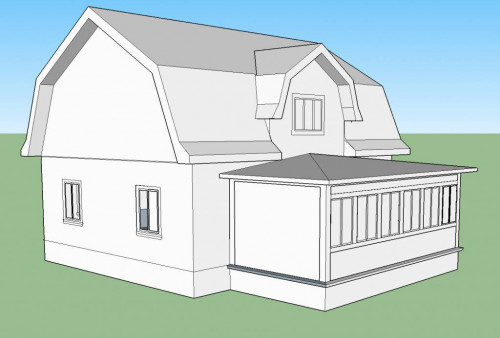
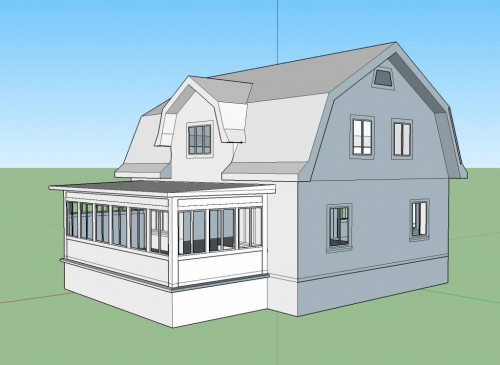
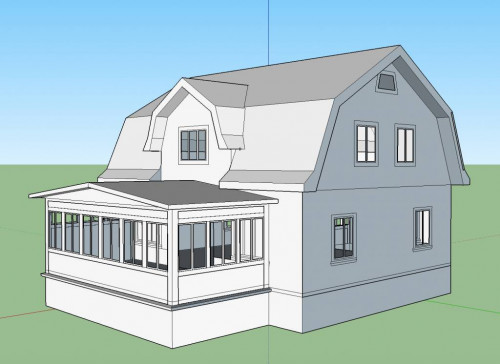
If it might be helpful, you can check out the thread about our extension. As mentioned, it has a hipped standing seam roof which is ventilated.
https://www.byggahus.se/forum/threads/inbyggnad-av-veranda-20-talshus.295043/
It can function without proper ventilation, but we didn't dare to. Cellulose is definitely a good choice if you're going without an air gap, as it becomes a bit less sensitive since any moisture can be buffered. The question is just whether the insulation can get rid of it quickly enough without any movement of air in the gap.
https://www.byggahus.se/forum/threads/inbyggnad-av-veranda-20-talshus.295043/
It can function without proper ventilation, but we didn't dare to. Cellulose is definitely a good choice if you're going without an air gap, as it becomes a bit less sensitive since any moisture can be buffered. The question is just whether the insulation can get rid of it quickly enough without any movement of air in the gap.
Very interesting reading!
"Results from research at SP show that in a well-insulated roof without moisture addition, i.e., in a roof that is both waterproof and vapor-tight and airtight, ventilation is rather a disadvantage than an advantage"
"Experiences from Germany, Denmark, and Finland
At Fraunhofer Institute für Bauphysik in Holzkirchen, they conducted both laboratory and field investigations on roofs with and without air gaps for several years at the end of the 80s. Measurements were made on roofs with a slope of 30° facing north and south. The results from moisture measurements during the winters of 1988 and 1989 show that it is significantly more humid in the ventilated roofs than in the non-ventilated ones, see figure 6. ......."
Source: http://www.fuktcentrum.lth.se/fileadmin/fuktcentrum/Publikationer/Bygg-Teknik/2_00_49.pdf
Another response I have found:
"Expert Answer

Ove Kummel
County representative
Build as you describe. Cellulose wool without an air gap. Absolutely right! There is no building norm that prescribes an air gap. What is said is that it should be built safely. And your idea is not unsafe.
The next question is interesting. I am a so-called expert. I answer, among other things, reader questions in the magazine Gård&Torp. Additionally, I have been a cellulose insulation contractor for 20 years. Indeed, there are contradictions. But these are more about cowardice, money, and other weaknesses."
Source: https://byggnadsvard.se/kunskapsbanken/frågeforum/cellulosa-utan-luftspalt-och-takfotsventilation
"Results from research at SP show that in a well-insulated roof without moisture addition, i.e., in a roof that is both waterproof and vapor-tight and airtight, ventilation is rather a disadvantage than an advantage"
"Experiences from Germany, Denmark, and Finland
At Fraunhofer Institute für Bauphysik in Holzkirchen, they conducted both laboratory and field investigations on roofs with and without air gaps for several years at the end of the 80s. Measurements were made on roofs with a slope of 30° facing north and south. The results from moisture measurements during the winters of 1988 and 1989 show that it is significantly more humid in the ventilated roofs than in the non-ventilated ones, see figure 6. ......."
Source: http://www.fuktcentrum.lth.se/fileadmin/fuktcentrum/Publikationer/Bygg-Teknik/2_00_49.pdf
Another response I have found:
"Expert Answer
Ove Kummel
County representative
Build as you describe. Cellulose wool without an air gap. Absolutely right! There is no building norm that prescribes an air gap. What is said is that it should be built safely. And your idea is not unsafe.
The next question is interesting. I am a so-called expert. I answer, among other things, reader questions in the magazine Gård&Torp. Additionally, I have been a cellulose insulation contractor for 20 years. Indeed, there are contradictions. But these are more about cowardice, money, and other weaknesses."
Source: https://byggnadsvard.se/kunskapsbanken/frågeforum/cellulosa-utan-luftspalt-och-takfotsventilation