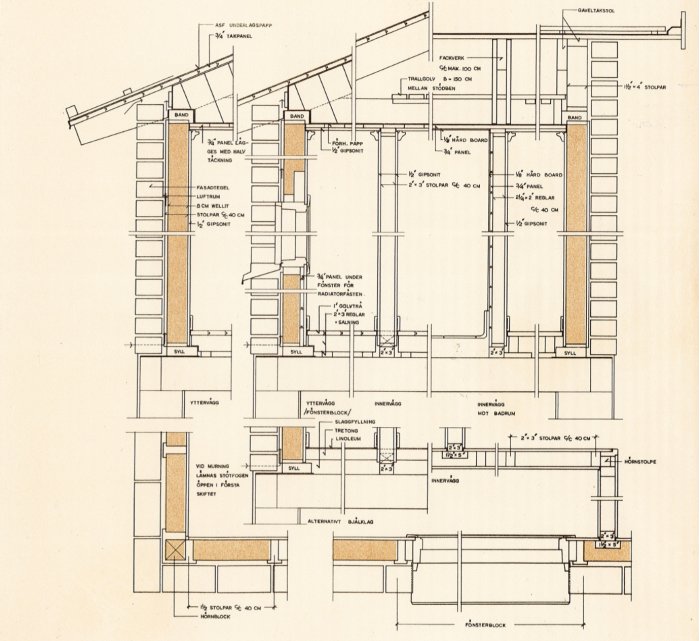
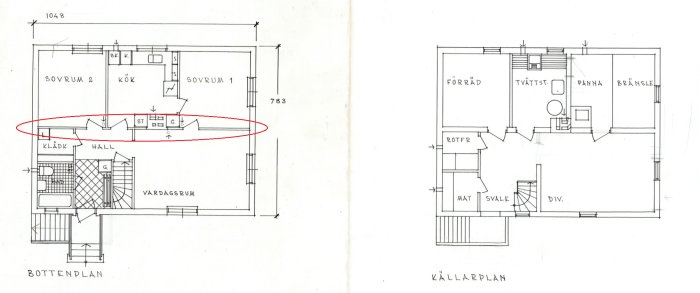
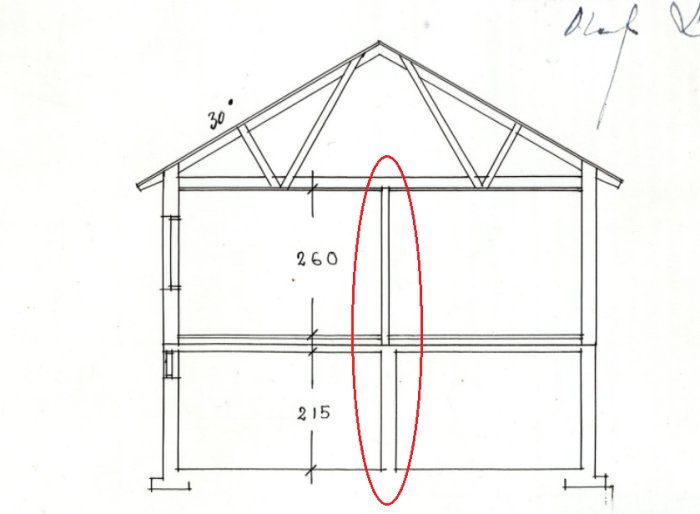
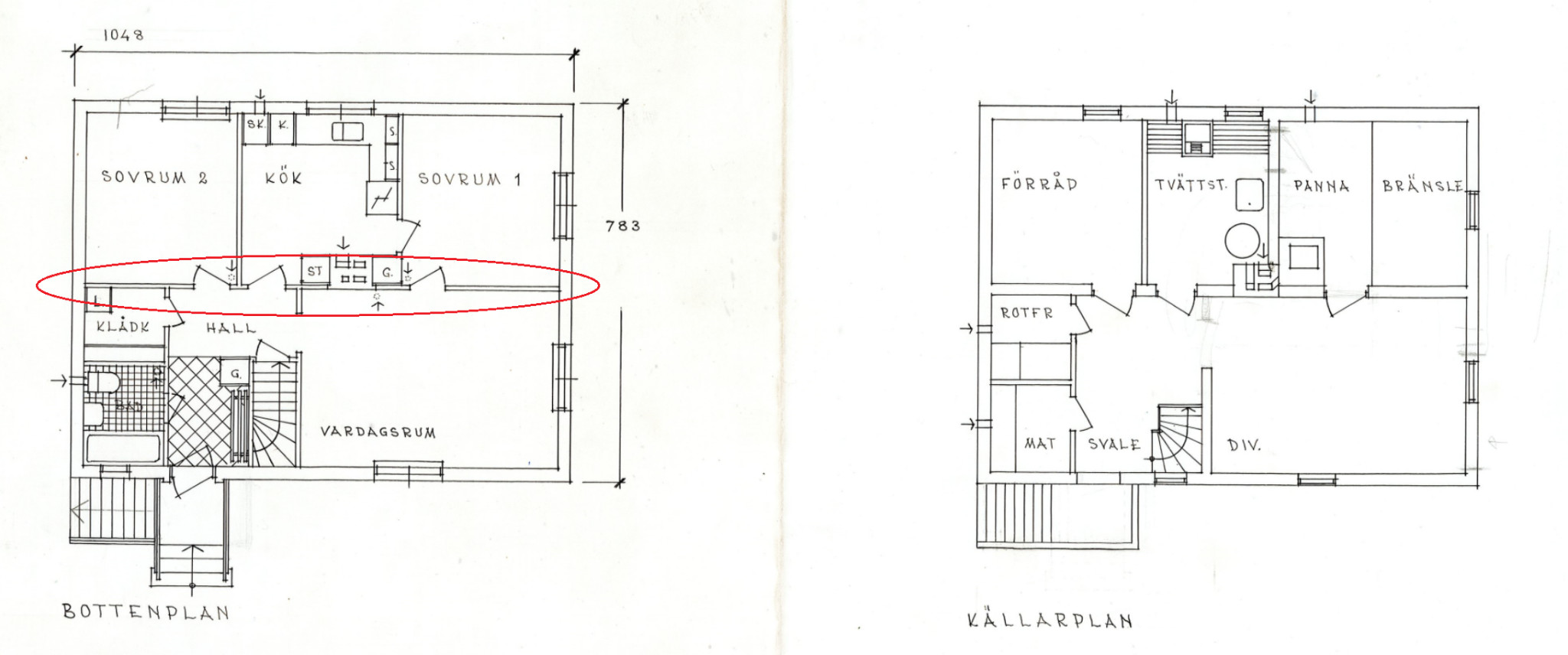
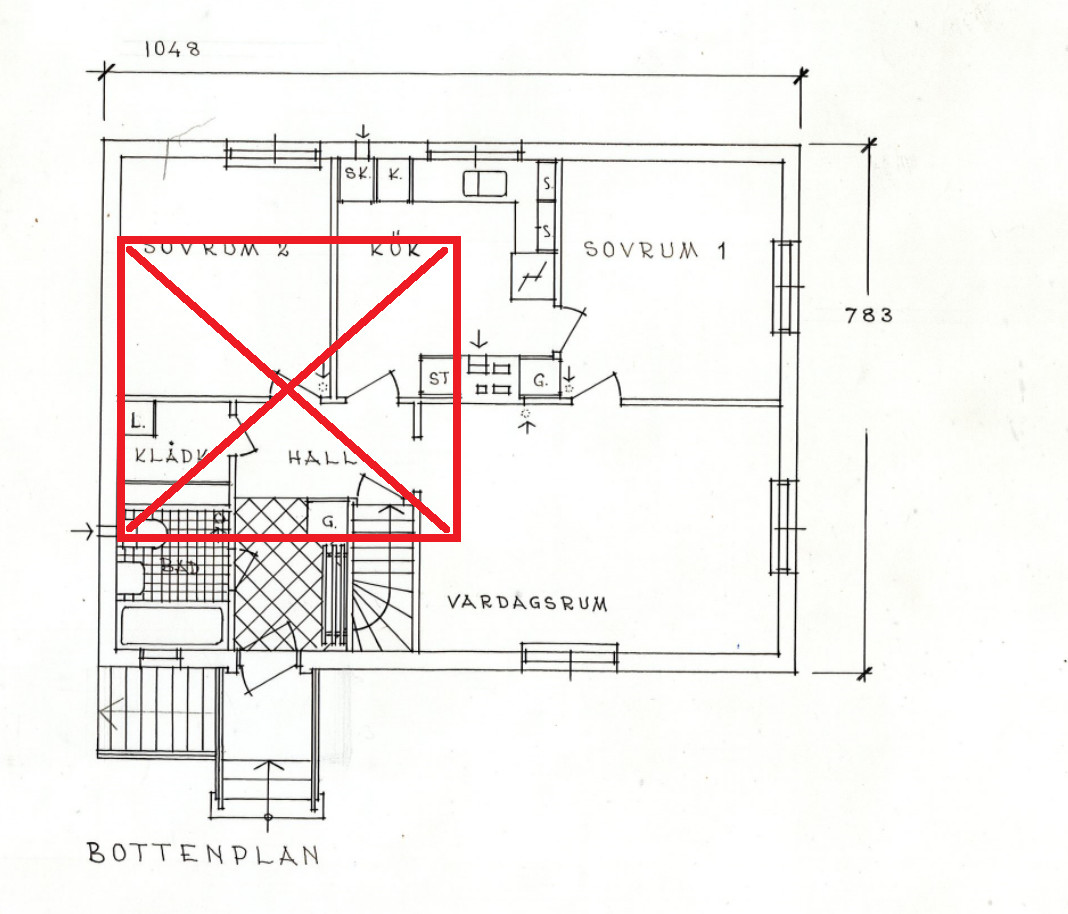
Another load-bearing wall question. Based on the drawings below, is the circled wall load-bearing?
I have some plans to remove the wall between the living room and bedroom 2 and also to convert the attic to the right of the chimney (above the living room and bedroom 1).
The attic to the left of the chimney (above the kitchen, hall, bedroom 2) is already converted.
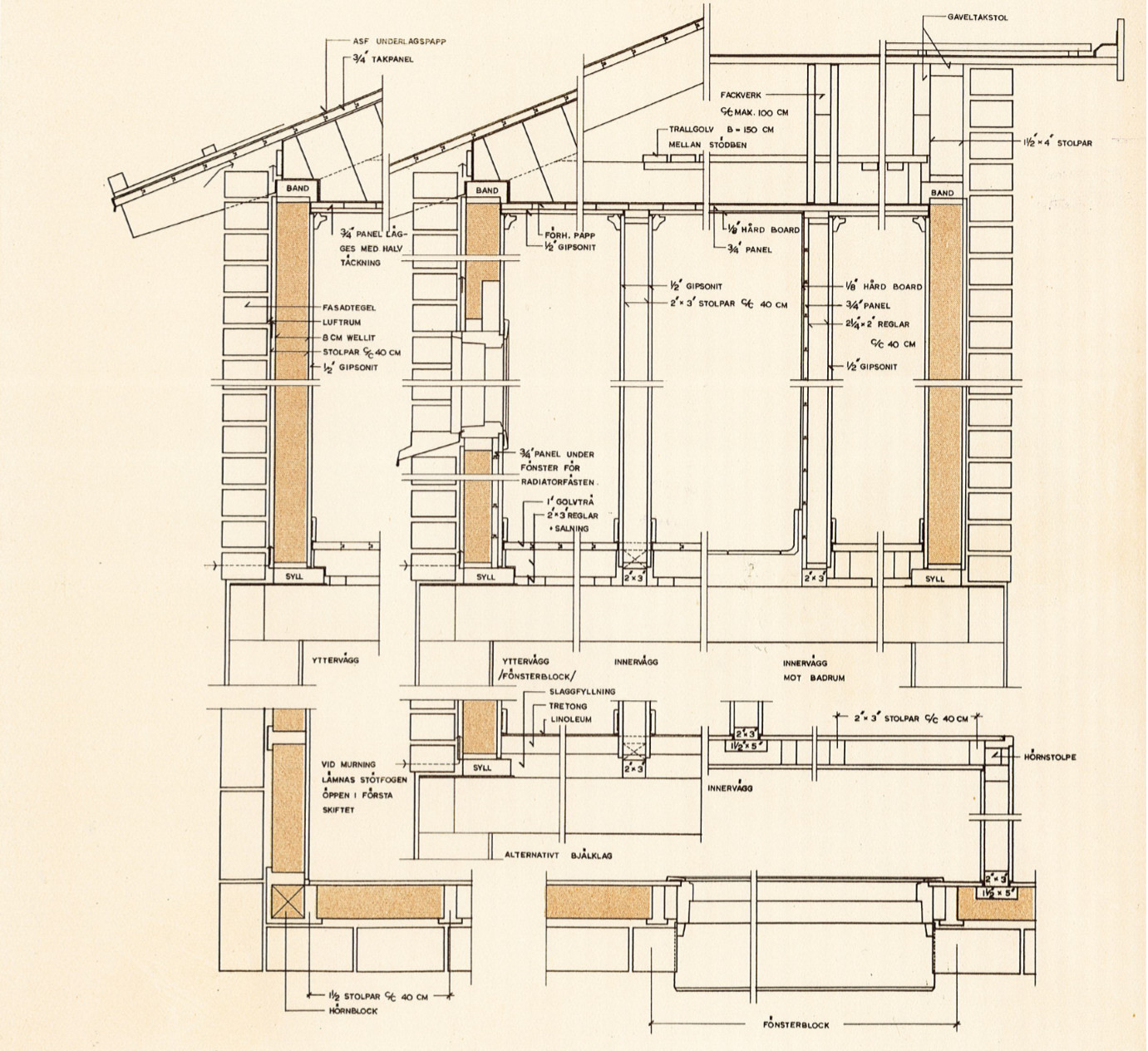
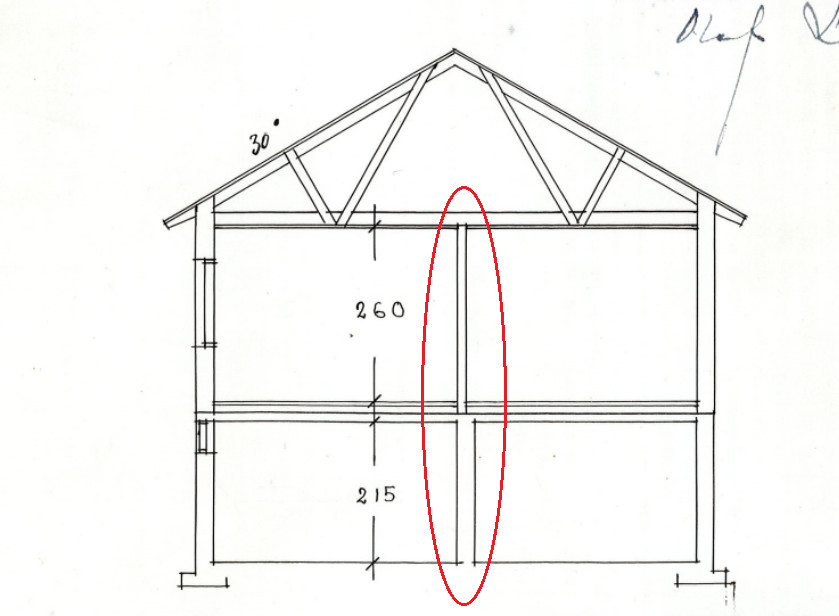
The truss rests on 50mm wide planks (I don't know the height, the welliten is hiding it).
The highlighted wall should not be load-bearing. However, one cannot be entirely certain without having examined the truss dimensions and other measurements.
The marked wall is load-bearing for the load on the collar beam, the horizontal beam in the roof truss. That is, if it is loaded by live load, etc. It has no function for supporting the roof. Since the attic is finished and should be expanded, you should reinforce it.
A truss roof truss, if properly dimensioned considering span and snow load, etc., is normally self-supporting. From a structural strength perspective, the truss can be considered as a large beam, where all parts cooperate. If you start loading the lower chord with a larger live load, the conditions change. It is not certain that its dimensions will even suffice with the support provided by a center wall.
However, a slightly uncomfortable follow-up question arises. How is the partition wall doing under the furnished attic section?
We are using it as storage, you see.
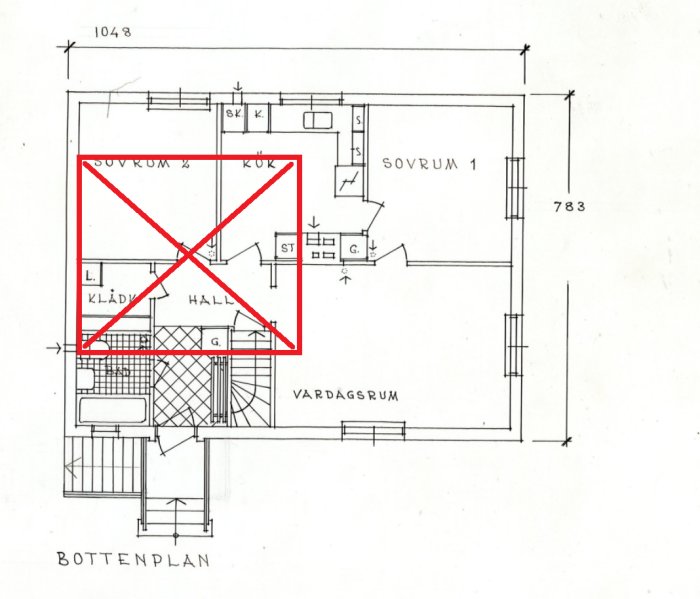
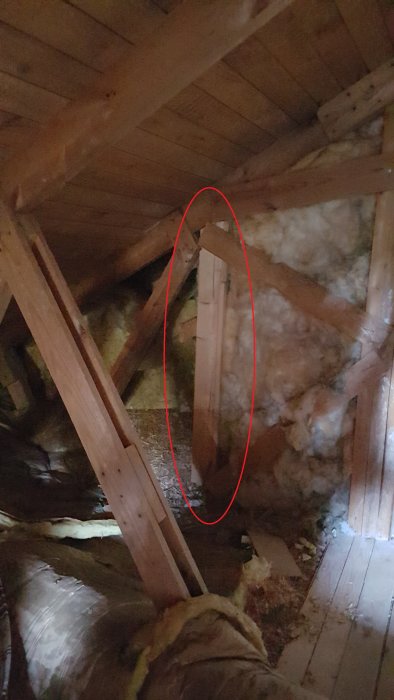
In picture 1 below, you can see where the attic has been furnished.
How they have worked with the truss, I don't know,
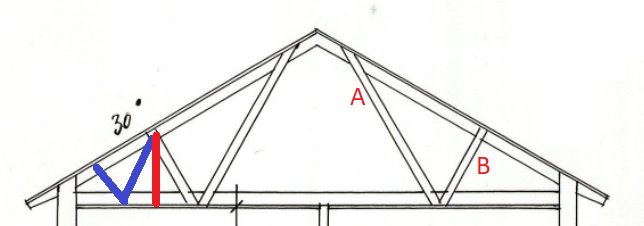
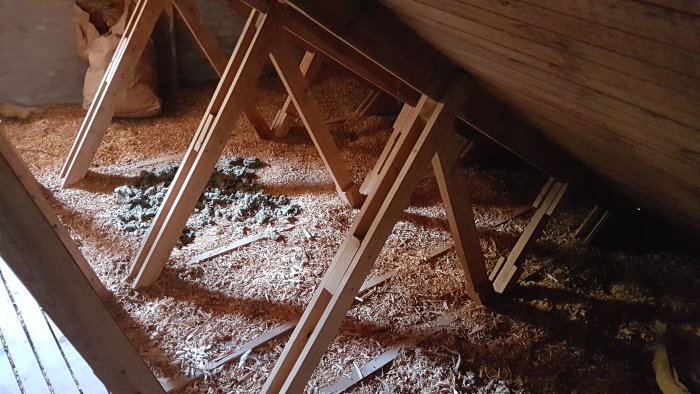
but I can only conclude that it has been done as in pictures 2 and 3:
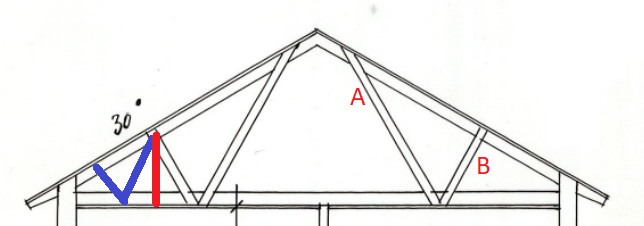
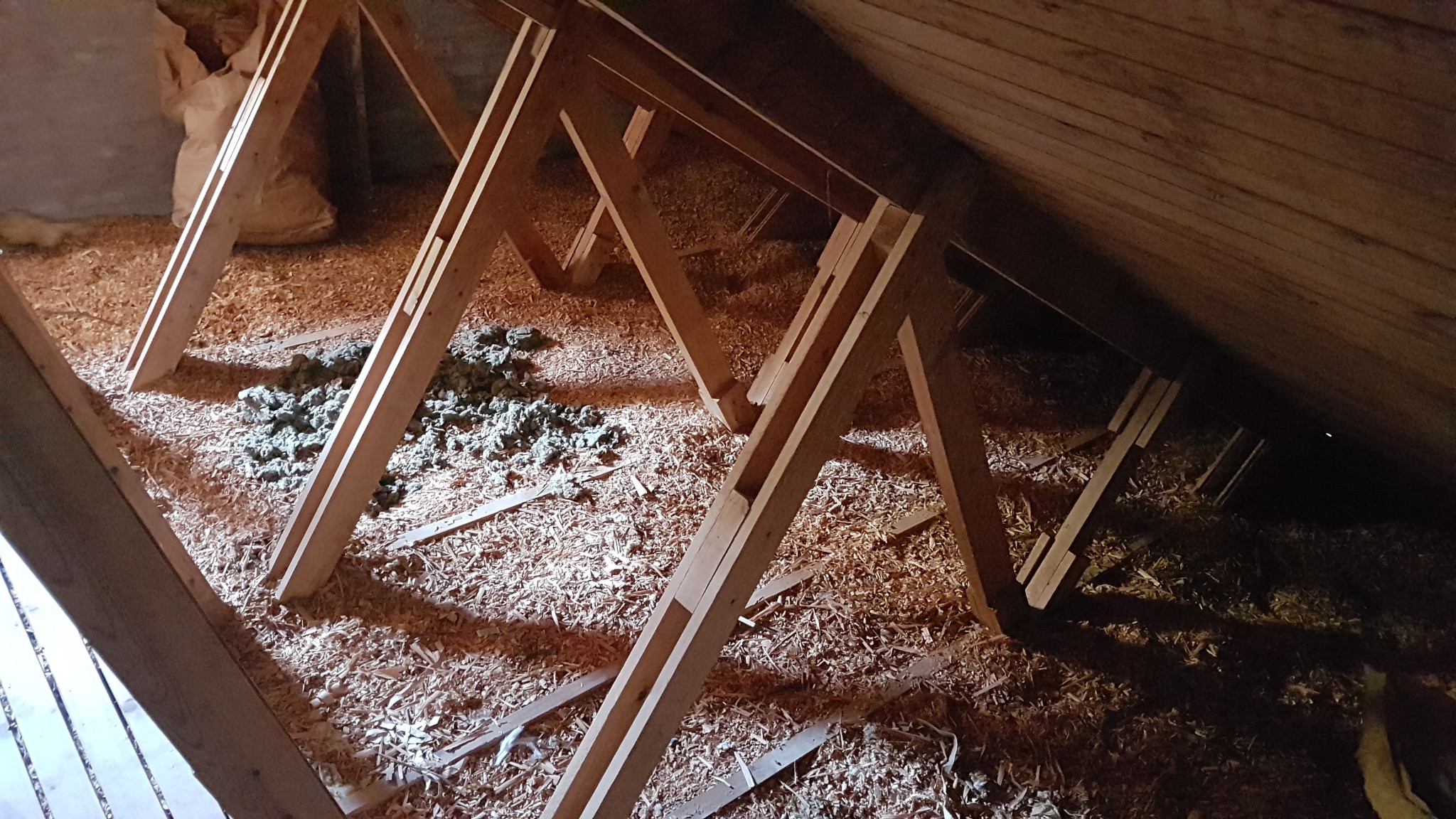
They have cut trusses A and B, then added a collar beam (red line on picture 2 and circled in picture 3).
Picture 3 is the wall between the raw attic and the furnished attic section.
Picture 4 also shows additional trusses that are not included in the original drawings. (blue lines)
probably nothing to worry about, however, if a lot of snow accumulates on the roof, you might want to shovel a bit more frequently than usual as it is primarily the snow load that the roof is designed for, in addition to its own weight.
The insulation that is wedged between the new rafter should be checked for moisture as it seems like a risk construction. Feel between the insulation and the sheathing during wintertime or see if it is black today.
The fact that A and B have been cut is potentially serious. How serious it is depends on the dimensions of the upper and lower frame. In SVT's series "Husdrömmar" earlier this year, there was an example where a previous owner did something similar, but all the way. It ended with the entire house being demolished. It doesn't have to be that bad in your case, but the best approach might be to restore everything. Truss rafters cannot be rebuilt without significant difficulties and only under the guidance of individuals with sufficient competence.
justusandersson,
Could you please specify a bit more how they had cut the A and B diagonals?
I might have been a bit unclear myself. A and B are cut on both sides, in the furnished part of the attic. The rest of the house's trusses are intact.
The house has (presumably) been like this since the mid-'70s.
I have only owned the house for 9 months.
I, the inspector, couldn't see any settling.
The only thing is that I had a roofer here (considering building a dormer) who said the battens are a bit misaligned here and there after the roof has sunk a little. The roof is 24 years old.
The wall in the basement is a so-called "hjärtvägg" (heart wall), it is "load-bearing". It is not certain that the intermediate joists rest on the wall normally; instead, it serves as a safety feature so that if the joists begin to sag, the hjärtvägg prevents the joists from flexing more than a few centimeters.
Our intermediate joists are about one cm above the hjärtvägg. When the building was constructed, the exterior walls were built first, and nearly the entire height of the hjärtvägg (except for the last row of bricks), then the intermediate joist beams were laid, after which the tongue-and-groove roof was nailed to the underside of the entire intermediate flooring, and finally the last row of bricks was placed on the hjärtvägg. The hjärtvägg and the exterior walls in the basement are built with polsten, while the remaining basement walls are built with lightweight concrete (low-radiation blåbetong). Our interior walls on the ground floor are not load-bearing; we have the same type of truss construction (last picture in the first post).
A truss functions as a large beam. Compare, for example, with old railway bridges made of steel. Through truss technique, it is possible to achieve relatively large spans with fairly slender dimensions of the included parts. A truss is designed solely to bear roof loads. In a frame truss, the rafters absorb the roof loads. The floor joists do not actually belong to the truss, and their primary task is to support the load on the attic floor, often with a closer c/c distance than the trusses. In a frame truss, there is also a collar tie that prevents the roof loads from pushing out the walls. The dimensions of the rafters and floor joists are significantly larger than the corresponding parts in a truss.
In your case, it appears they have attempted to convert the trusses to frame trusses. The reason it hasn't collapsed is likely due to having a partition wall in the middle. If one wants to change the type of truss, new trusses with the correct dimensions must be built between the old ones. It is not advisable to do as your predecessors did. The house risks becoming unsellable in its current condition.
I find it a little hard to believe that the house would become unsellable, given that the entire street is essentially the same villas, all the villas have either an attic conversion, a dormer, or both in combination. However, I have not asked the entire neighborhood how they have resolved it in their house. But the closest neighbors have no load-bearing wall in the middle.
I write this not to contradict, just for information.
It doesn't have to be as bad as it sounds. The roof trusses may be oversized from the beginning. If you want to use the attic for storage, you can install new floor joists between the trusses and lay stronger floorboards on top of them so that the bottom chords of the trusses are not loaded. Then you can restore the braces, which is not particularly complicated.
Vi vill skicka notiser för ämnen du bevakar och händelser som berör dig.