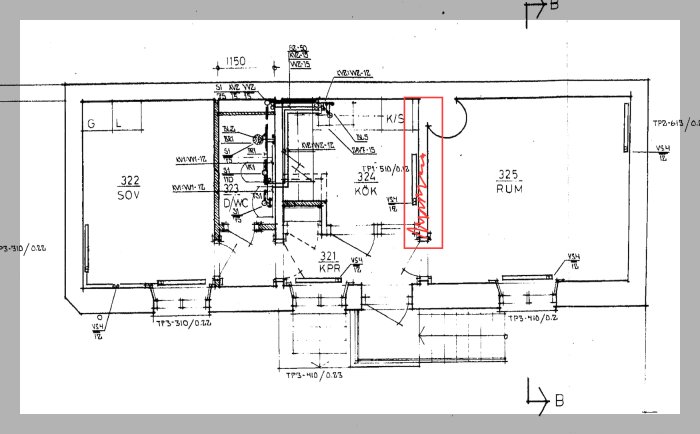
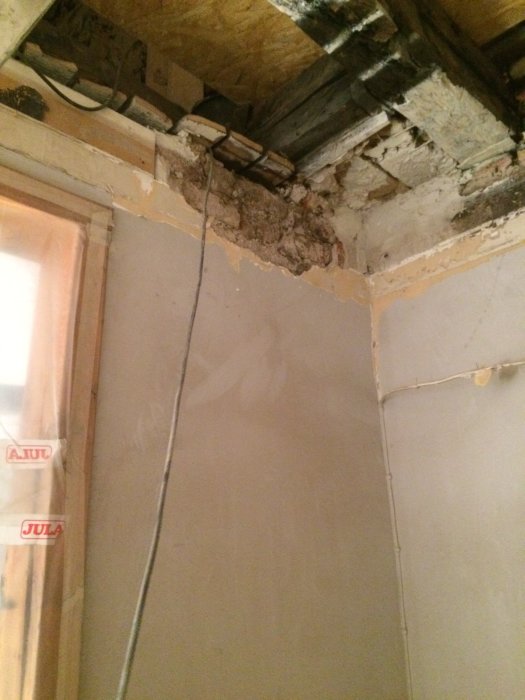
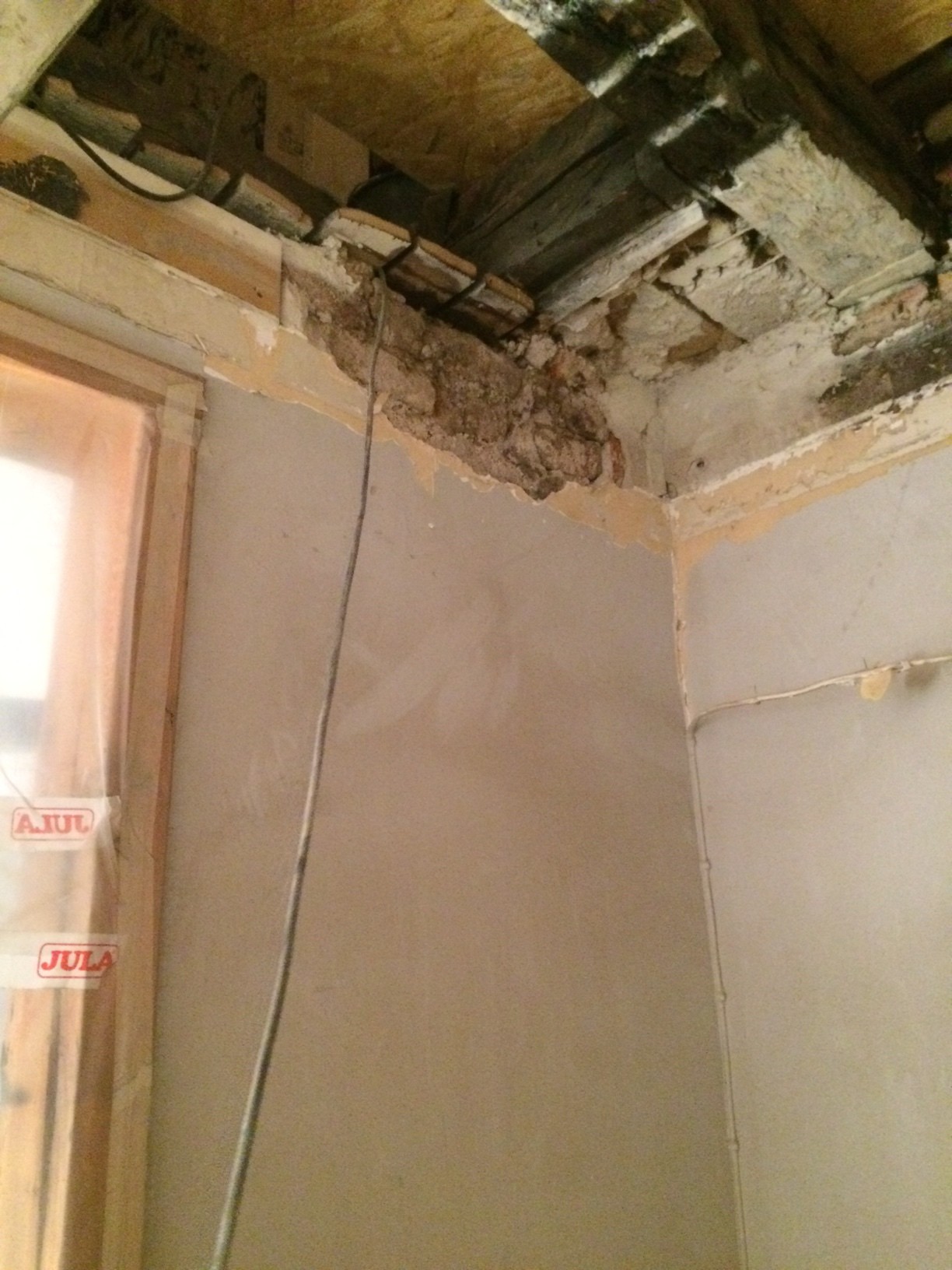
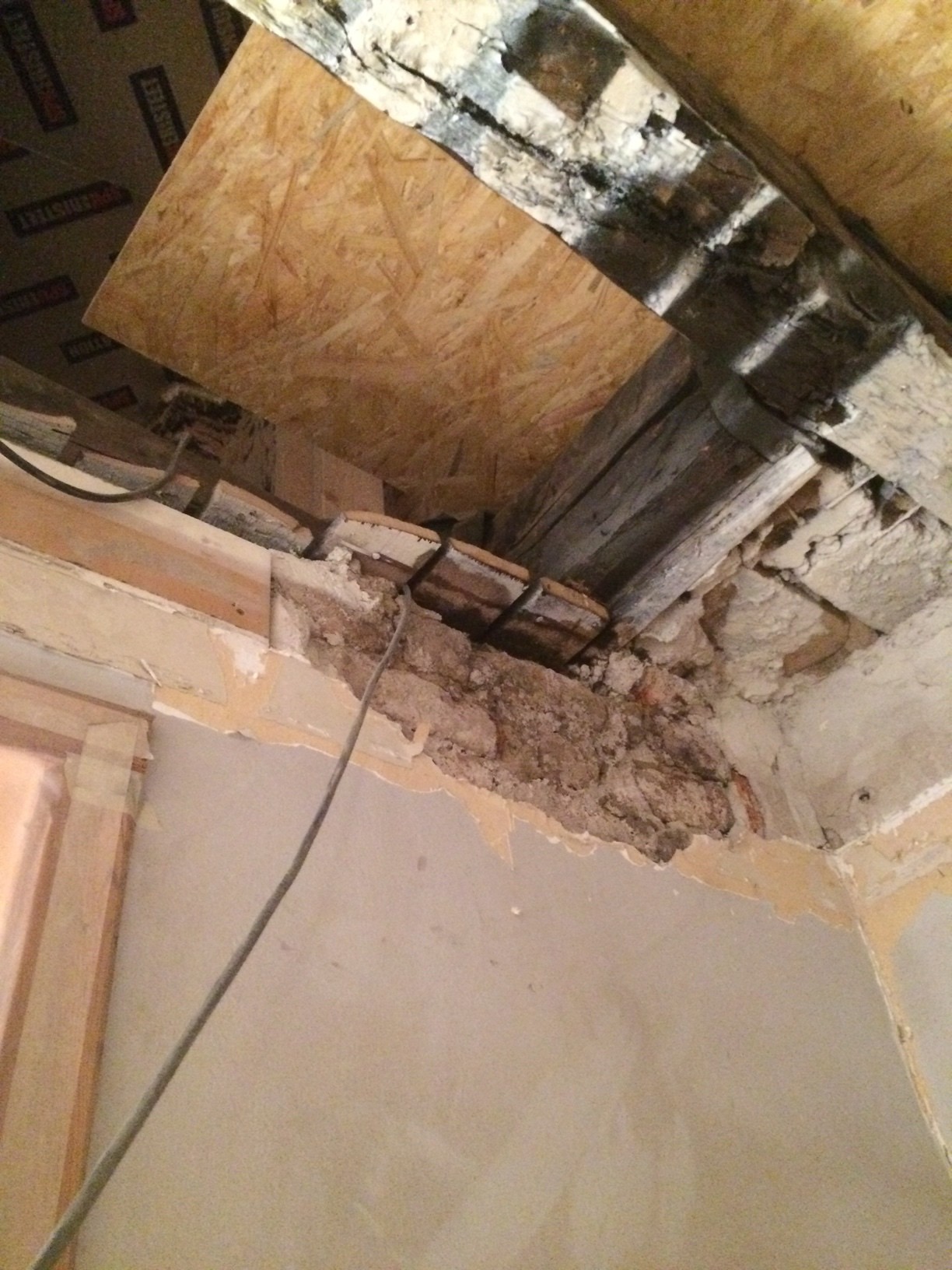
Need advice regarding a wall in a turn-of-the-century house. The desire is to completely remove it or at least reduce it as much as possible. In the drawing below, you can see the wall marked in red. As seen on the drawing from the '80s, the wall was considerably longer and separated the kitchen from the living room. The part of the wall that was removed by what I suspect was the previous owner was made of wood. The remaining wall section, which I now wish to demolish, is made of brick, which makes me wonder if it might be load-bearing. Could it be purely for practical reasons that it is made of brick, like having a tiled stove connected to the wall?
Does anyone have any insight on this? I can add that the wall is about 15 cm wide
That the wall is made of brick is probably because there is or has been a fireplace in the corner. The round thing on the drawing is probably a tiled stove. Regulations for fire protection are among the oldest building codes we have.
Whether the brick wall is load-bearing is not easy to know. I myself have a house from the early 1900s and once made the mistake of assuming that a wall stump I demolished, which according to all current building methods should have been non-load-bearing, actually was. Fortunately, it was easily resolved; it was just a ceiling joist on a single truss that was supported by the wall, and it was easily resolved with an extra beam in the attic.
The reason why almost all walls in old houses can be load-bearing, and particularly walls near chimneys, is that all forms of hardware and the like were expensive at the time because they were hand-forged. To transfer the load of walls near a chimney, hardware was needed that does the same thing as today's joist hangers. But a joist hanger today is mass-produced and costs a few tens. Corresponding forged hardware was probably significantly more expensive. So even if it was only one you saved on, it was worth it. Besides, who would be so foolish as to remove a wall? Open plan solutions probably weren't in fashion then...
But a masonry "wing" like this on a brick wall or chimney can also stabilize the wall or chimney so that it doesn't crack under the load from above, or indeed from its own weight. So it's not just any potential joists above the wall you need to check but also what the wall connects to.
Yes, exactly, there used to be two tiled stoves in the house at one time, one of which was located next to the wall I wish to take down.
It's tricky to consider that the wall stump might be stabilizing for the exterior wall it stands against. Additionally, it could be noted that later extensions have been added in connection to that exterior wall, so it should be well-braced.
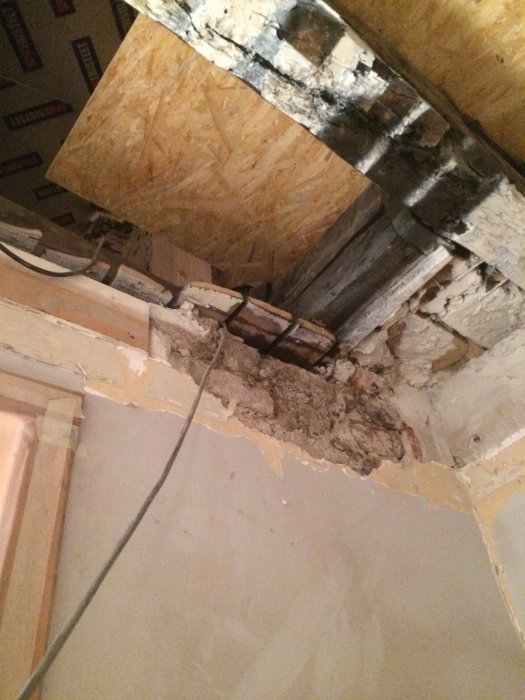
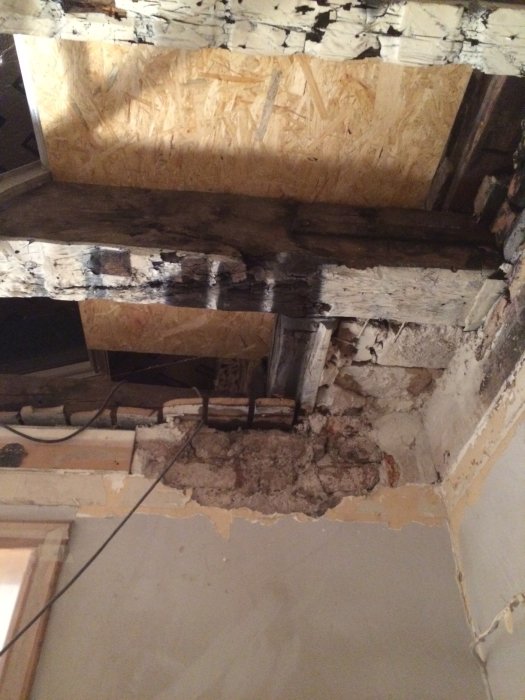
The transverse beam visible protruding from the wall at the top spans the entire chimney parallel to the exterior wall all the way to the next partition wall on the drawing, to the left of the "demolition wall." I'm wondering if the "demolition wall" in question acts as support for this transverse beam or if it rests on a joist hanger against the transverse beam?
Click here to reply
Vi vill skicka notiser för ämnen du bevakar och händelser som berör dig.