You need a cross brace if you're not going up to comical dimensions. Like a solid I-beam. The force from the line should press down on the post, not bend it.
Were you thinking of a zip line with a harness? If so, maybe you can skimp a little on the thickness of the sand layer over the stretch. It looks like bedrock.
The trees are too weak, only 15-20 cm in diameter. Also, they grow on rocks so I'm not sure how stable they are.
I think you're absolutely right here, leave the trees alone!👍
As previously pointed out, the forces become really huge, but with cross braces and/or by attaching the wire to the rock behind the posts, the construction becomes much stronger.
Why would the forces be greater in a construction with a taut vs. slack line? I might argue that the forces are somewhat greater in a construction with a slack line (the line needs to be continuously folded which consumes the forward momentum, and you carry less energy when you jump off because you have a lower final speed).
5 tons was an assumed figure without any calculation.
But if we try... with 0.3 meter sag on 30 meters of line, we get a leverage of 100 times. With 50 kg hanging on the line, we have 5000 kg in the direction of pull. So no, there is no margin.
(I'm sitting here wondering if you should calculate using half the length of the line... but it doesn't matter much... the forces become large quickly anyway.)
200% in safety margin, so TS needs to account for 15 tons for the welds in any case.
Nah, you probably don't need to pad the ground under the whole ride, but it would be a shame if you spent 15000 kronor on VKR, and then the pipe bends when some over-refreshed neighbor wants to take a test ride....
I think it sounds like a fun project that I hope you carry out. With a bit of figuring, you'll probably come up with a construction that holds. I've never built a zipline, but I've built many other things. Among other things, I have a homemade passenger lift that's been used daily for 10 years. And a material lift for the garage basement that carries several tons. Right now, I'm constructing a small hook loader with a machine flatbed that will fit in the trunk of a car. A handicap adaptation. It includes, among other things, a pole that is stressed in a similar way to your zipline pole. We'll see if I've calculated correctly or if it bends... You have to dare if you want to get somewhere with your sometimes wild ideas. But sure, there are many around you who want to slow down the creation and shout about missing CE markings and insurance disasters.
This thing with a taut line... it's one of the fundamental physical elements along with the lever and the wheel. With only a taut line, you have a poor man's winch that can move many tons of material by hand power. If you keep the line taut between two heavy objects and pull by hand in the middle of the line, the heavy objects will be moved slightly towards each other. As soon as the line starts to get a bit of an angle, the force diminishes. Tighten the line again and repeat the procedure. Soon, you'll have moved the objects a bit. For example, pulling down a tree with root and all using a larger tree as a support. Or moving a 3-ton heavy stone.
I think it sounds like a fun project that I hope you complete.
With a bit of ingenuity, you'll probably come up with a construction that holds.
I've never built a cable car but a lot of other things. Including a homemade passenger lift that has been used daily for 10 years.
And a material lift for the garage basement that carries several tons.
Right now, I'm designing a small load changer with a machine bed to be placed in the trunk of a car.
A handicap adaptation.
There is, among other things, a pole that is loaded in a way similar to your cable car pole.
We'll see if I've calculated correctly or if it buckles...
You have to dare if you want to get somewhere with your sometimes wild ideas.
But sure, there are many around you who want to hinder creativity and shout about missing CE markings and insurance disasters.
When it comes to a tight line...it's one of the fundamental physical elements along with the lever and the wheel.
With just a tight line, you have a poor man's winch that can move many tons of material by hand.
If you keep the line tight between two heavy objects and pull by hand in the middle of the line, the heavy objects will move towards each other a little bit. As soon as the line starts to angle, the force decreases. Tighten the line again and repeat the process. Soon you will have moved the objects a bit.
For example, pulled down a tree with the root and all using a larger tree as a counterweight.
Or moved a 3-ton stone.
I have pulled free grounded boats this way; you become very strong when pulling perpendicular to a tight line.
Why would the forces be greater in a construction with a taut vs. slack line? I might even argue that the forces are somewhat greater in a construction with a slack line (the line needs to be continuously bent, which consumes the forward momentum, and you carry less energy when you jump off because you have a lower final speed).
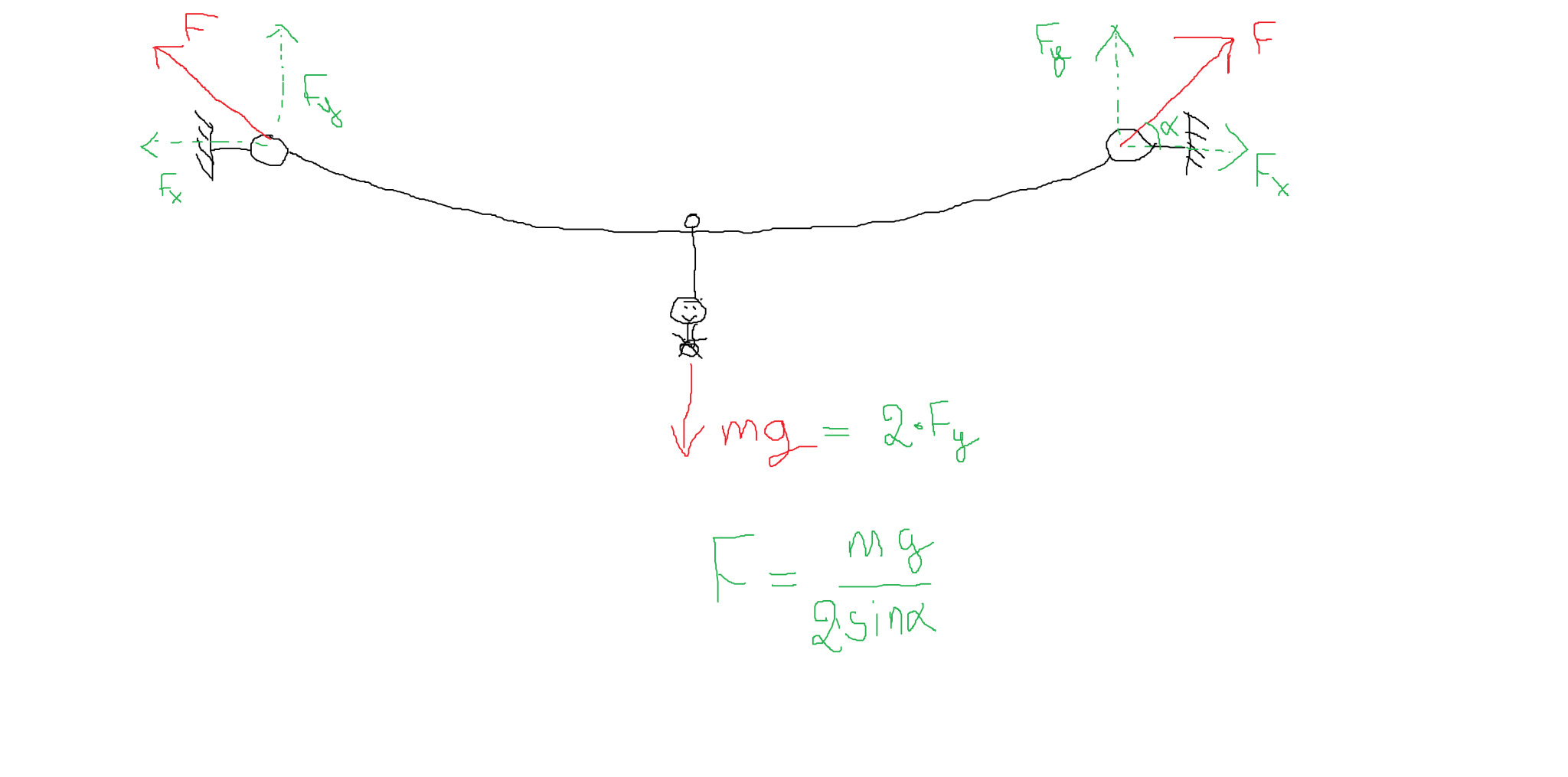
A taut cable has much larger forces in it than a slack one with the same load in a zip line.
The force goes in the direction of the cable at the attachment points. If you imagine the forces at the attachment points as an arrow, they should point up as much as the force of the load, i.e., the child, points straight down. And at a low angle, the arrows point very slightly up and must be much longer than the child's arrow.
An angle of, for example:
5 degrees gives a leverage of about 11 times
15 degrees a leverage of about 4 times
With the load in the middle between the attachment points. '1/sin(x)' where x is the angle between the horizontal plane and the cable.
How this looks in a zip line with incline or when the child is not in the middle is left as an exercise for someone who knows something.
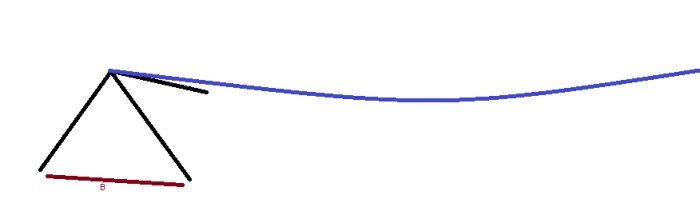
A simple engineering construction is to think triangles
Just a straight pole is probably very challenging to make stable, although it's certainly not impossible - in practice, it becomes a "mini triangle" inside the pole, so a hollow pole with, say, a meter in diameter could probably be equated with three small "rods" with a few centimeters thickness at the right angles.
It's often better to increase the angles instead of increasing the diameter of the "tube."
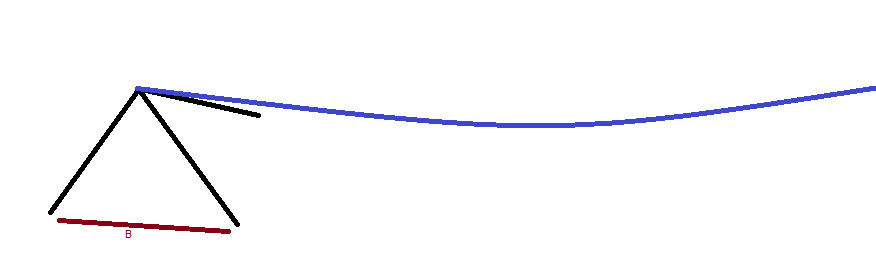
So make sure that B in the sketch above is reasonably large, then it might work with relatively thin "tubes" (logs, etc.). If the cable is tight, it might work to have the rear "leg" in the form of a cable with a cable fastened to, for example, the rock. And if there is little space behind, it doesn't matter: Place the rear support as far back as possible and then the support legs forward in a "V" shape, so you go between them: In theory, they can extend long after the line ends (even if the angles might be a little tricky in practice).
If you fasten it properly to the ground and add a crossbar that forms a V, it will probably be quite okay.
You can spice it up with some cross braces to get a few more "triangles." Depending on the anchoring in the ground, it might either tip to the side or collapse.
Vi vill skicka notiser för ämnen du bevakar och händelser som berör dig.