8,737 views ·
33 replies
9k views
33 replies
Check foundation post / air bubbles
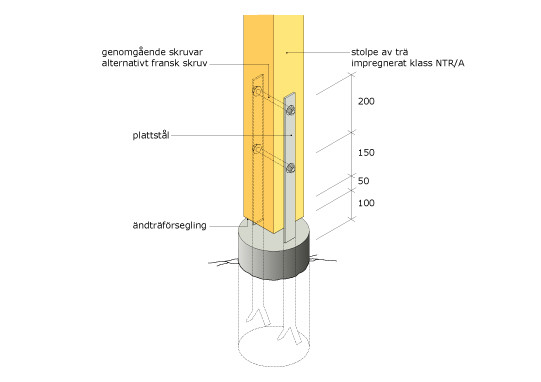
Thanks for the suggestion! But I don't quite understand, do you mean that I should replace the pedestal with a wooden post? So basically attach a post shoe/concrete pedestal to the rock and then a post on it? If so, I've considered it myself before because it seems super easy, but can the post handle the load?Stickan56 said:
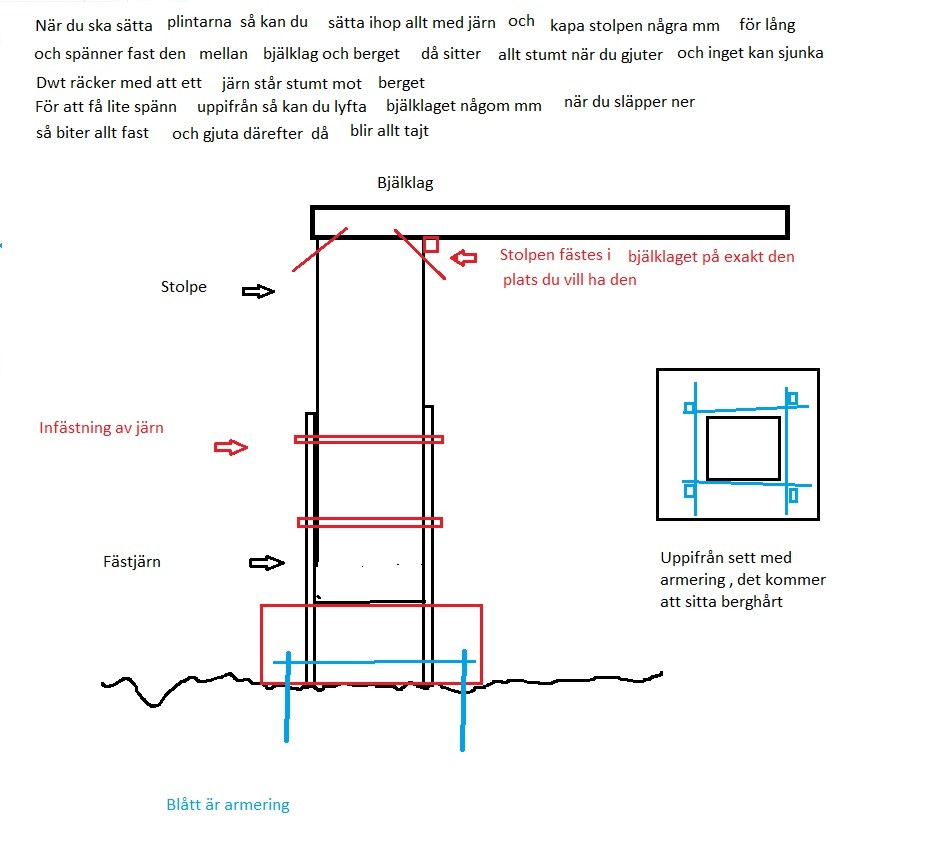
As freehopper says, it is possible to perform in different ways. You need to make a concrete pillar on the rock that is at least 40 cm high and about 40x40 cm square, this is to ensure the anchor irons stand well on the rock. If you just use a sturdy post, it will hold, for example, by screwing together 3 pieces of 125x45 to make a post. The tricky part can be getting the anchors positioned correctly in terms of distance to attach the post, it usually ends up a bit crooked no matter what you do.
Just as "Rävlyan" writes, you should first cast a pier as the picture describes.F frihopper said:Thanks for the suggestion! But I don't quite understand, do you mean that I should replace the pier with a wooden pole? So essentially attach a post shoe/concrete pier to the rock and then a post on it? If so, I've considered it myself before because it seems very easy but can the post handle the load?
Stickan
 it should be Stickan56
 It certainly feels like a tempting proposal!
Could you use a post like this:
https://www.hornbach.se/shop/Stolpe...A-95x95x4200-mm/7189159/artikel-detaljer.html
Does the plinth need to be so large? A regular plinth is only 19 cm in diameter. With this volume, if I've calculated correctly, it will be about 64 liters of coarse concrete if it's 40 cm high and 40 * 40 cm in area. That's more concrete than a standard plinth at 19 cm by 140 cm (about 40-50 liters).
Could you use a post like this:
https://www.hornbach.se/shop/Stolpe...A-95x95x4200-mm/7189159/artikel-detaljer.html
Does the plinth need to be so large? A regular plinth is only 19 cm in diameter. With this volume, if I've calculated correctly, it will be about 64 liters of coarse concrete if it's 40 cm high and 40 * 40 cm in area. That's more concrete than a standard plinth at 19 cm by 140 cm (about 40-50 liters).
The post you are linking is somewhat like that, a pure post has the ability to twist and it cannot be stopped.
Therefore, screw a few together, a bit rough but it should stand against something on the underside as well.
As for the plint, it needs to be quite rough and tall, okay maybe 30x30 wide and the iron needs to be at least 20 cm high, so that the iron is seated properly, then some square reinforcement on the plint so it can't crack and a few extra dowels, it lies loose on the rock.
Concrete does not adhere to rock.
It's possible to make a sketch of it, otherwise in the style of what has previously emerged, with some modification.
Therefore, screw a few together, a bit rough but it should stand against something on the underside as well.
As for the plint, it needs to be quite rough and tall, okay maybe 30x30 wide and the iron needs to be at least 20 cm high, so that the iron is seated properly, then some square reinforcement on the plint so it can't crack and a few extra dowels, it lies loose on the rock.
Concrete does not adhere to rock.
It's possible to make a sketch of it, otherwise in the style of what has previously emerged, with some modification.
30 cm high * 30 cm * 30 cm sounds more feasible. The reason for hesitation is that this is the Stockholm archipelago, and it's a real hassle to haul stuff to the house which is in the middle of the island. Then it becomes 27 liters, about 2 bags of coarse concrete, which feels more OK. As long as it works structurally of course!R rävlyan said:The post you linked to is so-so, a plain post has the ability to twist, and it can't be stopped. Hence, screwing some together, a bit rough but it should stand against something underneath as well. As for the plinth, it needs to be quite coarse and tall, okay maybe 30x30 wide, and the irons need to be at least 20 cm high, for the irons to sit properly, then some reinforcement in a square on the plinth so it can't crack, plus some extra dowels, it lies loose on the rock. Concrete does not bond to rock. It's possible to make a sketch of it, otherwise, in the style of what has been discussed earlier, with some modification.
This is the construction I am thinking of:
Build a mold. Secure 3 pieces of 10 mm rebar into the rock with anchor compound 29 cm out of the plinth's 30 cm. Pour coarse concrete and then place 50 cm plinth iron which will then be 20 cm above the plinth surface. Screw together 3 pieces of pressure-treated 145*45 beams that I attach with hot-dip galvanized threaded rod M12 at two points according to Stickan's sketch. Then attach the 145*45 post to the house frame with angle brackets. Will it work?
It is addressed in another thread, https://www.byggahus.se/forum/threads/bjaelklagsregel-utanfoer-plintarna.291888/#post2668196, but it is probably about poor construction from the beginning, almost 40 years ago, as the outermost frame beam on the house is very close to the edge of the bases (which are straight) and on one base has completely "fallen" off.R rävlyan said:
Edit: different username then, which I lost the password to.
If you are going to screw together two or more studs to a post, you should buy this kind of screw, they pull nicely.
http://essve.se/webcatalogue/skruv/689269-konstruktionsskruv-et-t-corrseal/
6.5X90mm if you are using 45X90 or 45X120 studs.
Stickan
http://essve.se/webcatalogue/skruv/689269-konstruktionsskruv-et-t-corrseal/
6.5X90mm if you are using 45X90 or 45X120 studs.
Stickan
Last edited: