
Hello,
I am going to build a floor structure with 90x315 glulam as the "frame"...
Now to the question:
Can you "combine" joists that are 45x195 + 45x120 to get the same height (315) for the rest of the floor structure?
also:
Are "nail plates" the best option? Or should I glue as well?
I am going to build a floor structure with 90x315 glulam as the "frame"...
Now to the question:
Can you "combine" joists that are 45x195 + 45x120 to get the same height (315) for the rest of the floor structure?
also:
Are "nail plates" the best option? Or should I glue as well?
Well, it's the floor, but I need a base, for example, blindbotten, I have to attach it to something. Therefore, I thought of laying on 45x120 underneath, then 28x120 to fasten the boards to, and then fill with insulation, then I'll have 315 insulation. The other option is 220 insulation.
Can you manage with 220 insulation in the floor structure?
Will it "creak" and make noise from the floor if you "layer" it this way?
The floor itself will be 30x183 solid wood flooring... no underfloor heating.
Can you manage with 220 insulation in the floor structure?
Will it "creak" and make noise from the floor if you "layer" it this way?
The floor itself will be 30x183 solid wood flooring... no underfloor heating.
The studs don't necessarily have to align, you can have 45'45 studs for the blind bottom. Then a gap and finally your load-bearing studs. It does save a bit by doing it this way. I can't say I know insulation, is it between the floor and the ground? Or between two floors?
Well, you can do that indeed... but then you'd have to put noggings between 220 and 45... at about 50. The problem then is if 220 can handle the span of 3.75m?
It's between the floor and the ground, single-story house...
It's between the floor and the ground, single-story house...
The bending moment at the midpoint of the load P is M=PL/2, where L is the length.
The bending stress is S=M/W, where the section modulus W=bh^2/6. b and h are the width and height of the beam.
So, S=3PL/bh^2. P in Newtons and all measurements in millimeters will give you the bending stress in Megapascals (MPa). S should be less than the beam's flexural strength.
The flexural strength for pine and spruce is 87 and 75 MPa, respectively.
So, we'll consider your beam as spruce, the weaker wood, just to be safe.
75=(3*P*3750)/(45*220^2)
75=(3*P*3750)/2178000
75*2178000=((3*P*3750)/2178000)*2178000
163350000=3*P*3750
163350000/3750=(3*P*3750)/3750
43560=3*P
43560/3=(3*P)/3
14520=P
So, in the middle of the beam, you can load 1452 kg. Did you say you were going to park the car there?
Also, I can say good luck that it doesn't creak, maybe not when it's newly laid, but it will eventually.
Regarding insulation, I don't want to say anything because I don't know much about it.
The bending stress is S=M/W, where the section modulus W=bh^2/6. b and h are the width and height of the beam.
So, S=3PL/bh^2. P in Newtons and all measurements in millimeters will give you the bending stress in Megapascals (MPa). S should be less than the beam's flexural strength.
The flexural strength for pine and spruce is 87 and 75 MPa, respectively.
So, we'll consider your beam as spruce, the weaker wood, just to be safe.
75=(3*P*3750)/(45*220^2)
75=(3*P*3750)/2178000
75*2178000=((3*P*3750)/2178000)*2178000
163350000=3*P*3750
163350000/3750=(3*P*3750)/3750
43560=3*P
43560/3=(3*P)/3
14520=P
So, in the middle of the beam, you can load 1452 kg. Did you say you were going to park the car there?
Also, I can say good luck that it doesn't creak, maybe not when it's newly laid, but it will eventually.
Regarding insulation, I don't want to say anything because I don't know much about it.
Danneå, the best insulation solution here is to use 220 studs in the joists and insulate with mineral wool between the beams. For the rest, use foam board that you attach across the underside of the 220 studs as a suspended ceiling. This breaks the thermal bridges underneath and provides better insulation than with 315mm mineral wool and a regular blind bottom. We have this in our construction with a post foundation as you know.. and now this weekend when I was working in the house and the temperature dropped a bit below zero, it was still warm and pleasant on the chipboard floor.. and I only had heat from 2x 500-watt work lights
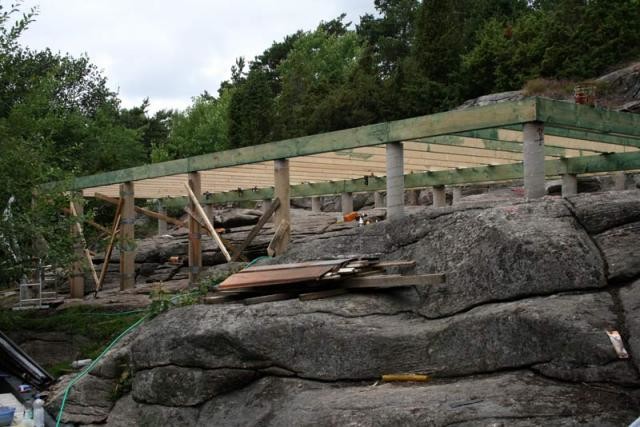
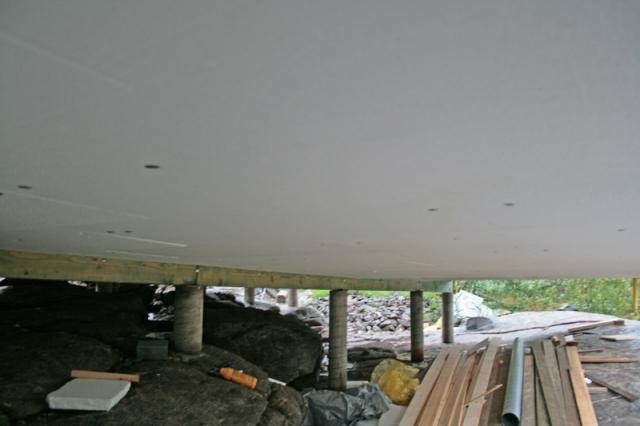
While waiting for the drawings, I can upload some pictures here to illustrate just this.
Image 1 is, as seen, the joist on plinths. (I would like to make you aware of the 3-meter post on the far left...it was a bit tricky)
Image 2: Double layers of interlocking cellplast under the joist. 30+50mm.
Image 1 is, as seen, the joist on plinths. (I would like to make you aware of the 3-meter post on the far left...it was a bit tricky
)Image 2: Double layers of interlocking cellplast under the joist. 30+50mm.
Last edited: