If you measure the moisture in the concrete/slab, you might be able to draw some conclusions with a bit of luck.
If the moisture is higher in the concrete closer to the sill and lower closer to the ground, it could mean that it doesn't come from the ground.
Unfortunately, there is an asbestos board (or something similar) in front of the concrete, so I can't access it to measure the moisture except from above. I'll see if I can find an exposed spot to measure on.
Maybe it can be measured with an inductive moisture meter. With one of those, you might be able to measure other parts of the facade in depth. However, I don't know how it handles material transitions...
Sounds a bit strange imo that a cast slab would transport water?? But not my area
Unfortunately, there is an eternit sheet (or something similar) in front of the concrete, so I can't measure the moisture in it except from above. I'll see if I can find an exposed spot to measure.
Break it apart. It is relatively brittle. A few blows with a hammer and the matter is taken care of.
Maybe it can be measured with an inductive moisture meter. With one of those, you might be able to measure other parts of the facade in depth. However, I don't know how it handles material transitions…
Sounds a bit strange imo that a poured slab would transport water?? But not my area
Thanks for the tip about the inductive moisture meter. I'll check it out!
Don't completely agree with that. The dew point in late summer and autumn can be up to 15 C. Cold nights can cause the inside of the wall to become colder than that, and the relative humidity is often high at this time of year.
And because there is no air gap, the moisture can't dry out properly.
Yes, it might be unwise to rule out any possible, even if less likely, cause before the problem is pinpointed.
From what has emerged, the construction has been the same for 40 years without problems.
However, it is a construction that lacks an air gap and earth against the foundation.
The only thing that has changed is ventilation through mechanical exhaust.
I suspect water intrusion from outside, but do not rule out other sources.
This looks like pressure-treated wood. Could it be that it has gotten wet due to weather events (driving rain with unusual wind direction) and that's what's causing the mold smell?
The construction is otherwise in good condition considering its age. If it had absorbed water since the 80s, the wood in the wall would have been completely rotten and the mold would look like a French cheese. That is, even if there is moisture now, it seems to be an unusual and temporary event based on the wall's lifespan.
1) General error that there is no sill insulation below.
2) This is how it looks at the bottom edge of a wooden facade. No surprises. Wooden facades are not waterproof, and in driving rain and ground splatter, water penetrates behind the cladding. This water then drains downward due to gravity. Consequently, it is at the bottom edge of a facade that moisture problems manifest themselves - always.
3) Ventilation of a wooden facade is only necessary if it is painted with a dense paint. If it is painted with distemper, the moisture dries outward. Additionally, panel boards are never so straight and flat that there are not plenty of air gaps mostly everywhere.
However, a battens/spacer with properly chamfered edges at the top and bottom so that the water penetrating behind the facade is directed outward and keeps the fiberboard as dry as possible should reduce/delay moisture problems against the sill caused by rainwater.
Whether the moisture in the sill in this case is due to the lack of sill insulation and the moisture migration of the concrete slab, or mainly from penetrating rainwater, is difficult to say. Moisture migration is not digital but analog, meaning it can lie anywhere between 0-100 on a scale. The stronger the moisture migration, the faster the sill becomes damaged by rot.
However, it seems reasonable that the odor indoors comes from the sill and/or the floor. It may also be that the rainstorm earlier in the summer has driven in moisture that generated mold on and behind the sill (=under the floor at the outer edge).
A preliminary investigation is to remove the baseboard against this wall and inspect as well as possible. Further investigation will damage the floor. It is, of course, appropriate to try to ensure it is not due to something else first. However, a mold smell indoors is usually associated with moisture in sills and floors (slab on grade, and especially uninsulated slab on grade).
This looks like pressure-treated wood. Could it be that it has gotten wet due to weather events (driving rain with an unusual wind direction) and it's this that smells of mold?
[image]
The construction is otherwise in good condition considering its age. If it had absorbed water since the '80s, the wood in the wall would have been completely rotten, and the mold would look like a French cheese. That is, even if there is moisture now, it seems to be an unusual and temporary event considering the wall's lifespan.
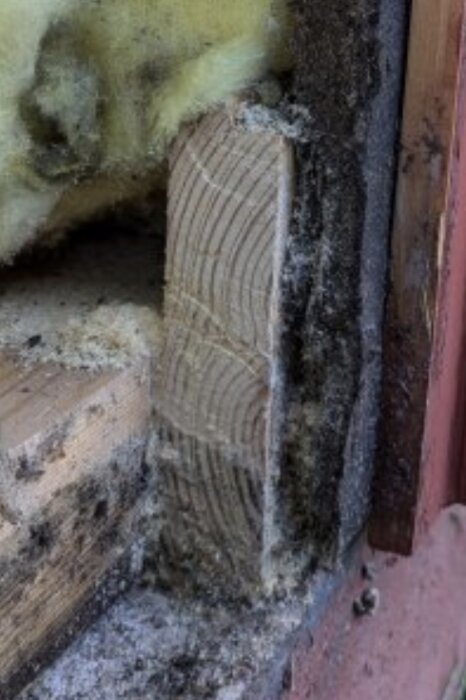
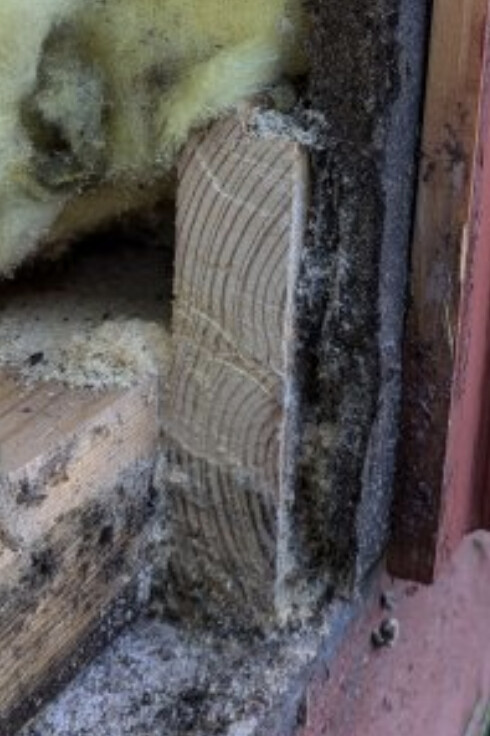
No, it's not pressure-treated wood. I removed a piece and checked. It's entirely possible that it got wet due to a weather event, but then shouldn't it dry out if there's dry weather for a few days? Could it be weather changes with heavier rain that have caused problems to arise now? That the facade works well as long as there isn't a 100-year rain every year?
Oldboy said:
1) Major error that there is no sill insulation underneath.
2) This is what happens at the lower edge of a wooden facade. Nothing unusual. Wooden facades are not watertight, and during driving rain and splash from the ground, water penetrates behind the panel. That water then runs down due to gravity. Consequently, it is at the bottom of a facade that moisture problems become apparent - always.
3) Ventilation of a wooden facade is only needed if it's painted with a dense paint. If it's painted with Falu paint, the moisture dries outwards. Moreover, panel boards are never so straight and flat that there aren't plenty of air gaps almost everywhere.
However, a nail batten/spacer with properly beveled edges at the top and bottom so that the water entering behind the facade is directed outwards, keeping the fiberboard as dry as possible, should reduce/delay moisture problems against the sill caused by rainwater.
Whether the moisture in the sill in this case is due to the lack of sill insulation and the concrete slab's moisture migration or mainly from penetrating rainwater is hard to say. Moisture migration is not digital but analog, meaning it can be anywhere between 0-100 on a scale. The stronger the moisture migration, the faster the sill becomes rot-damaged.
However, it seems reasonable that the indoor odor comes from the sill and/or the floor. It could also be that the rainstorm earlier this summer drove in moisture that generated mold on and behind the sill (=under the floor at the outer edge).
An initial investigation would be to remove the baseboard against this wall and investigate as best as possible. If going further, it involves destructive work on the floor. Naturally, it's appropriate to try to ensure it's not due to something else first. However, mold odor indoors is most often associated with moisture in sills and floors (slab on grade, and especially uninsulated slab on grade).
I accept that the actual panel boards get wet at the bottom, but should the construction behind also be, even several days after the last rain?
I understand that the panel boards themselves get wet at the bottom, but should the construction behind them also be wet, even several days after the last rain?
There should be an air gap and drainage, which you seem to be missing, and thus it doesn't dry out. However, it's strange that this hasn't been a problem before. I can't quite make sense of it.
I agree that the bottom edges of the panel boards themselves get wet, but should the construction behind also be wet, even several days after the last rain?
Yes, if it can't dry out, and/or if there is also moisture coming from underneath through the slab. Wood dries out towards the surrounding air. Under the sill is the concrete slab. There, the sill cannot dry out. Moreover, if insulation is packed between the sill and the slab, it acts like a sponge. Old asfaboard can also act like a sponge if it gets wet regularly and doesn't have a chance to dry in between. A lack of an air gap against the panel, as well as directions where little or no warming sun can reach, means it takes longer to dry out.
Judging by the picture, the sill and the nailing battens look dark at the bottom. This is exactly how it looks from prolonged moisture exposure (=>moisture damage). This is not caused by a 100-year rain but by constantly too much moisture over many years. Once moisture damage, and thus mold, is established, the mold grows immediately when a little water comes. If it's also warm (summer), it grows rapidly.
Vi vill skicka notiser för ämnen du bevakar och händelser som berör dig.

Ulltand said:



Claes Sörmland said:
This looks like pressure-treated wood. Could it be that it has gotten wet due to weather events (driving rain with an unusual wind direction) and it's this that smells of mold?Oldboy said:
1) Major error that there is no sill insulation underneath.