
5,211 views ·
48 replies
5k views
48 replies
Is this the reason for the mold smell?
Hello,
We have a 1950s house with an extension from the early '80s, which we have lived in for almost 4 years. Wooden house, slab on grade. In recent weeks, we have noticed an increasingly strong smell of mold in the extension. The mold smell is strongest down at the floor by an exterior wall.
Two separate companies have been here trying to find the cause of the smell. They have inspected the roof, walls, floors, ventilation, and conducted thorough moisture measurements but have not been able to find any cause. One company thought it was moisture migration from the slab into the framework and thus mold growth under the floor, the other company found a couple of small holes in the roof metal and suggested there might be mold in the air space in the roof. There is no attic and we have not ripped up the parquet, so none of this is confirmed, just suspicions. I removed the roof metal in question and saw no signs of moisture or mold in the construction underneath. I have also checked the drainage and even though it might be a bit shallow, it seems to divert water well during heavy rain.
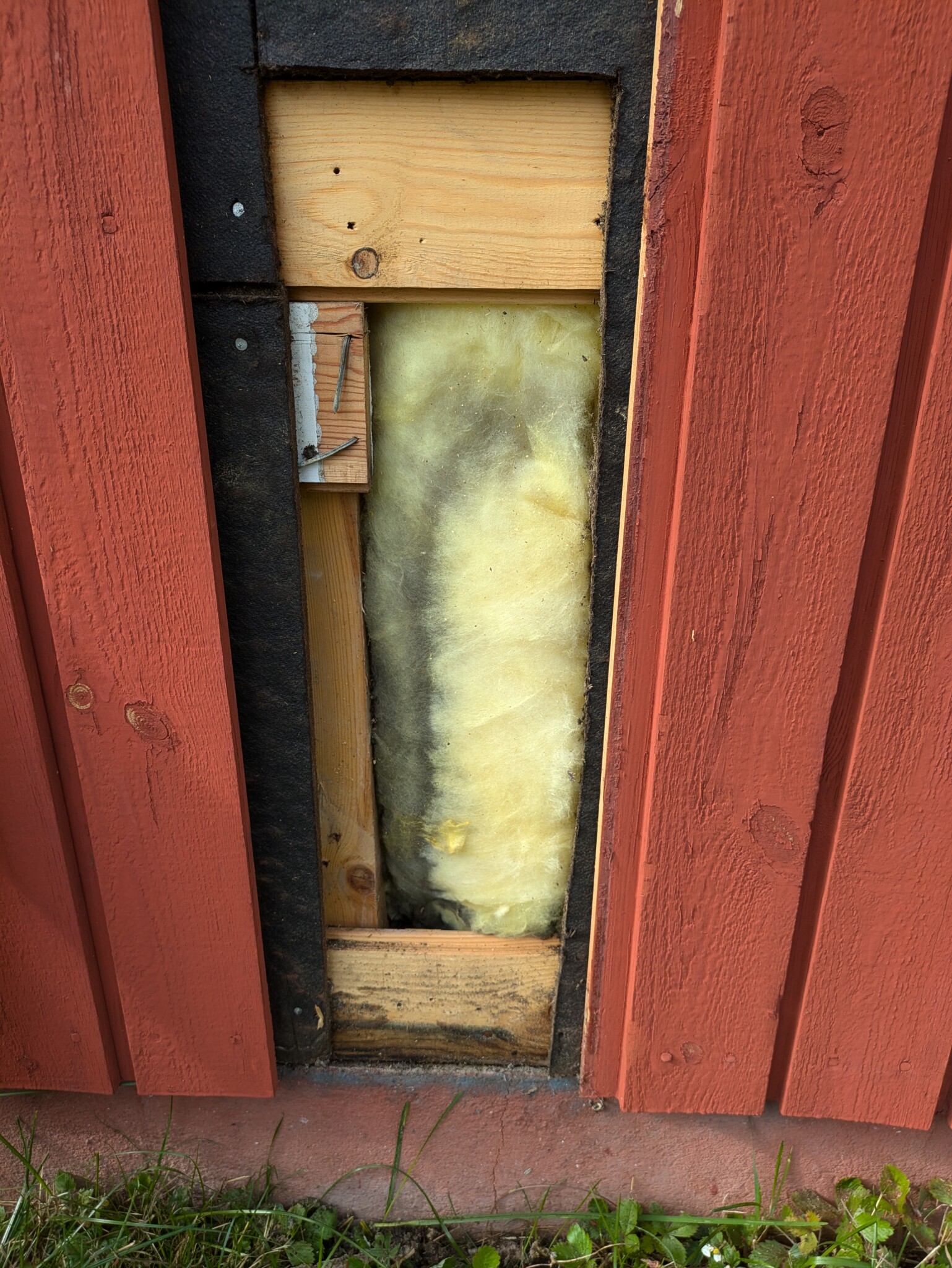
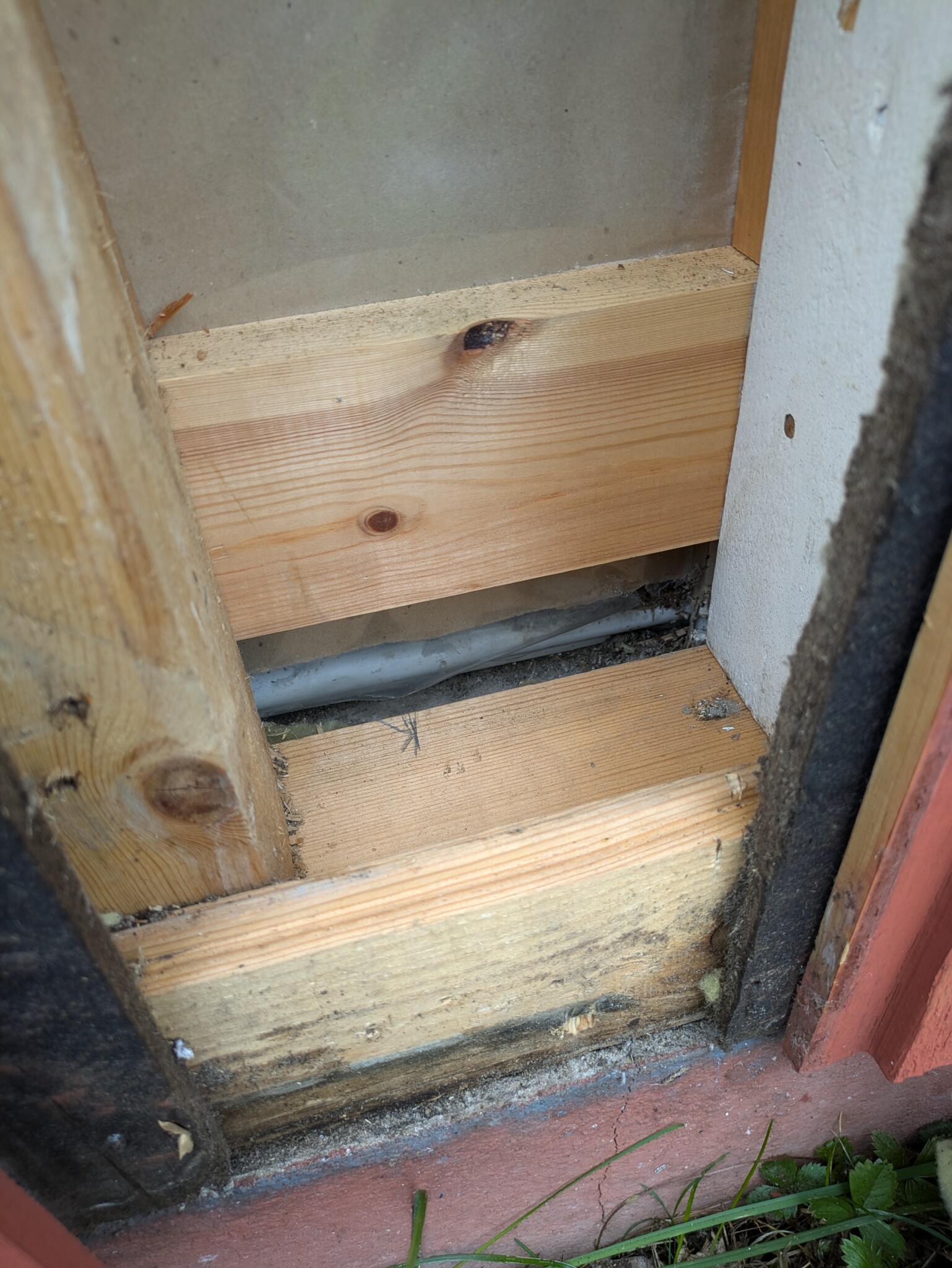
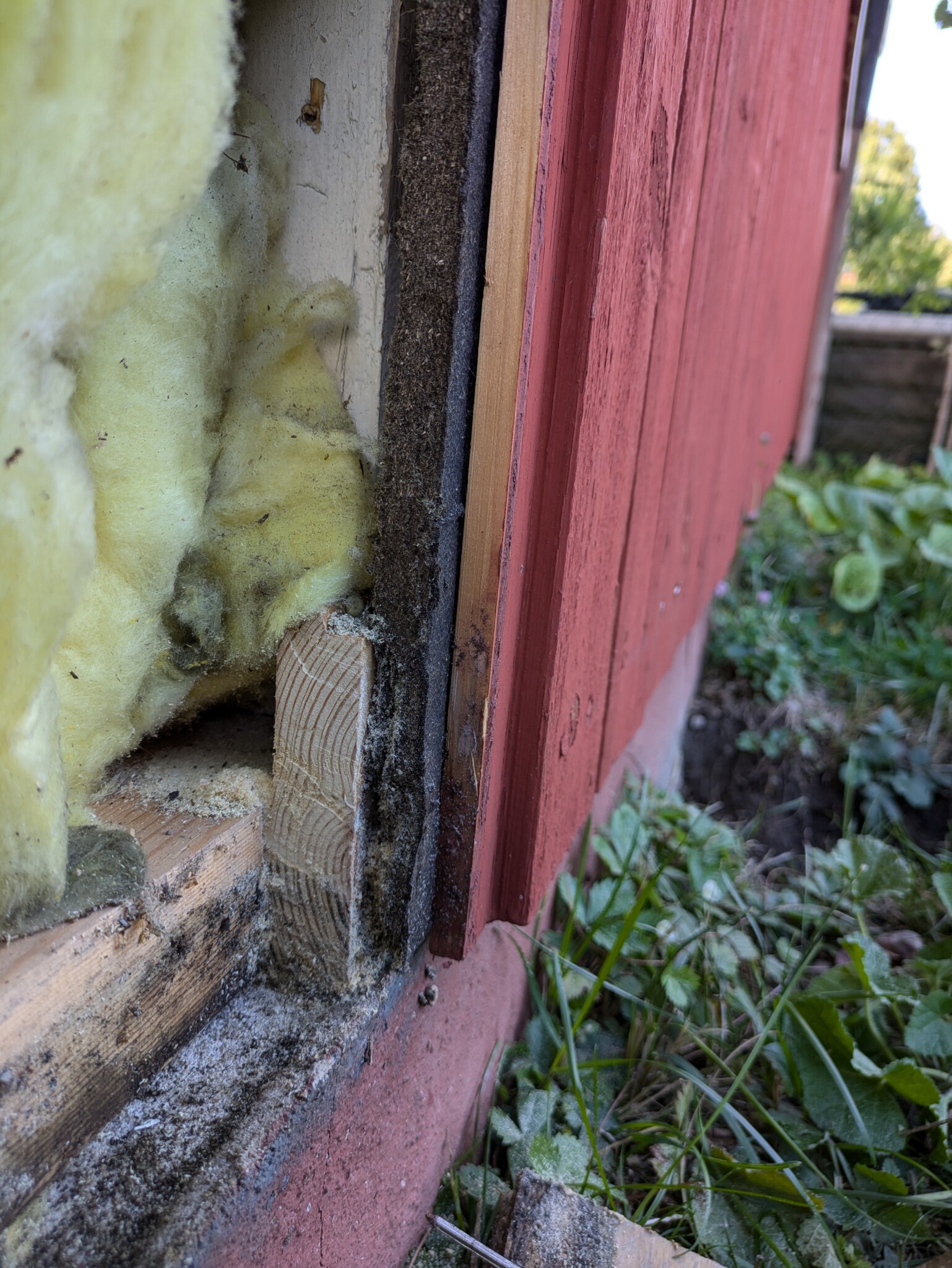
I suggested to both companies that we could remove some siding boards and look behind, but they didn't want to, "you won't see anything there" apparently. I ignored their advice and made a hole myself and found that both the sill and the plank the siding is nailed to at the bottom were quite damp. I didn't smell mold here, but the moisture meter showed high readings and it's visibly and detectably wet. I also cut away a piece of the plank to see the bottom edge of the sill. See pictures:
My observations:
- The sill does not seem to be sitting on any asphalt or rubber but directly on the concrete, with some insulation packed under it.
- The concrete is damp at the edge of the facade but seems drier further in.
- The siding boards and fiberboard are also quite damp at the bottom edge, even though they don't have contact with the concrete.
- The plastic film between insulation and drywall doesn't go all the way down under the floor, so if there's mold in the construction, the smell can certainly find its way into the house.
Questions:
- Does this seem like typical moisture migration from the concrete slab?
- If not, why is it so wet despite no rain for a few days?
- Could this be the cause of the mold smell indoors?
- Do you see any obvious construction errors here?
- How is it that the smell is occurring only now?
Grateful for any help!
We have a 1950s house with an extension from the early '80s, which we have lived in for almost 4 years. Wooden house, slab on grade. In recent weeks, we have noticed an increasingly strong smell of mold in the extension. The mold smell is strongest down at the floor by an exterior wall.
Two separate companies have been here trying to find the cause of the smell. They have inspected the roof, walls, floors, ventilation, and conducted thorough moisture measurements but have not been able to find any cause. One company thought it was moisture migration from the slab into the framework and thus mold growth under the floor, the other company found a couple of small holes in the roof metal and suggested there might be mold in the air space in the roof. There is no attic and we have not ripped up the parquet, so none of this is confirmed, just suspicions. I removed the roof metal in question and saw no signs of moisture or mold in the construction underneath. I have also checked the drainage and even though it might be a bit shallow, it seems to divert water well during heavy rain.
I suggested to both companies that we could remove some siding boards and look behind, but they didn't want to, "you won't see anything there" apparently. I ignored their advice and made a hole myself and found that both the sill and the plank the siding is nailed to at the bottom were quite damp. I didn't smell mold here, but the moisture meter showed high readings and it's visibly and detectably wet. I also cut away a piece of the plank to see the bottom edge of the sill. See pictures:
My observations:
- The sill does not seem to be sitting on any asphalt or rubber but directly on the concrete, with some insulation packed under it.
- The concrete is damp at the edge of the facade but seems drier further in.
- The siding boards and fiberboard are also quite damp at the bottom edge, even though they don't have contact with the concrete.
- The plastic film between insulation and drywall doesn't go all the way down under the floor, so if there's mold in the construction, the smell can certainly find its way into the house.
Questions:
- Does this seem like typical moisture migration from the concrete slab?
- If not, why is it so wet despite no rain for a few days?
- Could this be the cause of the mold smell indoors?
- Do you see any obvious construction errors here?
- How is it that the smell is occurring only now?
Grateful for any help!
Last edited:

No basement and slab directly on the ground, then moisture/water can be absorbed by the slab and continue into the sill. As a result, it may reach a level of moisture where it wants/starts to deteriorate. Depending on whether the sill is made of pressure-treated wood, it smells more. If you stick a knife into the sill/wood, is it soft or solid?
The sill is softer at the bottom than at the top, but not so soft that I can easily insert the knife. Difficult to describe in text, but it doesn't seem entirely rotten.J jonaserik said:No basement and slab directly on the ground, then moisture/water can be absorbed by the slab and continue into the sill. As a result, it assumes a level of moisture that it may start to deteriorate. Depending on whether the sill is treated wood, it may smell more. If you insert a knife into the sill/wood, is it soft or firm?

Yes, that's not the right type of material against the foundation, it probably should be some kind of gravel instead. I should add that the concrete is not directly exposed to the ground, there's an asbestos cement sheet in between, which might be a little hard to see in the pictures.S sblixten said:
You must find the source, it could be a leak from the roof/wall as well.V Vemsomhelst2 said:
I opened the sheets that the inspection company suspected. I can open the others as well, of course. The roof drainage runs elsewhere into pipes in the ground, no risk of splashing there either.Jonatan79 said:
Do you have any tips on how I can find out if the moisture is coming from the slab or from condensation? I suspect it requires different measures.Ulltand said: