
34,486 views ·
31 replies
34k views
31 replies
Is this built correctly?

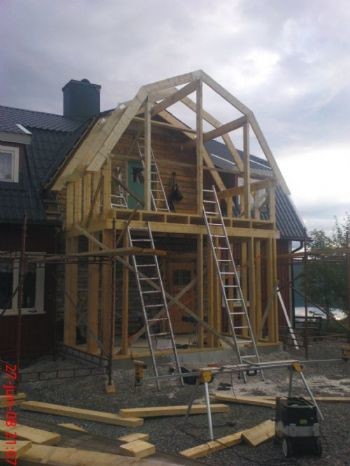
It looks like laminated beams resting on their outer posts and attached to the existing wall of the house. What you need to do is calculate the dimension of these beams needed for the roof weight and snow load. It looks like a fine construction for achieving a good ceiling height in the extension.chrille112 said:
Then I will try to find more info about it! It's hard to see, but I think the beams look quite thin...?

Which drawings?
Besides, isn't the whole point of this forum to be able to ask and exchange information with each other?
Besides, isn't the whole point of this forum to be able to ask and exchange information with each other?
So, mycke_nu, those aren't trusses but a variant of a cathedral ceiling - thus no truss factory involved. Our extension (made by previous owners) is built the same way with a glulam beam at the ridge and the "breaks," but without the raised wall base as they have in the picture. It's important that the beams have proper support at the ends, and what I think looks questionable in the picture is that the post supporting the end of the left beam in the "breaks" rests on the floor without any support directly underneath. I would have placed a post there, all the way down to the foundation.
I wonder if the trickiest part in such a construction - what I would really need a designer's help with - is how to arrange support for the other end of the beams, the end towards the house. Especially the ridge beam will carry quite a large load, and where it meets the original roof, at least a couple of trusses have probably been cut and altered to create an opening for the extension - alterations that need to be much stronger to also support the ridge beam. In our house, they didn't solve that part particularly well. The reinforcements are quite weak, and in return, they placed a post under the inner end of the ridge beam down towards the attic floor. But that post ended up quite far in, and the beam it stood on had a deflection of over 5 cm when we moved in...
I wonder if the trickiest part in such a construction - what I would really need a designer's help with - is how to arrange support for the other end of the beams, the end towards the house. Especially the ridge beam will carry quite a large load, and where it meets the original roof, at least a couple of trusses have probably been cut and altered to create an opening for the extension - alterations that need to be much stronger to also support the ridge beam. In our house, they didn't solve that part particularly well. The reinforcements are quite weak, and in return, they placed a post under the inner end of the ridge beam down towards the attic floor. But that post ended up quite far in, and the beam it stood on had a deflection of over 5 cm when we moved in...
I agree with most of what Farzan writes but would like to add that if you omit the elevated facade, a truss construction is possible and, in my opinion, also better and likely cheaper.
A couple of tips: At the turn of the last century, mansard roofs were common. To achieve a nice shape on the roof, the truss was designed within a semicircle. Like this: draw a semicircle where the diameter equals the width of the house plus the eave. This semicircle is divided into six equal parts. Then you get seven points on it. Number the points from left to right. Then draw a straight line between point 1 and 3, between 2 and 4, between 4 and 6, and between 5 and 7. The intersections you get are where the actual roof breaks are.
Mansard roof and broken roof are the same thing. Good to know when looking for info.
A couple of tips: At the turn of the last century, mansard roofs were common. To achieve a nice shape on the roof, the truss was designed within a semicircle. Like this: draw a semicircle where the diameter equals the width of the house plus the eave. This semicircle is divided into six equal parts. Then you get seven points on it. Number the points from left to right. Then draw a straight line between point 1 and 3, between 2 and 4, between 4 and 6, and between 5 and 7. The intersections you get are where the actual roof breaks are.
Mansard roof and broken roof are the same thing. Good to know when looking for info.
Thank you for your tips and suggestions! I have sent a request to the truss factory for this one (see attached image). Since it doesn't have a raised wall line, you lose some space in width because of the sloping wall, but as you point out, it is probably both cheaper and easier.
The idea is that this extension will be connected to the long side of a pitched roof (slope approximately 27 degrees), so I would need to extend the "ridge" 2-3 meters into the existing roof, and then you have the issue with the support inside as Farzan points out.
Do you think this problem is smaller if trusses are used, since the load is distributed in a completely different way?
The idea is that this extension will be connected to the long side of a pitched roof (slope approximately 27 degrees), so I would need to extend the "ridge" 2-3 meters into the existing roof, and then you have the issue with the support inside as Farzan points out.
Do you think this problem is smaller if trusses are used, since the load is distributed in a completely different way?
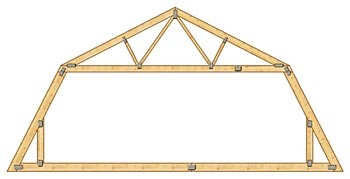
Yes, absolutely - then it's the trusses that bear most of the roof's weight.chrille112 said:
I become a little hesitant when you mention you have a gable roof. I've seen some examples where they have been added in an angle with mansard roofs and don't think it's really aesthetically pleasing. Gable and mansard have such different expressions that it creates a style clash in a somewhat unfortunate way. Have you considered a gable roof with an elevated wall section instead? Compared to a regular gable roof, it gives approximately the same area gain on the floor as a mansard roof and there are such trusses available for purchase.
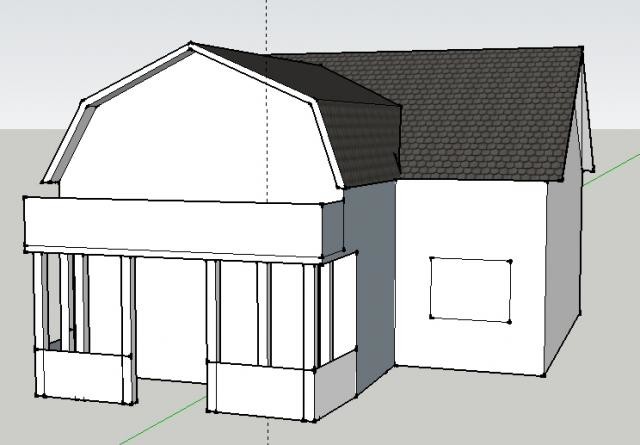
I made this model, I think it looks pretty good  Or what do you mean?
I also made a version with a regular gabled roof earlier, but then it's a bit too much "fågelholk" in my opinion..?
By the way, I just realized when I see the model that since the current roof starts so high up, you have to have an elevated wall height anyway, otherwise the new roof will be much lower than the existing one?
Or what do you mean?I also made a version with a regular gabled roof earlier, but then it's a bit too much "fågelholk" in my opinion..?
By the way, I just realized when I see the model that since the current roof starts so high up, you have to have an elevated wall height anyway, otherwise the new roof will be much lower than the existing one?

hello.
the first image doesn’t look good as the column under the glulam at the ridge isn’t resting on a good support... dangerous.
also, no glulam is needed at the break of the mansard either.
using metal plates on each side is sufficient.
submitting and calculating pointless expenditures.
build the trusses in 2"9" so you don’t have to worry about anything.
best regards,
carpenter estwing
the first image doesn’t look good as the column under the glulam at the ridge isn’t resting on a good support... dangerous.
also, no glulam is needed at the break of the mansard either.
using metal plates on each side is sufficient.
submitting and calculating pointless expenditures.
build the trusses in 2"9" so you don’t have to worry about anything.
best regards,
carpenter estwing
Yes, it's just that part that I think looks strange, as if two completely different houses have been connected. But if you're happy with it, and apparently you're not alone since there are others who have done the same, then go for it!chrille112 said:
Estwing - interesting that there's no need for a beam in the break - with us, there's a beam there, but he had drawn it himself so it was probably belts and braces perhaps. But don't you need a collar beam then, or? Is it stable enough without?
no, for such a small extension it is not needed.
I have a mansard at home here with a ridge beam. in the middle.
but a collar beam is needed if the distance starts to be long and it's a large roof.
we have a collar beam that creates a large imposing attic over our 2 children's rooms... so sure it's good.
but for TS nothing is needed.
regards
estwing
I have a mansard at home here with a ridge beam. in the middle.
but a collar beam is needed if the distance starts to be long and it's a large roof.
we have a collar beam that creates a large imposing attic over our 2 children's rooms... so sure it's good.
but for TS nothing is needed.
regards
estwing
It's probably hard to see in the picture, but the extension is meant to have an "overhang" on the second floor of about 2 meters, which becomes a veranda underneath. In total, I've calculated that the room will be 6 x 5 m.
The door is basically centered on the veranda, so it would be a shame if a post is needed there. Do you have any ideas on how to solve this?
Estwing, do you know how to solve the support against the existing roof?
The door is basically centered on the veranda, so it would be a shame if a post is needed there. Do you have any ideas on how to solve this?
Estwing, do you know how to solve the support against the existing roof?
yup it's simple. the easiest is if the truss was exactly at the center of your glulam*ler*chrille112 said:It might be hard to see in the picture, but the extension is intended to have an "overhang" on the upper floor of about 2 meters, which will be a veranda below. I have calculated that the room will be 6 x 5 m in total.
The door is almost centered on the veranda, so it would be a shame if a post is needed there. Do you have any idea how to solve it?
Estwing, do you know how to manage the support against the existing roof?
you need to transfer the load between 2 trusses. nail together 2 planks of the same dimension as you have in the truss on your existing roof. attach these with joist hangers + you hammer in good nails at the ends too ^_^b. then you lay this glulam on top of it. you won't have a very large weight either since your trusses rest against each other at the ridge. you place nail plates on each side there...
hope my explanation made some sense?
then the support I mentioned for the pillar on the gable that holds your glulam, yes you need a floor joist under it, not just place it right on the sill if you understand? then you still have a floor beam distributing the load over your other posts so that's good. regards estwing
Last edited: