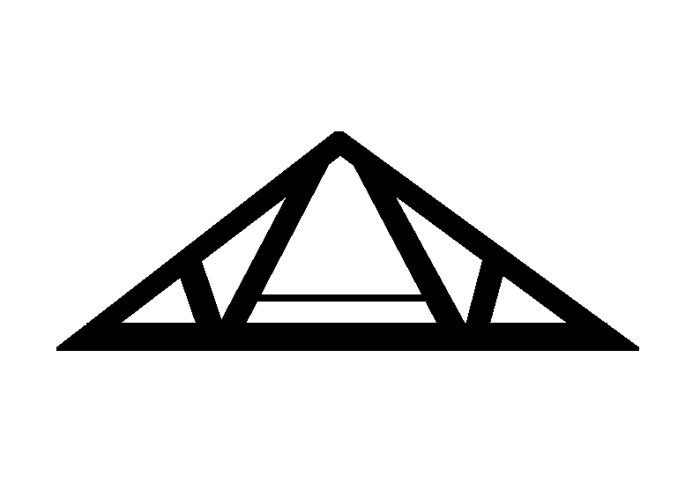
Does anyone know if this is a self-supporting truss? We want to enlarge a door from about 120 cm to 240 cm but don't know if we can do it without putting up some kind of beam.
The house is 16 m long and there are 15 of these trusses.
It definitely looks like a free-standing truss. Is there an attic space on top? What is the span and roof pitch? How old is the house? A floor plan would also facilitate the assessment.
There is no attic space. I haven't measured the span and I have no idea about the pitch. The house was built in -91. Where the lines are, we plan to open up.
In the drawing, it seems like the center wall has some load-bearing function. It is drawn slightly thicker than the other walls, and it runs continuously from gable to gable. But based on how you have drawn and described the truss, I don't understand why one would need a load-bearing wall. The span of 8.4 m internally is no problem to manage with a self-supporting framework, regardless of roof pitch and snow zone. Do you have a sectional drawing?
The opening that you already have, does it go all the way up to the ceiling? If not, you can check if there is a reinforcement there and if so, you can replace it with a longer one.
I would believe that you can certainly open it up as you want, since the truss you drew is self-supporting and rests on the top plate.
But to be sure, open up the wall and reveal the stud you need to cut away, then cut into it and if the saw pinches while you are cutting, you must insert a new one or support it with a "horizontal" above the opening.
We recently replaced old telephone poles that were supporting a balcony, we propped up and cut and "lifted" if it pinched, and it went smoothly though a bit tricky.
Same principle, just a bit larger
See image:
if the wall is thicker than the other walls in the house, it is likely load-bearing!
There should probably be some form of construction drawings of the house and the trusses, where it is likely indicated if you need to offset in the doorway. Otherwise, you might have to go up to the attic and measure the truss and check how it is joined to get a reliable answer.
Note! cutting and checking if it pinches is not a good way to determine if structural parts are load-bearing! It might work, but it can also become exciting when winter comes with lots of heavy snow!
Make it easy for yourself. Don't take chances. Buy a sturdy glulam on blocket and place it on the rafters, hang the lower parts in this. Then you can also open all the way up to the ceiling if desired.
Make it easy for yourself. Don't take chances. Buy a sturdy laminated timber from Blocket and place it on the rafters, hang the lower parts on this. Then you can also open all the way up to the roof if desired.
if the wall is thicker than the other walls in the house, it is likely load-bearing!
There should probably be some form of construction drawings for the house and trusses, where it is likely stated if you need to accommodate in the doorway. Otherwise, you might have to go up in the attic and measure the truss and see how it is joined to get a clear answer.
Note! cutting and checking if it pinches is not a good way to check if building parts are load-bearing! It might work but can also become interesting when winter comes with lots of heavy snow!
It looks on the drawing that the wall is thicker, but the wall that is for example between the hallway and the kitchen is just as thick. About 125 mm.
If the truss is self-supporting, then why should there be a load-bearing wall? It doesn't seem to add up. I'm going to tear down the wall this weekend and check it out. If it looks like it's load-bearing, I'll have to go for a glulam beam or an I-beam.
A square tube should also work instead of an I-beam.
Last edited:
Click here to reply
Vi vill skicka notiser för ämnen du bevakar och händelser som berör dig.