
3,620 views ·
12 replies
4k views
12 replies
Is there a vapor barrier missing in the storage ceiling?
I have converted my carport into a garage, and it is connected to the house and a storage room. Everything shares the same roof. In the whole house, they have correctly installed a vapor barrier and then loose-fill insulation.
In the storage room, they skipped this and also skipped wind deflectors.
I have just installed all the wind deflectors in the garage and storage room. How do I handle the vapor barrier? In the garage, I haven't installed the ceiling yet, so it's easy to put the vapor barrier there. But in the storage room, there's already drywall up. Can I place the vapor barrier on top of the battens and studs, or does that defeat the purpose?
Thanks!
In the storage room, they skipped this and also skipped wind deflectors.
I have just installed all the wind deflectors in the garage and storage room. How do I handle the vapor barrier? In the garage, I haven't installed the ceiling yet, so it's easy to put the vapor barrier there. But in the storage room, there's already drywall up. Can I place the vapor barrier on top of the battens and studs, or does that defeat the purpose?
Thanks!

Self-builder
· Stockholm
· 8 592 posts
Vapor barrier is needed if it is "always" warmer inside than outside. Otherwise, you risk getting condensation on the inside of the plastic. So in spaces that are not heated year-round, it's probably better to skip the plastic.
The plan is to have the garage and storage heated to around 15 degrees year-round. The storage has not been heated before but is insulated.
The garage and storage are connected.
Should I not have a vapor barrier at all then?
Going crazy with this. Trying to read up on what has been previously posted here in the forum, and half advocate for a vapor barrier and the other half not.
Anyone else have any input here?
From what I understand, some type of plastic is required when using loose-fill insulation for the ceiling?
What about the walls? Should there be a vapor barrier before the particleboard + drywall?
Currently, the outer walls are constructed with paneling - battens - wind protection fabric - studs + insulation (145mm). Should I have a vapor barrier here?
And regarding the wall to the main house the garage is attached to, should there be some type of barrier here? Currently, there is wind protection fabric because this was previously an exterior wall.
Anyone else have any input here?
From what I understand, some type of plastic is required when using loose-fill insulation for the ceiling?
What about the walls? Should there be a vapor barrier before the particleboard + drywall?
Currently, the outer walls are constructed with paneling - battens - wind protection fabric - studs + insulation (145mm). Should I have a vapor barrier here?
And regarding the wall to the main house the garage is attached to, should there be some type of barrier here? Currently, there is wind protection fabric because this was previously an exterior wall.
You can install a vapor barrier on walls and ceilings if you plan to have the space heated, but then it should always be heated going forward.
The wall against the main building should not have a vapor barrier. The plastic must be sealed and the seams taped.
The wall against the main building should not have a vapor barrier. The plastic must be sealed and the seams taped.
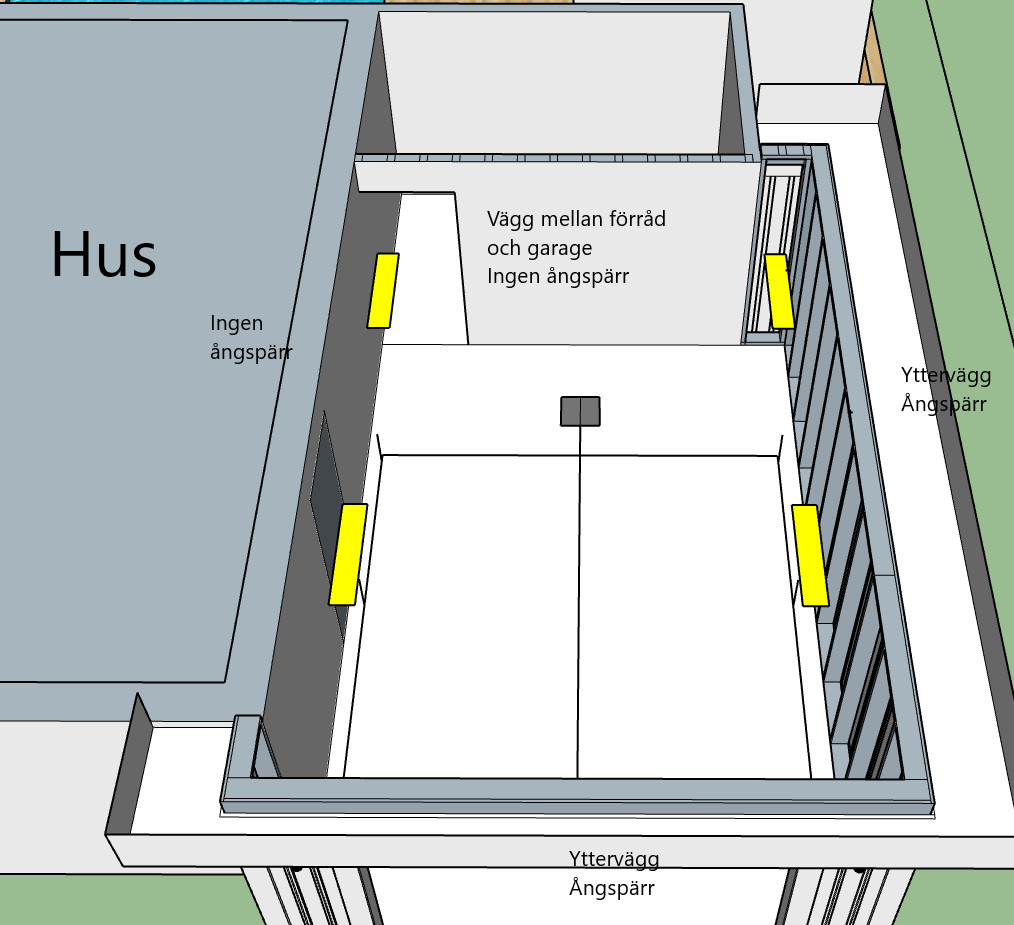
Thank you, just to clarify, vapor barrier on exterior walls and ceiling.Larsa said:
As this picture shows:
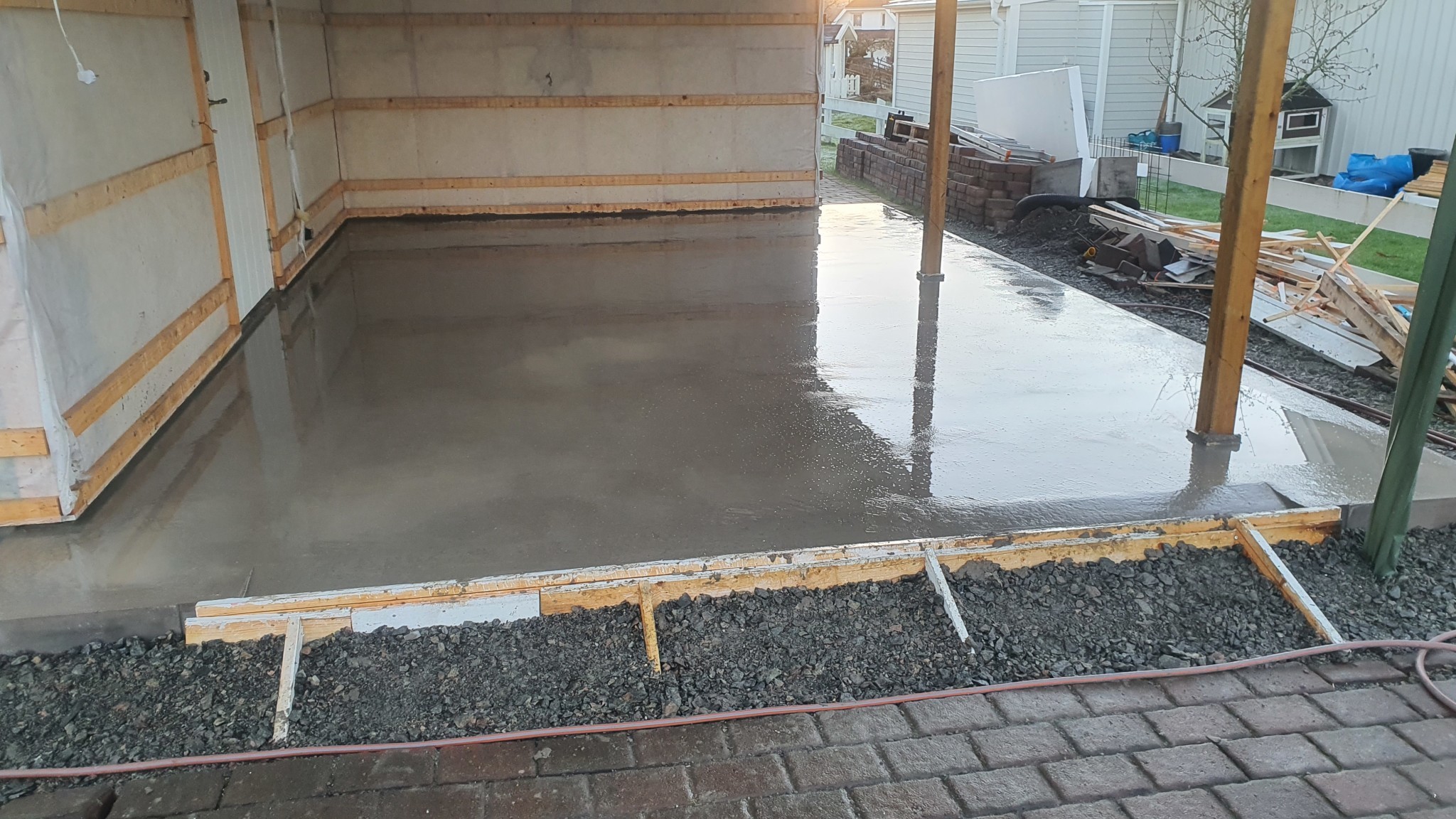
Is there any benefit in keeping the windproof fabric that sits against the house and the storage (refer to this old picture that shows this):
Regarding the ceiling in the storage (same attic space as the garage), there is no vapor barrier there now, loose-fill insulation will also be added. Can I place a vapor barrier between the rafters from above without needing to take down the ceiling?
Your picture looks correct. Vapor barrier in the walls of the storage as well, I assume?
In theory, adding a vapor barrier in the attic should work, but I assume you would need to enclose the studs and have a sufficient amount of insulation on top. The challenge would be sealing between the walls and the attic.
A vapor barrier can be placed 1/3 into the insulation from the inside. It's often convenient to put a 45mm stud on the barrier for electrical wiring, then add 45mm of insulation.
In theory, adding a vapor barrier in the attic should work, but I assume you would need to enclose the studs and have a sufficient amount of insulation on top. The challenge would be sealing between the walls and the attic.
A vapor barrier can be placed 1/3 into the insulation from the inside. It's often convenient to put a 45mm stud on the barrier for electrical wiring, then add 45mm of insulation.
I assume there's a vapor barrier in the storage room walls; it was there before the garage was built, as seen in the second picture. I'm connecting it with the newly built garage and planning to make an opening between the two.Your image looks correct. Vapor barrier in the storage room walls too, I assume?
Putting a vapor barrier in the attic should theoretically work, but then I assume you’re covering the studs and have adequate insulation on top. The problem would be sealing between the wall and the attic.
The vapor barrier can be 1/3 into the insulation from the inside. Often, it's convenient to place a 45mm stud on the barrier for wiring, then fill in with 45mm insulation
Yes exactly, it would mean covering the studs in such a case. As you say, it’s a bit tricky where the wall meets the roof. But maybe it’s better than nothing? Or should one use a diffusion-open membrane just to keep the loose-fill insulation in place?
This seems to be used in ISOVER's instructional video when they install the steam brake from above and fill with loose wool. https://www.isover.se/products/isover-varior-xtra-variabel-angbroms
Planning to use ISOVER's loose-fill insulation FyllUpp.
Time to finish this now, and I have looked at the different options. Isover themselves recommend their Isover Xtra steam brake (as seen in the video above).
However, unnecessarily expensive, so I might go for this model:
https://www.byggmax.se/ångbroms-bison-p6303022#1250=53317
Should I also put this in the outer walls instead of the vapor barrier? Because if I use a steam brake in the ceiling, shouldn't I have a vapor barrier in the walls?
Click here to reply