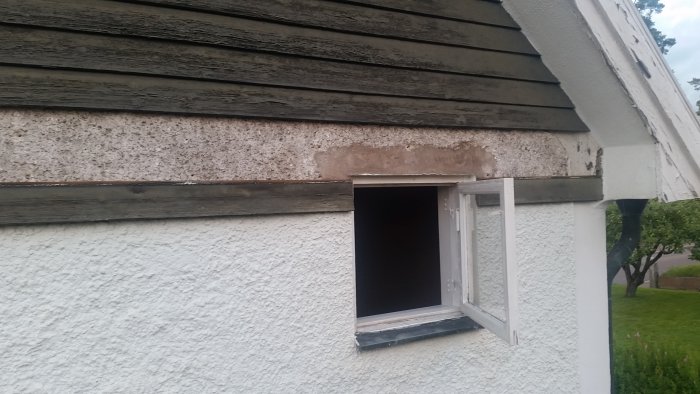
House built in 1922. Render on reed matting on vertical planks. Renovated in the 60s with windows and external panel in gable ends around 65.
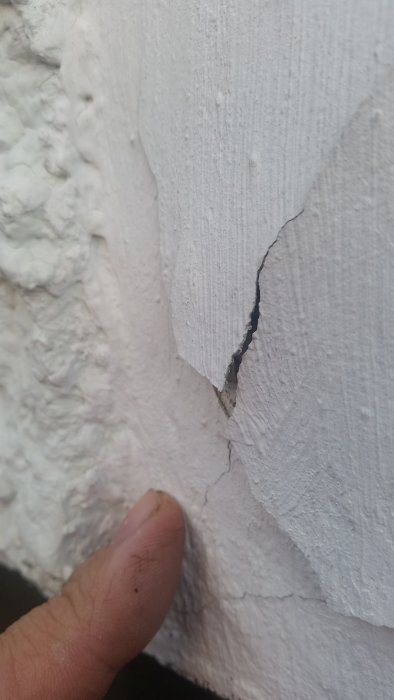
First, an image illustrating the paint's appearance. Overall, the paint is in good condition, but this corner shows the paint's thickness and texture quite well. The paint seems to be about half a millimeter thick and has likely been applied in a fairly thick layer, you can see the brush marks.
It's white and smooth at the corners and coarse stucco with a slight green tone on the rest of the facade. I broke off a piece of the white paint and burned it with a gas torch. It doesn't burn on its own, just a minimal yellow flame at the edge of the paint flake and a little glow. The flake is not completely hard like crispbread, more like hard flatbread so it bends slightly before breaking off. I interpret this as Silicate paint?
The reason I want to repaint is mainly because I want to remove the ugly board facade (keeping the render underneath) but also to paint everything white instead of green. Here's a picture where I've torn off a board, under it you can see render. The render is almost colorless (lime paint that needed repainting, but boards were put over instead?), the render is white inside (lime render?).
What I'm considering now is:
1. Remove all the boards.
2. Paint the render under the boards with a silicate binder.
3. Paint the entire house with white silicate paint. (wash the old paint first).
Would this work? Have I guessed right on the paint? Risks?
Sure, but it doesn't adhere to silicate paint, so if I'm going to use lime paint, the house needs to be re-plastered... Costs about 250,000. I want the same color on what is under the boards and what has already been painted once.
I read about how to analyze the paint on Alcro's page, found a PDF. Just need to get some hydrochloric acid.
I will test it. Just need to buy hydrochloric acid. The house was repainted sometime in the 60s, it's definitely not "real" old-fashioned lime paint, the kind you paint in 6 layers, because it doesn't rub off at all and doesn't absorb water that much, but it might be some modern version with additives, the kind that's applied in 1 layer.