
19,676 views ·
16 replies
20k views
16 replies
Interior wall with steel studs - 45 or 70 mm with OSB and plasterboard?
I have torn down a wall with old built-in wardrobes. I'm planning to frame a whole wall in one room and build a new wardrobe along the entire wall in the adjacent room. I want to use OSB and drywall to make it easier to hang things on the wall.
I plan to use steel studs since it seems simpler for a novice (I've never set up a wall before), but should I use 45mm or 70mm studs? Will 45mm be stable enough if I use both OSB and drywall?
I plan to use steel studs since it seems simpler for a novice (I've never set up a wall before), but should I use 45mm or 70mm studs? Will 45mm be stable enough if I use both OSB and drywall?


...honestly, I think wooden studs are easier.
I would say that all options work.
In the countryside, we built a wall to hang a kitchen on using 45mm wooden studs with glued OSB on the studs and Kalles Kaviar-tube glued plasterboard on the OSB. Plus screws in the usual way, of course. It turns out surprisingly stable and is probably the stiffest option for a 45mm stud.
I would say that all options work.
In the countryside, we built a wall to hang a kitchen on using 45mm wooden studs with glued OSB on the studs and Kalles Kaviar-tube glued plasterboard on the OSB. Plus screws in the usual way, of course. It turns out surprisingly stable and is probably the stiffest option for a 45mm stud.
I've watched some videos and it's clear, everything looks easy when a professional does it. What speaks for steel in my case is that they are completely straight and lightweight, which makes it easier for me to install it myself without help, and the price was almost the same. I'm more comfortable with a drill than a hammer, and I've understood that you're supposed to nail wooden studs, or is that just the old school way?
I gladly welcome more opinions and tips.
I gladly welcome more opinions and tips.
I would have built with 45x45 wooden studs, OSB + plasterboard on both sides and screwed everything. It will be as sturdy as can be. Just make sure not to buy studs that look like bows and it will work out. The wooden studs are not heavy, OSB and plasterboard considerably heavier.
Got a tip to use a steel track for the sill plate and top plate, and then wooden studs. Convenient because I can screw easily and the studs don't need to be cut precisely. It sounds like a good solution for me.
OSB and drywall should not join at the same place, check! Thanks for that tip.
When you mud the drywall joints later, should you use a tape first that you tape into the joint, or how does it work?
OSB and drywall should not join at the same place, check! Thanks for that tip.
When you mud the drywall joints later, should you use a tape first that you tape into the joint, or how does it work?
Exactly as I was thinking, I will use 1200mm OSB and plasterboard on CC60, the first plasterboard I will split and place the joint towards the corner so I get the beveled edge in the middle of the wall, so to speak, so there will be a joint on the first and last board.
Correct?
Correct?
Encountered a small problem when I looked closer today. I have a flue for the chimney that comes up between the rooms. Previously, there was very flimsy wood around it and an air gap against the flue. 45*45 works with a narrower casing around the door, 45*70 becomes too large.
Will the wall be stable enough with 45*45 and OSB + gypsum overlapping, or do I need to find another solution?
One thought was to use 45*45 only around the flue but it will be a bit trickier.
Will the wall be stable enough with 45*45 and OSB + gypsum overlapping, or do I need to find another solution?
One thought was to use 45*45 only around the flue but it will be a bit trickier.
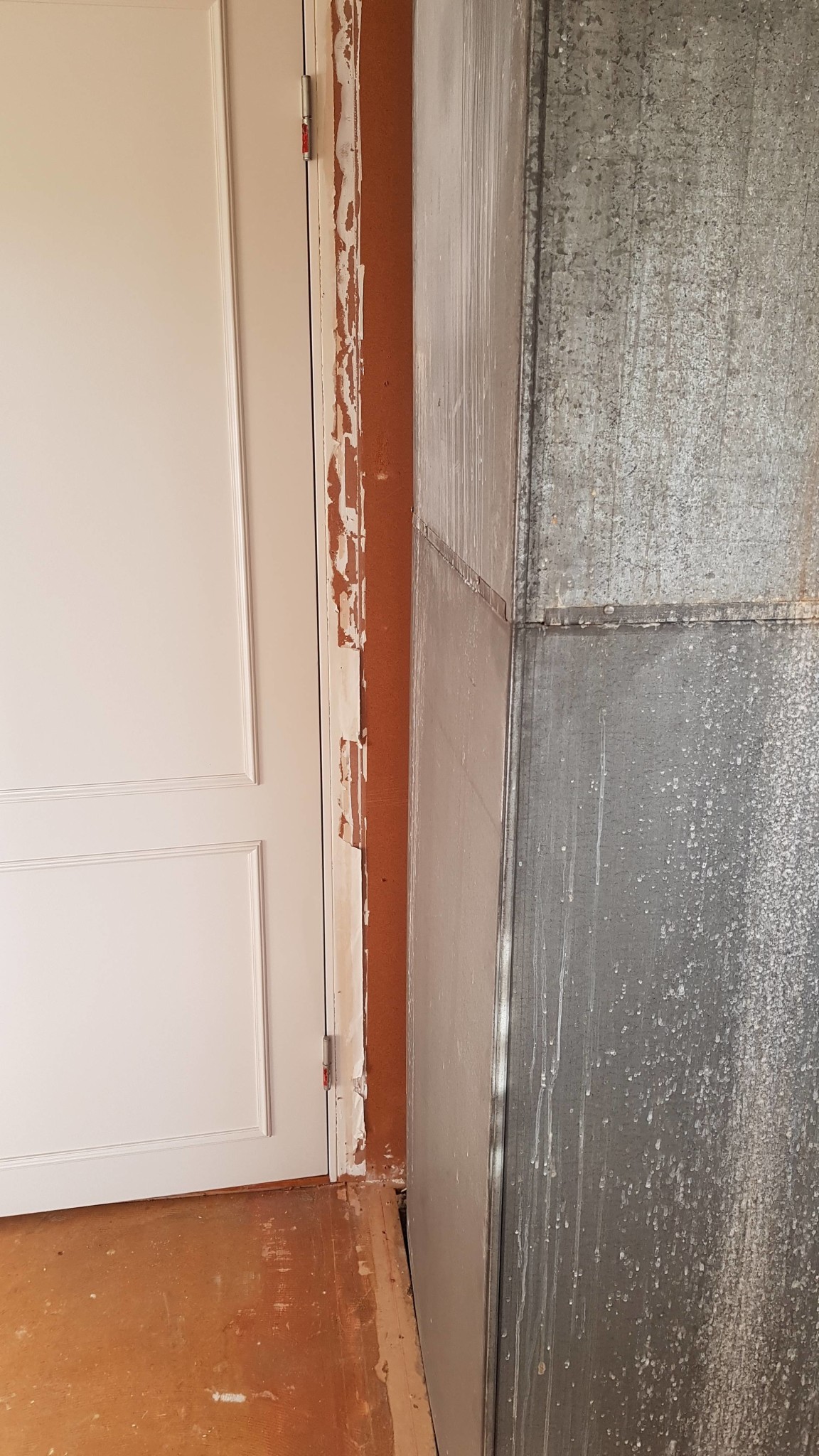
Regarding stability, it's a wall in a bedroom/living room - not a wall in a stable or a gym where balls are played against the wall. It should be able to withstand someone leaning against it and be able to support a shelf - not for someone to run full speed and throw themselves into it
Furthermore, it's a sandwich construction with screwed OSB and drywall on either side, which stiffens it up properly.
I personally have a platform (250 cm) that I use between two saw horses to walk on when working on the house, and it has a frame of 45x45 studs with a batten in the middle, an 11 mm OSB that is screwed approximately c/c 200 mm. When I stand in the middle of it, it flexes a bit but holds without any problem. At one point, I considered putting an OSB on the underside for durability/stiffness, but it hasn't been necessary.
Using a 45 or 70 mm stud is more about the fact that a 70 mm stud might not bend as much as a 45, but it's a non-issue if you screw sheets onto it relatively quickly after bringing them home from the lumber yard (and you should choose from the shelf so they're straight from the start...) and then to allow more space for (sound) insulation.
Another reason could also be if you have door frames that are 120 mm and not 95 mm.
Furthermore, it's a sandwich construction with screwed OSB and drywall on either side, which stiffens it up properly.
I personally have a platform (250 cm) that I use between two saw horses to walk on when working on the house, and it has a frame of 45x45 studs with a batten in the middle, an 11 mm OSB that is screwed approximately c/c 200 mm. When I stand in the middle of it, it flexes a bit but holds without any problem. At one point, I considered putting an OSB on the underside for durability/stiffness, but it hasn't been necessary.
Using a 45 or 70 mm stud is more about the fact that a 70 mm stud might not bend as much as a 45, but it's a non-issue if you screw sheets onto it relatively quickly after bringing them home from the lumber yard (and you should choose from the shelf so they're straight from the start...) and then to allow more space for (sound) insulation.
Another reason could also be if you have door frames that are 120 mm and not 95 mm.

Know-It-All
· Västra Götaland
· 12 411 posts
Are you going to build the wardrobe with cabinets or rails on the wall? If you build with cabinets, the wall doesn't need to be doubled where the cabinets will stand...
I would have used wood and screws, it's super easy, and wooden studs weigh little too...
I would have used wood and screws, it's super easy, and wooden studs weigh little too...