Hello!
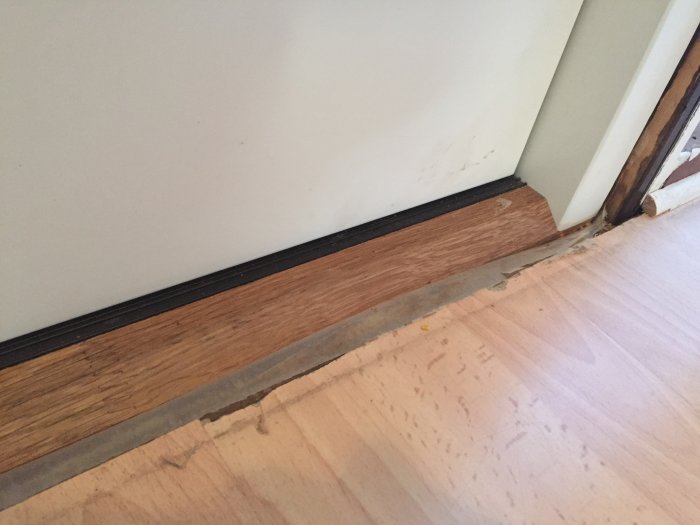
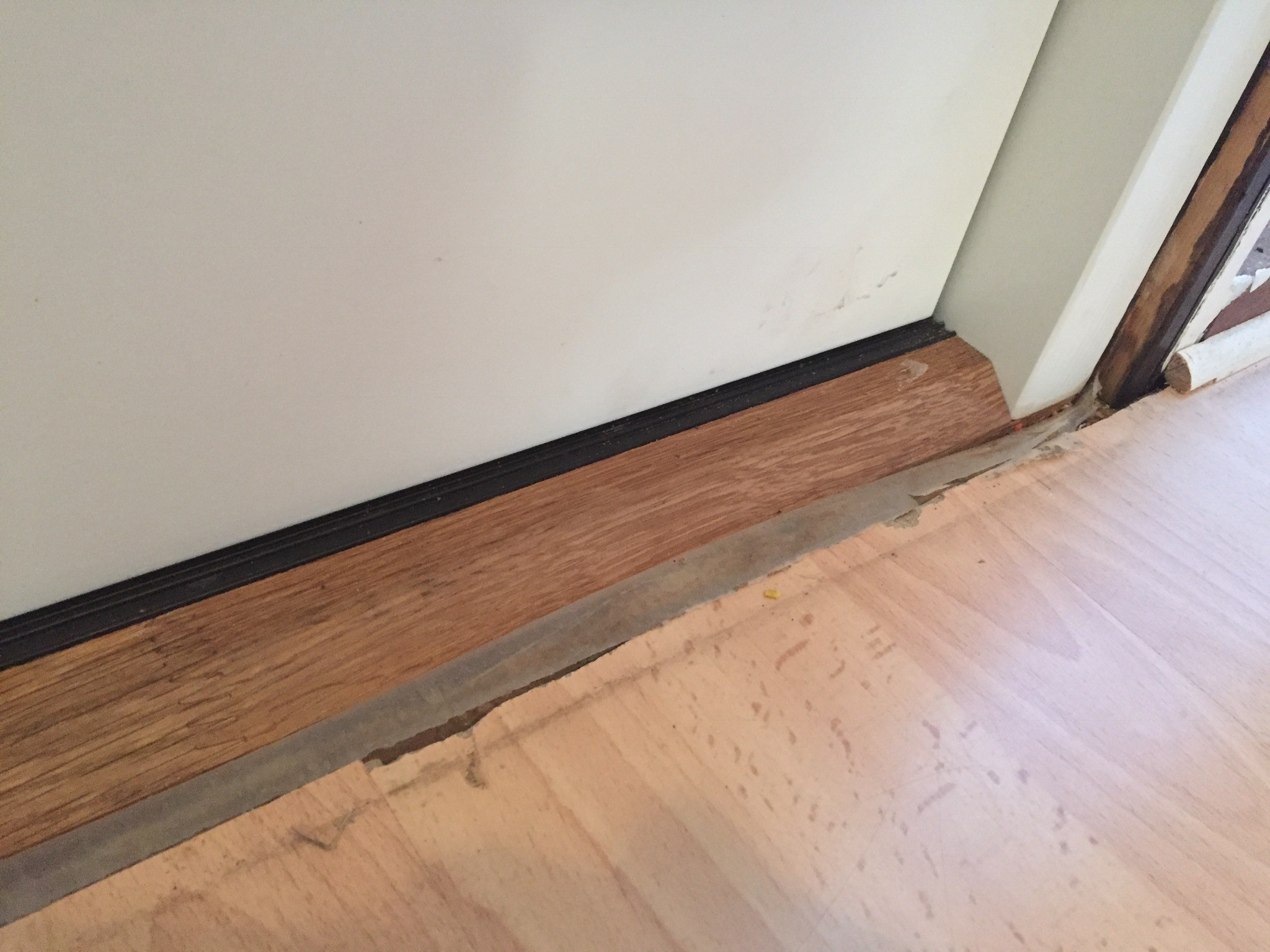
Anyone have an idea how I should place a threshold on the inside of my newly replaced front door? The threshold in the door frame is beveled at 45 degrees down towards the floor, which makes it tricky to place a regular threshold without having a gap between the door frame threshold and the threshold plate. Attached is a picture so you can see how it looks. As you can see in the picture, it's the gap between the cut laminate planks and the door frame threshold that needs to be covered so it becomes tight and neat.
To answer your question, we need to know a little more. Is the threshold in the picture an integrated part of the frame, or can it be removed? What is the height difference between the top of the laminate floor and the bottom of the threshold? What is the black thing lying between the door and the threshold?
The solution is essentially to replace the current threshold with an oak piece that you cut to fit around the frame and covers the ends of the laminate planks. You might need to stack several oak pieces on top of each other if you don't have access to the right machines.
To answer your question, a bit more information is needed. Is the threshold in the picture an integrated part of the frame, or can it be removed? What is the height difference between the top of the laminate floor and the bottom of the threshold? What is the black thing lying between the door and the threshold?
The solution is basically to replace the current threshold with an oak piece that is custom cut around the frame and that goes in and covers the ends of the laminate planks. You might have to stack several oak pieces on top of each other if you don't have access to the right machines.
- yes, the threshold is part of the entire door frame and cannot be removed.
- the height difference between the top edge of the threshold and the top edge of the laminate floor is about 3mm. The height difference between the top edge of the laminate floor and the bottom of the threshold is the same as the thickness of the laminate planks, i.e., 9 mm
- the black thing is a rubber strip that seals the door gap against the door
I should add that I don't have many tools. A circular saw and a jigsaw, so any advanced carpentry is unfortunately out of the question.
If you don't want to saw off the threshold, the only option left is to create a superstructure for it. You can do this by purchasing a piece of planed oak (as thin as possible, at most 15 mm) that is long enough to go past the frames up to the quarter round and wide enough to go from the inside of the door leaf and cover the edges of the laminate boards. Cut it out using a jigsaw. Then glue it together with another oak strip that takes up the height difference between the laminate floor and the existing threshold's top edges. Screw this superstructure to the threshold and treat it with, for example, Osmo hard wax oil. A superb surface treatment available in small cans.
Hello!
Does anyone have an idea on how I should install a threshold on the inside of my newly replaced exterior door? The threshold in the door frame is angled at 45 degrees down towards the floor, which makes it tricky to install a regular threshold without getting a gap between the door frame threshold and the threshold plate. I am attaching a picture so you can see what it looks like. As you can see in the picture, it's the gap between the cut laminate planks and the door frame threshold that needs to be covered so it becomes tight and neat.
[image]
Wouldn't a 90-degree metal angle from the flooring section at any hardware store work? You would need to cut it to the right length and trim it a bit at the edges so it fits precisely without any gaps.
If the threshold had been a little higher at the front edge, it might have worked, but I am doubtful in this case. There's a big risk of getting a sharp edge that one could get caught on. But it might be possible if the metal sheet is angled downwards next to the threshold. It's a bit difficult to assess with just this photo as the basis. In that case, you need to fill the gap between the threshold and the laminate with a piece of wood. Take a more detailed photo and remove the plastic or whatever it is.
I usually put an aluminum strip on that type of threshold.
First, attach the casings so you know how long the strip should be, then you need to hook on both sides so that the strip covers all the way out to the casing.
I also replaced my front door this summer and to avoid this exact problem, I had to move the latch at the top of the hole a bit upward. If "professionals" changed the door, they should have realized this would happen and taken it into account.
I also changed my front door this summer and to avoid this exact problem, I had to move the upper latch in the hole a bit upward. If "professionals" replaced the door, they should have realized this would happen and accounted for it.
Moving the upper mounting latch is probably not always "just" to do, it could cost more than it's worth. Might have to tear apart a lot in both the surface layer and the framework to solve it. I'm probably on the same page as justusandersson, to use a thin oak piece to fix this.
If the threshold had been a bit higher at the front, it might have worked, but I'm doubtful in this case. There's a high risk of getting a sharp edge that could catch onto something. But it might be possible if the sheet metal is angled down next to the threshold. It's a bit hard to judge with just this photo as a reference. In that case, you need to fill the gap between the threshold and the laminate with a wooden piece. Take a more detailed photo and remove the plastic or whatever it is.
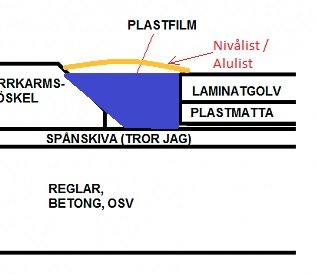
I made an amateurish exploded view to make it easier to see the conditions. Let me know if I should clarify anything.
As you can see in the picture, the edge of the laminate floor is slightly below the edge of the door frame threshold. I measure the level difference to be about 3 mm.
Otherwise, it's not so hard to plane or saw a filler piece,
that fits to place between the slanted threshold and the floor?
What purpose does the filler piece serve, if there's an aluminum strip covering the gap anyway? Do you think it's there to screw the aluminum strip into?
What function does the filler piece serve, if there's still an aluminum strip covering the gap? Do you think it's meant to screw the aluminum strip into?
[image]
No, naturally it should be placed there instead of the aluminum strip. The Al-strip would otherwise be both troublesome, difficult and tricky to install neatly in the right place. And the Al-strips don't typically contribute much to the floor's aesthetic value.
(Based on my own experience. We don't have thresholds, "rollator-adapted", and those five aluminum strips aren't something one enjoys looking at.)
No, naturally it should be placed there instead of the aluminum strip. The Al-strip would be both troublesome, difficult, and risky to attach nicely in the right place. And the Al-strips generally don't contribute to the floor's aesthetic value at all.
(Based on personal experience. We have no thresholds, "walker-adapted," and those five aluminum strips are not something you enjoy seeing)
If you look at TS's first picture, how is it supposed to cover an angular floor that has also spread from sawing? Additionally, you can't place anything rigid against the laminate floor as it needs to be able to move.
Vi vill skicka notiser för ämnen du bevakar och händelser som berör dig.