
30,820 views ·
6 replies
31k views
6 replies
Insulate storage without air gap?
I want to insulate my 15 sqm storage built in 1990 in connection with our house we recently bought. As it looks today, there is paneling, wind paper, and 95 mm framework stacked on top of each other without spacers. The question is how to best insulate the walls when it is obviously not possible to create an air gap? Or maybe it's not that important in simpler constructions like this? Thinking about placing insulation directly into the cavities, taping plastic, OSB, and then plasterboard. And what do you think about the ceiling? Air gap through 25 mm battens, masonite, and then insulation on top of that? The outer roof consists of newly laid Icopal tar paper that is welded and watertight.
For heating, I was thinking of using a heat guard. The only real requirement is that the temperature does not drop below 0 and damage items that cannot withstand freezing temperatures.
Thanks in advance for your opinions!
Andy
For heating, I was thinking of using a heat guard. The only real requirement is that the temperature does not drop below 0 and damage items that cannot withstand freezing temperatures.
Thanks in advance for your opinions!
Andy
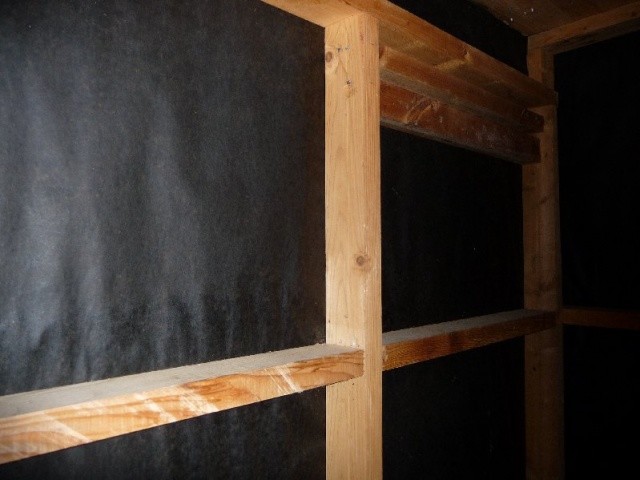


I recall that Paroc recommended 90 mm in the walls of storage buildings, which would fit my framework perfectly. I don't have the exact measurements of the roof beams in my head, but at least 150 mm of insulation should fit there.
The storage is on a concrete slab and it is doubtful if it is insulated with ground board, but considering that my only requirement is to keep above 0, this may not be crucial. We live down in southern Skåne where it normally doesn't get particularly cold in winter.
The storage is on a concrete slab and it is doubtful if it is insulated with ground board, but considering that my only requirement is to keep above 0, this may not be crucial. We live down in southern Skåne where it normally doesn't get particularly cold in winter.
Hey.
Doing it "by the book" as you might consider for a residential building is relatively difficult in this case.
If I were in your shoes, I would decide that no moisture-generating activities will occur in the storage room and that insulation and other constructions are thin, which is favorable for drying.
So, in the ceiling, I would nail 25x32 battens in the corner between the ceiling beam and the roof decking. The battens should be arranged so there is a 25mm air gap against the roof decking.
The battens are nailed (or screwed) sideways into the roof truss so they don't go through the roofing felt.
Then I would cut masonite boards to the width so they fit between the roof trusses.
In the middle of these boards, a piece of batten (or some small pieces) is screwed in so there's no risk of the boards being pressed up against the ceiling when insulating.
Then the boards are screwed up with short screws to the battens in the roof truss-roof decking angle.
The first board closest to the ridge, with some cm overlap for the next board.
The last board is stuck out through a sawn hole in the outer wall.
At least through the wind barrier, but through the outer panel is definitely preferable.
But then you might need to saw a gap of about 30mm at the top of the wall panel.
You cover the hole that then appears with insect netting.
Then you insulate with as much insulation as fits.
If you're going to run electricity in the ceiling, you place 28x70 mm sparse panels at cc30 so electricity can be run there before the inner ceiling is put in place.
Against the outer walls, I would then place 95mm insulation boards against the wind barrier and then inner wall panels.
Skip plastic and paint with the most diffusion-open paint possible (how you find that out, I don't know :O). On the outside, paint like Falu red or any other similar paint would be excellent.
A relatively wide eave would also be good. But you probably can't do anything about either the eave or the paint now.
Finish by placing a moisture meter in the storage room and check the moisture every week during the first year. It should preferably be under 75% rH all the time.
It's not certain that this is the best, but this is what I would do anyway.
Doing it "by the book" as you might consider for a residential building is relatively difficult in this case.
If I were in your shoes, I would decide that no moisture-generating activities will occur in the storage room and that insulation and other constructions are thin, which is favorable for drying.
So, in the ceiling, I would nail 25x32 battens in the corner between the ceiling beam and the roof decking. The battens should be arranged so there is a 25mm air gap against the roof decking.
The battens are nailed (or screwed) sideways into the roof truss so they don't go through the roofing felt.
Then I would cut masonite boards to the width so they fit between the roof trusses.
In the middle of these boards, a piece of batten (or some small pieces) is screwed in so there's no risk of the boards being pressed up against the ceiling when insulating.
Then the boards are screwed up with short screws to the battens in the roof truss-roof decking angle.
The first board closest to the ridge, with some cm overlap for the next board.
The last board is stuck out through a sawn hole in the outer wall.
At least through the wind barrier, but through the outer panel is definitely preferable.
But then you might need to saw a gap of about 30mm at the top of the wall panel.
You cover the hole that then appears with insect netting.
Then you insulate with as much insulation as fits.
If you're going to run electricity in the ceiling, you place 28x70 mm sparse panels at cc30 so electricity can be run there before the inner ceiling is put in place.
Against the outer walls, I would then place 95mm insulation boards against the wind barrier and then inner wall panels.
Skip plastic and paint with the most diffusion-open paint possible (how you find that out, I don't know :O). On the outside, paint like Falu red or any other similar paint would be excellent.
A relatively wide eave would also be good. But you probably can't do anything about either the eave or the paint now.
Finish by placing a moisture meter in the storage room and check the moisture every week during the first year. It should preferably be under 75% rH all the time.
It's not certain that this is the best, but this is what I would do anyway.
Thank you for the detailed feedback and comments!
One problem as I see it is that I will be storing wet surf and kite gear during the warmer part of the year, which means that moisture will be generated from within. I'm not sure if the option of cutting an inlet gap at the top of the panel is practically feasible. However, I am considering installing openable vents in the walls (there is already a vent in one wall) that can be used to create cross ventilation and thereby remove moisture.
One problem as I see it is that I will be storing wet surf and kite gear during the warmer part of the year, which means that moisture will be generated from within. I'm not sure if the option of cutting an inlet gap at the top of the panel is practically feasible. However, I am considering installing openable vents in the walls (there is already a vent in one wall) that can be used to create cross ventilation and thereby remove moisture.
Yes, under those circumstances you need to ensure that the surf gear can dry well and quickly.
In addition to vents, you can of course complement with a PAX fan (or equivalent from another manufacturer).
There are also nice variants with humidity control, which turn on automatically when needed.
Regarding the air gap in the ceiling, I am worried/concerned about whether it might condense water against the raw wood, as it is diffusively tight upwards.
Where does this water run if you don’t have masonite boards that lead it out under the eaves?
In addition to vents, you can of course complement with a PAX fan (or equivalent from another manufacturer).
There are also nice variants with humidity control, which turn on automatically when needed.
Regarding the air gap in the ceiling, I am worried/concerned about whether it might condense water against the raw wood, as it is diffusively tight upwards.
Where does this water run if you don’t have masonite boards that lead it out under the eaves?
It drains into the insulation. That's probably why you build with an air gap as you described in your previous post.Mikael_L said:
To TS, I would advise either following Mikael_L's construction advice or refraining from insulating or avoiding storing damp items in the space. Your plan to build an insulated space without air gaps in the walls and roof of a building that was originally constructed as a cold storage to then store damp/wet items there isn't particularly good.
Click here to reply