
68,009 views ·
26 replies
68k views
26 replies
How to frame for lowering a ceiling?
Hello,
I'm planning to lower the ceiling by a total of 12 cm to hide ugly wires and take the opportunity to install spotlights (hallway, raw wood ceiling).
I assume that gypsum is best for the ceiling, or would MDF work just as well (also considering that I need to make holes for the spotlights)?
But to the main question, how do I install frames at a depth of 12 cm for the ceiling plate thickness? Let's say I'm using 13 mm gypsum. I then need a 10.7 cm "thick" frame. Aside from it being an odd measurement, how do you frame that deep? Should I first use a frame, say 45 mm, against the existing ceiling (screwed with well-countersunk screws into the ceiling), and then attach another framework of about 70 mm to this? Or should angle brackets be used to attach the frames to the ceiling?
Best regards,
Alko
I'm planning to lower the ceiling by a total of 12 cm to hide ugly wires and take the opportunity to install spotlights (hallway, raw wood ceiling).
I assume that gypsum is best for the ceiling, or would MDF work just as well (also considering that I need to make holes for the spotlights)?
But to the main question, how do I install frames at a depth of 12 cm for the ceiling plate thickness? Let's say I'm using 13 mm gypsum. I then need a 10.7 cm "thick" frame. Aside from it being an odd measurement, how do you frame that deep? Should I first use a frame, say 45 mm, against the existing ceiling (screwed with well-countersunk screws into the ceiling), and then attach another framework of about 70 mm to this? Or should angle brackets be used to attach the frames to the ceiling?
Best regards,
Alko

I had used steel straps...
Steel straps are a band of steel, with holes along the entire band, which you can use to determine the height with. Simply nail or screw it into the ceiling and then onto something like a 45x45 beam.... the framework should be at max C/C 60, if you're really meticulous, you'll secure it for heavier items and use beams with c/C 30...
With C/C means half the distance of the first free beam from, in this case, the wall... then C/C measurement like 60 or 30...
Steel straps are a band of steel, with holes along the entire band, which you can use to determine the height with. Simply nail or screw it into the ceiling and then onto something like a 45x45 beam.... the framework should be at max C/C 60, if you're really meticulous, you'll secure it for heavier items and use beams with c/C 30...
With C/C means half the distance of the first free beam from, in this case, the wall... then C/C measurement like 60 or 30...
Thank you for the quick response!
But steel band is something you buy on rolls, right? Do you mean that you should screw a piece to the ceiling, and that the joist is attached to the part of the band that hangs down? So the joists will hang down from the ceiling? The thing is, it's a small hall of about 4 m2, so I was thinking of spacing 30 CC.
Best regards/
Alko
But steel band is something you buy on rolls, right? Do you mean that you should screw a piece to the ceiling, and that the joist is attached to the part of the band that hangs down? So the joists will hang down from the ceiling? The thing is, it's a small hall of about 4 m2, so I was thinking of spacing 30 CC.
Best regards/
Alko

if you have cc 600 the ceiling will sag, max 400 is recommended by the gypsum manufacturers,Milkshaken said:
I would have used 70 metal studs and secondary and primary profiles and steel bands if it is a large room
if you use wooden studs there is a chance they will warp or that they are already twisted so you have problems mounting the gypsum, attached is a picture of how you frame with metal studs etc.
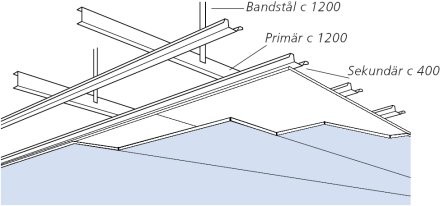
Thanks for that picture, really clear!
Metal studs seem perfect, considering the risk of the wood warping. The primary and secondary steel stud, are they the same, just that one lies against the existing roof (unless it hangs on band steel, that is), while the other lies against the first studs??
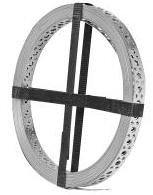
And steel band/band steel - is it like this one (attaching image)?
It will be bent at the attachment to the wall - no risk that it weakens and breaks right there, if the bands must hold all the weight?
Best regards/
Alko
Metal studs seem perfect, considering the risk of the wood warping. The primary and secondary steel stud, are they the same, just that one lies against the existing roof (unless it hangs on band steel, that is), while the other lies against the first studs??
And steel band/band steel - is it like this one (attaching image)?
It will be bent at the attachment to the wall - no risk that it weakens and breaks right there, if the bands must hold all the weight?
Best regards/
Alko

Check out Gyproc's website.
I also believe they have a booklet you can have sent to you.
You have a small hallway.
So just start by putting up the wall tracks first and then stack the secondary studs "hat profiles."
If you're using 90 gypsum on the ceiling, I would have placed 30cc.
Depending on how wide the hallway is at its widest and how you place the studs, you'll need to add the appropriate number of primary studs.
Keep in mind that you might need to go up with the primary studs before screwing all the secondaries.
It can be tricky to push them up if the ceiling is low, as you have.
Screw the secondary into the primary and then attach the primary with steel straps so the ceiling is level.
It might be appropriate to have "pots" in the gypsum ceiling for the spots considering the heat against the old ceiling.
Best regards,
Putte
I also believe they have a booklet you can have sent to you.
You have a small hallway.
So just start by putting up the wall tracks first and then stack the secondary studs "hat profiles."
If you're using 90 gypsum on the ceiling, I would have placed 30cc.
Depending on how wide the hallway is at its widest and how you place the studs, you'll need to add the appropriate number of primary studs.
Keep in mind that you might need to go up with the primary studs before screwing all the secondaries.
It can be tricky to push them up if the ceiling is low, as you have.
Screw the secondary into the primary and then attach the primary with steel straps so the ceiling is level.
It might be appropriate to have "pots" in the gypsum ceiling for the spots considering the heat against the old ceiling.
Best regards,
Putte
Fredrik: Yes, with single plasterboard yes, but it certainly holds with double plasterboard...
Didn't think about the fact that they will probably only use single.
The problem with metal studs is that they are quite difficult to work with I think.
And if the wood is dry, I see no reason not to use convenient wooden studs.
Didn't think about the fact that they will probably only use single.
The problem with metal studs is that they are quite difficult to work with I think.
And if the wood is dry, I see no reason not to use convenient wooden studs.
I have lowered the ceiling in a guest bathroom (1.3 sqm) with metal studs and I will definitely use these in the kitchen as well (19 sqm), I found it incredibly easy to get right, plus I used small "tabs" that you "snap" the secondary and primary with, so you don't have to screw, they cost 7 SEK each and can probably be found cheaper. It was incredibly convenient and you can also move the studs before screwing the plasterboard, which is nice if you're going to have spotlights in the ceiling. I'm also going to lower it by about 12 cm.
60cc in the ceiling has never been seen and never will be either. If the wood is dry, it's always an advantage. But being crooked and twisted is usually more the rule than the exception. Sheet metal forever in the ceiling then  .
.
Best regards, Putte
. Best regards, Putte
sometimes you get lucky
yens said:I lowered the ceiling in a guest toilet (1.3 sqm) with metal studs and I will definitely use these in the kitchen (19 sqm) as well, thought it was incredibly easy to get it right, also used small "clips" that you "snap" primary and secondary with, so you don't have to screw, cost 7 SEK each and can probably be found cheaper. It was extremely convenient, and also you can move the studs before screwing the gypsum board, which is nice if you want spotlights in the ceiling. I'm also lowering it by about 12 cm.
Sounds exactly like what I would want to do. Where did you buy the studs, and the "snap clips"? And as mentioned, do you use the same studs for primary and secondary?
Did you use band steel, and how did you attach it to the ceiling if so??
Best regards/
Alko
The primary rule looks more like a smaller variant of a sheet metal rule. And a bit stiffer. The secondary is usually called a hat profile after its appearance. You use hole strap/patent band, a beloved child has many names. If you have raw boards to screw the band into, I would recommend mounting screws that have a flat and wide head.
Best regards, Putte
Best regards, Putte
I didn't use bandstål, since it was only 1.3 sqm I avoided it. However, I will need it in the kitchen, and since I have a concrete ceiling there, it will simply mean drilling and plugging... I bought everything at Silvan in Lund, maybe a few bucks more than, for example, hornbach, but it was nice to avoid transporting the stuff more than a couple of kilometers...Alko said:
