
5,477 views ·
19 replies
5k views
19 replies
How to best close a basement window?
Hi!
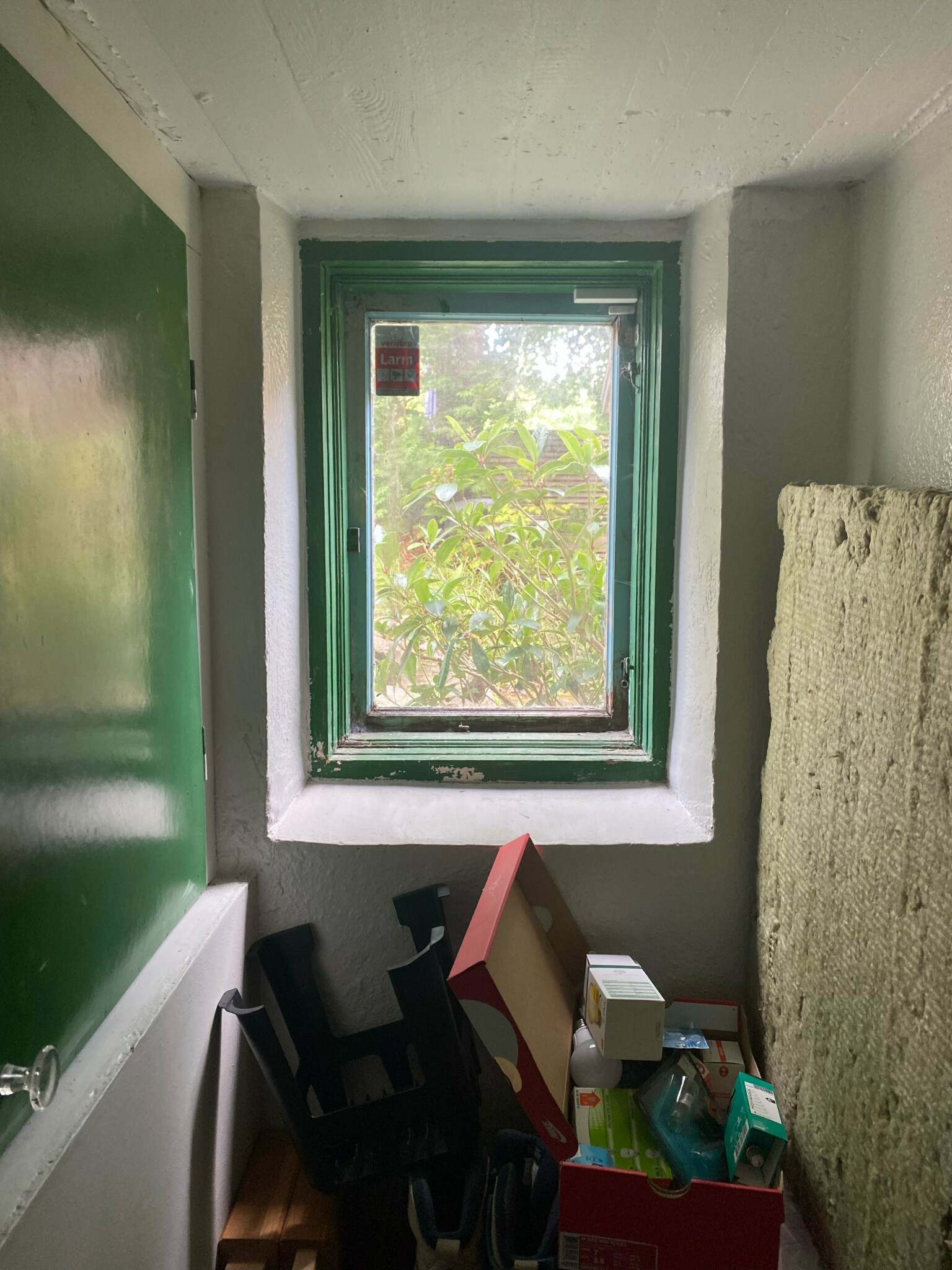
We have a small window in the basement that is broken. It can't be fully closed, so cold air leaks in during winter.
I'm now working on improving the ventilation in the basement and had an idea to kill two birds with one stone.
I'm thinking of sealing the window and then installing a PAX fan with cold draft protection. Hopefully, this way we can get a bit warmer and I won't need to make a new hole in the facade to install the fan.
The question is: how would you do it quickly and smoothly? There have been some moisture problems in the basement, and I want to do it right so I don't create more issues. What do you say about insulation, installation of the ventilation pipe, etc.?
The window is approximately 70*50 cm.
Best regards
We have a small window in the basement that is broken. It can't be fully closed, so cold air leaks in during winter.
I'm now working on improving the ventilation in the basement and had an idea to kill two birds with one stone.
I'm thinking of sealing the window and then installing a PAX fan with cold draft protection. Hopefully, this way we can get a bit warmer and I won't need to make a new hole in the facade to install the fan.
The question is: how would you do it quickly and smoothly? There have been some moisture problems in the basement, and I want to do it right so I don't create more issues. What do you say about insulation, installation of the ventilation pipe, etc.?
The window is approximately 70*50 cm.
Best regards
Plastering on cellular plastic is so-so. In that case, a hard mineral wool board that is netted and thick plastered is preferable.
The wall is so thick (30cm+?) that you can consider building with, for example, 9cm blocks and have a layer of blocks, an empty space in the middle that is insulated, and then another block on the other side. Then it’s easy to apply plaster on both sides. And in that case, you can use cellular plastic if you want.
But I would have repaired or replaced that window. Proper light in a basement is nice. We installed PVC windows in the basement, as the old ones leaked so much heat (were completely worn out).
The wall is so thick (30cm+?) that you can consider building with, for example, 9cm blocks and have a layer of blocks, an empty space in the middle that is insulated, and then another block on the other side. Then it’s easy to apply plaster on both sides. And in that case, you can use cellular plastic if you want.
But I would have repaired or replaced that window. Proper light in a basement is nice. We installed PVC windows in the basement, as the old ones leaked so much heat (were completely worn out).
Yes, that's smart, I was fixated on using wood. Much nicer with plaster indeed.mexitegel said:
To cut lecablock, which tool should be used? Angle grinder?
Thanks for the tips on insulation and plastering.B BSOD said:Plastering on polystyrene is so-so. A hard mineral wool board that is meshed and thick-plastered is preferable.
The wall is so thick (30cm+?) that you might consider building with, for example, 9cm blocks and having one layer of blocks, a hollow space in the middle that is insulated, and then another block on the other side. Then it's easy to get the plaster on both sides. And then you can use polystyrene if you want to.
But that window, I would have repaired or replaced. Real light in a basement is nice. We put in PVC windows just in the basement because the old ones leaked so much heat (were completely worn out).
Regarding a new window or not:
Yes, you might be right about that... maybe it will feel claustrophobic without a window. However, I was tempted by it because I could then install a fan without having to make a new hole in the facade.
Very thick concrete walls as you said, it feels tricky to make a hole in, and besides, I don't know much about how a new hole affects load-bearing capacity? No worries or?
Or reciprocating saw if you have one. https://www.bauhaus.se/tigersagsbla...Kpf2GeKW1wQt8tr-mzU4D68rxX0CJ7fhoC1nQQAvD_BwE
Is it concrete block?
Spontaneously, I find it very hard to believe that you would have load-bearing issues if you install a 100 mm hole, but I'm not a structural engineer.
We have about the same. I have drilled holes for a chimney, culvert, and drain through such a wall. A bit tedious. Either you use a diamond hole saw with the right diameter. These are quite expensive (can maybe be rented?) or you drill in a circle with a smaller concrete drill and knock out the contents with a sledgehammer and finish it off at the end for the right finish.
You can install a slightly smaller window so you have room for a fan beside or above the window if you're going to replace it.
Spontaneously, I find it very hard to believe that you would have load-bearing issues if you install a 100 mm hole, but I'm not a structural engineer.
We have about the same. I have drilled holes for a chimney, culvert, and drain through such a wall. A bit tedious. Either you use a diamond hole saw with the right diameter. These are quite expensive (can maybe be rented?) or you drill in a circle with a smaller concrete drill and knock out the contents with a sledgehammer and finish it off at the end for the right finish.
You can install a slightly smaller window so you have room for a fan beside or above the window if you're going to replace it.
Might want to think twice about whether to close up the window.L longtimelurker said:Thanks for the tips on insulation and plastering.
Regarding whether to have a new window or not:
Yes, you may be right about that... maybe it will feel claustrophobic without a window. However, I was tempted by it since I could then install a fan without having to make a new hole in the facade.
Very thick concrete walls as you said, it feels tricky to make a hole in, and besides, I don’t know much about how a new hole affects load-bearing capacity? No problem or?
Can't you otherwise buy a smaller window? There are still glaziers who make custom-sized windows, so you can have room for a fan above the window while still letting in light.
Another question though, how do you get air into the basement today? I currently have two pax fans that try to blow air out of the bathroom and laundry room, but since there are no intake vents otherwise, they work pretty hard against the wind as air is sucked in through them instead because an LLVP heats the air and warm air naturally rises to the upper floor.
So if you don't already have several other intake vents, maybe it doesn't matter if the window leaks air; maybe it should be a heat source instead?
Another question though, how do you get air into the basement today? I currently have two pax fans that try to blow air out of the bathroom and laundry room, but since there are no intake vents otherwise, they work pretty hard against the wind as air is sucked in through them instead because an LLVP heats the air and warm air naturally rises to the upper floor.
So if you don't already have several other intake vents, maybe it doesn't matter if the window leaks air; maybe it should be a heat source instead?
Construction veteran
· 2 675 posts
Removed windows in one of my old houses as they ended up under the deck floor. Replaced them with glass blocks instead. Avoided looking out from under the deck floor but at the same time it lets in some light from outside so it doesn't get dark.

If you absolutely do not want to buy a smaller window with the possibility to place the Pax fan above... then I also vote for glass blocks 19x19cm which fit perfectly to replace with pax fan + cover plate... and/or mix with 19x9cm, if it fits better in the window recess 👍
or you can do what the previous owner of my house did, screw the window into the window frame so it can't be opened at all, insert all kinds of styrofoam, preferably the thin sheets you get when you buy a wardrobe or something from IKEA. If there's still space, fill it with whatever you can find like rugs, newspapers, cardboard, foam mattresses, etc., and then smack on a piece of plywood to cover everything.
It took me a while to figure out why I had a window on the cellar wall but no window inside that room.
I can recommend installing a new window or renovating and installing a trickle vent, and if it really needs it, drilling in a fan.
But don't remove the window; it's invaluable to have daylight in the basement.
It took me a while to figure out why I had a window on the cellar wall but no window inside that room.
I can recommend installing a new window or renovating and installing a trickle vent, and if it really needs it, drilling in a fan.
But don't remove the window; it's invaluable to have daylight in the basement.
Smart compromise! I'll have to look into that.T TypRätt said:Can't you otherwise buy a smaller window? There are still glaziers who make windows according to measurements too. So that you have space for a fan above the window, I think, but at the same time let light in.
Another question though, how do you get air into the basement today? I currently have two pax fans trying to blow air out of the bathroom and laundry room, but since there are no intake vents otherwise, they are struggling quite a bit because air is sucked in through them instead as a heat pump heats the air and warm air naturally rises to the upper floor.
So if you don't already have several other intake vents, maybe it doesn't matter that the window leaks air, maybe it's a heat source you should have instead?
Now, this is getting a bit detailed, but this is right by the basement stairs in a small isolated space. The air will be taken from the ground floor which is very close. I have poor exhaust from the ground floor, so I thought this could be a win-win.
The rest of the basement has good intake and exhaust.
Thanks! You and the previous speaker have made me rethink sealing the window. I need to find another solution to maintain the light entry and get better ventilation. Back to the drawing board...I ikeo said:or you can do what the previous owner of my house did, screw the window into the window frame so that it can't be opened at all, stuff in all kinds of styrofoam, preferably the thin sheets you get when you buy a wardrobe or something from IKEA, if there's still space, fill it up with whatever you can find - carpets, newspapers, cardboard, foam mattress, etc., and then smack on a piece of plywood to cover everything.
It took a while to figure out why I had a window on the basement wall but no window inside that room.
I can recommend installing a new window or renovating and installing a slot vent; and if it really needs it, drilling to put in a fan.
But don't remove the window; it's worth so much to have daylight in the basement.