
23,193 views ·
65 replies
23k views
65 replies
How to construct insulated joists in an old cottage?
Yes, I can ignore the insulation capability. As long as it’s not drafty, it’s a massive improvement...Mikael_L said:I believe you can largely disregard the insulation capability, because you weren't planning for underfloor heating, right?
The Leca blocks probably have the same insulation capability as the wooden logs, roughly speaking. So if logs are sufficient just above, then...
As for how Leca absorbs ground moisture capillarily, how well and quickly it dries compared to cellular plastic, I'm unsure.
Leca certainly has better long-term properties than cellular plastic. Perhaps not entirely unimportant in a house that's supposed to stand another 200 years... at least...
The question is whether to pour over Leca pellets, if one chooses a slab, Maxit has a variant where you lay the plastic over the pellets, then reinforce and pour.

It's not exactly that I recommend this construction, I just wanted to say that I have seen it done exactly like that in one place. Whether it turned out well, we won't know for 20-50 years, typical...jon_h said:A bit of the problem remains if I choose such a construction. I still have to make it airtight for the few centimeters that the floor structure overlaps the sole plate. So maybe you have to put a border of lecasten (foamed against the sole plate?) and then place joists and fill inside them. And then I wonder if it's not better with a slab after all, then you avoid the moisture-sensitive joists.
When I saw it, I thought that if the soil in the mullbänken is simply replaced with LECA balls. In an otherwise functional construction, so... well, why not. Many houses from that time wouldn't have survived many years if they were built in the places where we build houses nowadays (are forced to), without a second thought... But as mentioned, high places on well-drained land are scarce, at least in areas where people want to build.
It's really tough to deal with this kind of stuff, isn't it?
If you choose the completely wrong solution, it might become apparent in just a few years.
If you choose a good one, you won’t know it for at least a decade. A truly superb solution, only your grandchildren will be able to confirm ...
edit:
Maybe you've seen this thread?
http://www.byggahus.se/forum/byggna...t-uthus-med-rutten-underra-nu-med-bilder.html
If you choose the completely wrong solution, it might become apparent in just a few years.
If you choose a good one, you won’t know it for at least a decade. A truly superb solution, only your grandchildren will be able to confirm ...
edit:
Maybe you've seen this thread?
http://www.byggahus.se/forum/byggna...t-uthus-med-rutten-underra-nu-med-bilder.html
Yes, it's quite tough, at least until you've made it halfway through the building process.. And we probably won't get there until the end of next summer.
Yes, I glanced at that thread a while ago. Feels a bit familiar somehow. Besides, there's probably not a single neighbor around here who doesn't think I'm completely crazy for not tearing down the mess and building anew instead, but that's never been an option.
Yes, I glanced at that thread a while ago. Feels a bit familiar somehow. Besides, there's probably not a single neighbor around here who doesn't think I'm completely crazy for not tearing down the mess and building anew instead, but that's never been an option.
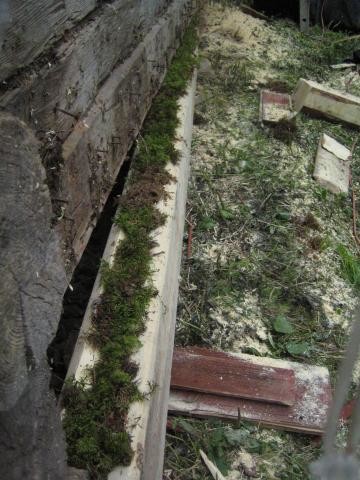

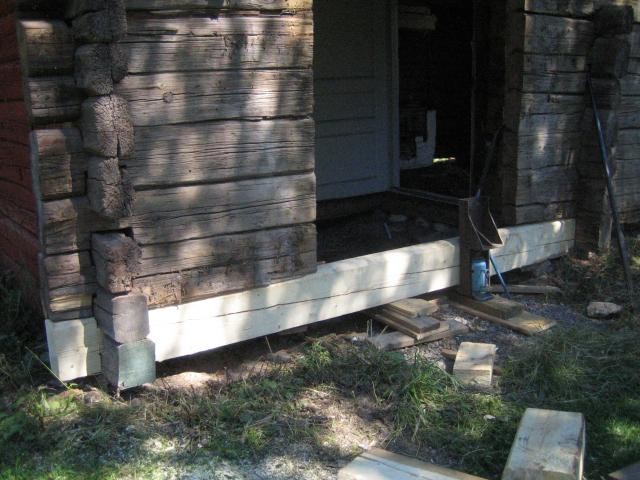
New idea on how to solve the floor structure, by the way. I thought about building a mold about 100-150 mm inside the sill and casting up to the correct level with cement-bound leca instead of placing leca blocks. It will be immensely easier, and then it will shape nicely around all the protruding stones. Additionally, it should seal decently against the sill by itself. Then use the leca as a form for the concrete slab.
Any thoughts on this?
Any thoughts on this?
With the right mixture, it will be equivalent to LECA-stone, right? So it should work well.jon_h said:
If you do this, you must form it somehow to keep the cement-leca mixture in place. Could you consider lining the inside of this form with 20-30 mm foam plastic boards, all to insulate a bit more. This would result in your slab being essentially floating from the edge, but that might not matter, or even possibly be better.
Then you might also be able to use the same mixture at the bottom, under the upcoming slab, to level everything horizontally. But now you might still be considering foam plastic under the concrete slab, which means it is already perfectly horizontal.
Proud log that one.
That's the downside of building a new house.
Cutting a 45x195 with a miter saw..., what is that compared to the clearly masculine task of chiseling out an entire log and then lifting the entire house to fit it in.
Last edited:
I have read the thread carelessly but still want to write:
Firstly, there are probably (partially) different readers here and on byggnadsvården. A question there would broaden the debate.
Then: we dug out a dry foundation because we had to due to the replacement of sill beams. It felt easiest to put back leca (more expensive but capillary-breaking and easy to scoop in). They do not lift the moisture (but it should of course be well-drained anyway), and hopefully create "just enough" ventilation. Previously, there was a decimeter of air gap under the floors and, as mentioned, holes in the sill, so there was a draft. The previous owner said "it was a bit cold on the floor."
The floor is floating on cast piers; we deliberated for a long time and got different advice, but since the house had settled earlier, it felt better. We'll see if it was the wrong approach...
Firstly, there are probably (partially) different readers here and on byggnadsvården. A question there would broaden the debate.
Then: we dug out a dry foundation because we had to due to the replacement of sill beams. It felt easiest to put back leca (more expensive but capillary-breaking and easy to scoop in). They do not lift the moisture (but it should of course be well-drained anyway), and hopefully create "just enough" ventilation. Previously, there was a decimeter of air gap under the floors and, as mentioned, holes in the sill, so there was a draft. The previous owner said "it was a bit cold on the floor."
The floor is floating on cast piers; we deliberated for a long time and got different advice, but since the house had settled earlier, it felt better. We'll see if it was the wrong approach...
Mikael: Not at all a bad idea to insulate with polystyrene between the edge beam and the concrete slab. And there will be polystyrene underneath. I was thinking of moisture-proofing the sill with tar paper or similar, glued to the sill.
And yes, it's a bit cool.. Solid stuff.
Aniska: At the same time, I posted a thread in the building care forum referring to this thread, just because I also wanted opinions from those who mostly frequent there.
I considered that solution earlier, but for various reasons, it probably wouldn't work very well in my house. I think I wrote a bit about it earlier in the thread if you have the energy to read.
And yes, it's a bit cool.. Solid stuff.
Aniska: At the same time, I posted a thread in the building care forum referring to this thread, just because I also wanted opinions from those who mostly frequent there.
I considered that solution earlier, but for various reasons, it probably wouldn't work very well in my house. I think I wrote a bit about it earlier in the thread if you have the energy to read.
Hmm. It's not quite clear why you want to insulate the floor specifically. I don't think the floor construction is the issue; most of the loss occurs through the roof, ventilation, windows. Stopping drafts is important, so seal through caulking and window frames.jon_h said:Very good thoughts there, thank you. And the house is mainly going to be used as a summer residence, although there will be the occasional weekend during the other seasons as well. Currently, it's insanely poor in terms of heat efficiency; it takes about 6-7 kW to maintain 20 degrees inside when it's -10 outside. On 40 m2...
I come from the heritage building preservation side of the forum and would definitely make an identical foundation to what was there previously without leca, plastic (and especially without foam!), seal the house well, drain, and buy a nice pair of indoor shoes
Also, don't use mineral wool or similar materials that can't handle moisture - possibly use hemp, flax, or cellulose-based materials.
The times you are there in winter, you start the heat with burning and then maintain it with electricity and fire (I assume that's what heats the house)
The best way to ruin an old house is to disrupt the moisture migration so that, as you pointed out, just leading the moisture to one place and thereby increasing the chance of rot, fungus, etc. Keep in mind that houses with old materials are meant to last 150-200 years, while mineral wool and foam last a maximum of 50 years, no matter how good they are. An old house also allows for "spare part" replacement in the house differently than a 70s villa.
Some shudder when they see your pictures but better that than getting a shoddy villa from the 90s in your possession - but as I said - I come from the heritage preservation side and there we sometimes become a bit fanatical...
frolsson: However, I must point out that leca is an acceptable material in building conservation contexts. We have received this recommendation from, for example, Byggnadsvård Nääs, and discussed it with antiquarians from Västerbottens museum who have visited our house. The reason is that it doesn't change the conditions for the foundation, as leca (in certain fractions) is vapor-permeable but capillary-breaking; in other words, it allows for the moisture movement you are talking about. For our part, this means an exactly similar foundation as before (mullbänk, warm foundation construction) but less risky (as it has been insulated with sawdust directly on the ground) and with somewhat better insulating capacity. However, I should add that we are not digging out much and therefore benefit from the ground heat.
Frolsson: Building an identical foundation to the previous one is out of the question. The existing solution was completely terrible, and a total home-crafted concoction by those who built the house. Not only was the insulation function nonexistent, but the construction has definitely been drafty from the start and a disaster in terms of moisture. No architectural conservator I've spoken with has seen anything like it. If it were a mullbänk, at least it would have worked in terms of heat, but I'm very doubtful if I would have reconstructed a mullbänk. Even Gudmundsson, who can be quite fanatical, seems to think that's simply not done anymore.
I will build a construction that works, both in terms of heat and technically for the house. Changing moisture migration is exactly what I want to do, to prevent the house from continuing to deteriorate. It will be a slab on foam plastic or leca, with an edge beam of cement-bonded leca, unless someone has a better suggestion. The slab will be completely moisture insulated from all other building parts, not built in entirely until it is properly down in moisture content (under 75-80% RH at least), and all the sills, including those under partition walls, will remain ventilated. The house will also be drained to further reduce moisture load. This is the only place where modern materials will be used, and out of necessity. Otherwise, it will be wood fiber, clay plastering, and so on.
I will build a construction that works, both in terms of heat and technically for the house. Changing moisture migration is exactly what I want to do, to prevent the house from continuing to deteriorate. It will be a slab on foam plastic or leca, with an edge beam of cement-bonded leca, unless someone has a better suggestion. The slab will be completely moisture insulated from all other building parts, not built in entirely until it is properly down in moisture content (under 75-80% RH at least), and all the sills, including those under partition walls, will remain ventilated. The house will also be drained to further reduce moisture load. This is the only place where modern materials will be used, and out of necessity. Otherwise, it will be wood fiber, clay plastering, and so on.
But warm foundation constructions are generally considered less risky than crawl spaces with insulated floors that don't allow the foundation to be warmed up at all. At least as long as you don't disturb the moisture migration with linoleum and plastic carpets, for instance. However, this assumes that the house is in a good location.jon_h said: