Anyone reading this on this forum can hardly have missed that Oggler is planning to fix up a furnished basement in a 70s house.
Now that I've started tearing into the construction, I think all the wood and insulation are doing fine as long as it hasn't been diffusion-tight inwards. For example, the walls have plastic between the wall panels and insulation/framework. The walls seem to have held up well. But the bottom sill has traces of moisture. While the floor joists in the same area that haven't been wrapped in plastic don't show a single trace of moisture.
A simple remedy if you're not too picky is probably to take down the wall panels and remove the plastic and put up something like drywall. That is, to leave the old insulation and framework as it is.
But now to the question. How well does a regular drywall breathe? Are there other wall panels that breathe better? Particle board for instance? My intuitive feeling is that particle board would breathe better. But maybe that's not the case? Or should one use real wood? Maybe that's the best option. To panel the wall?
Gypsum has higher vapor permeability than wood and particle board but lower than mineral wool. When comparing different materials, one must also consider the thickness of the material in the specific construction. Hygroscopic materials, wood and wood-based ones as well as concrete, have lower vapor permeability.
In a basement where the outer wall consists of some type of stone, concrete, concrete hollow block, and Leca block, one should never use a completely diffusion-tight material such as plastic film. I believe wood and wood-like materials such as plywood work best in basements over time.
Thank you for a great post. But if gypsum has a higher vapor permeability than wood-based boards, why don't you recommend gypsum? Or did I perhaps misunderstand?
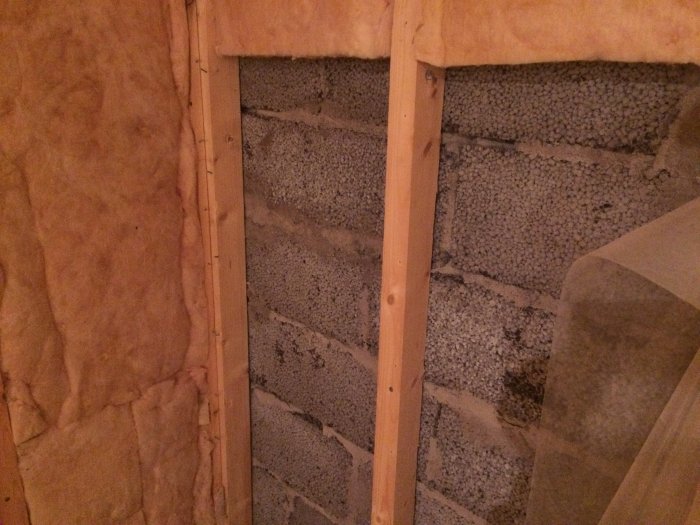
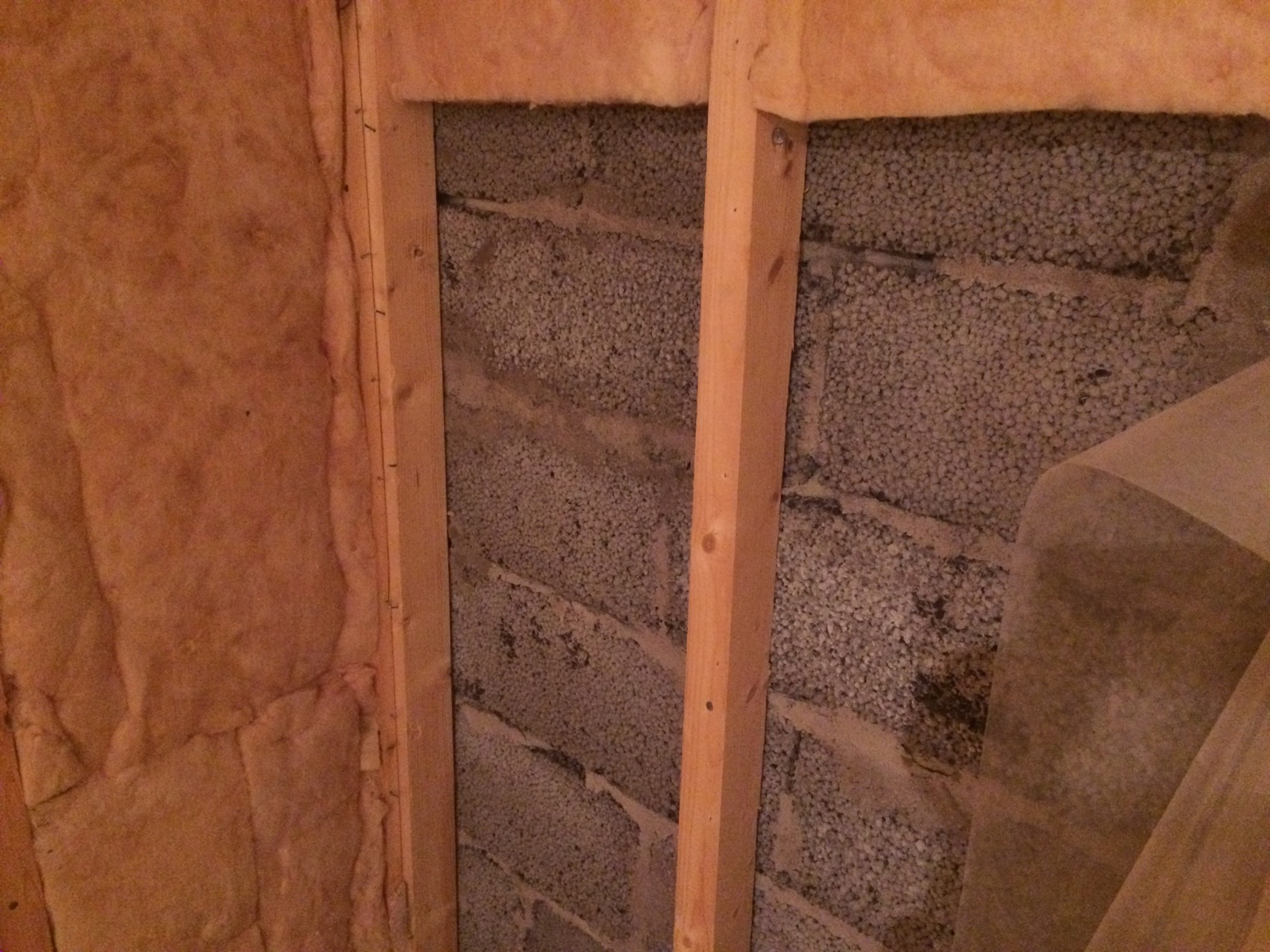
This is what the walls look like. Here, I've taken down the particle board and plastic in a corner. I've also removed some insulation to see what's behind. It is completely dry. Not a trace of moisture. And it's been wrapped in plastic for almost 50 years. These studs are in better condition than when they came from the lumberyard. But the sill at the bottom has some traces of moisture. Even though they are dry now.
If I remove the old particle board and plastic, and replace the sill with a steel sill, is it wise to then install new gypsum on this? No plastic behind it, that is?
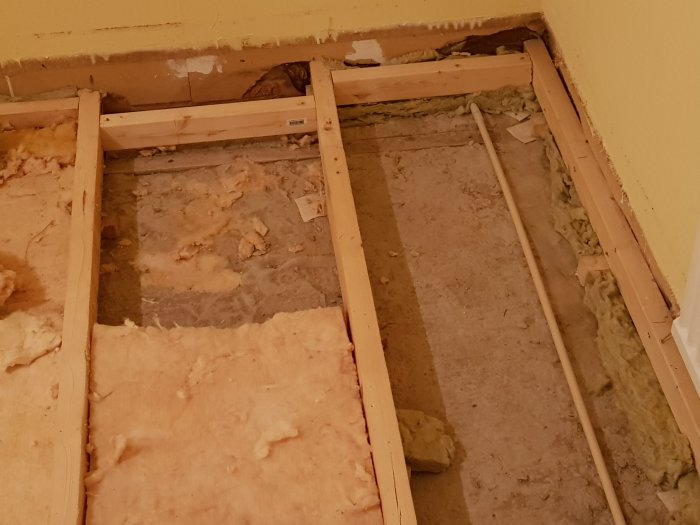
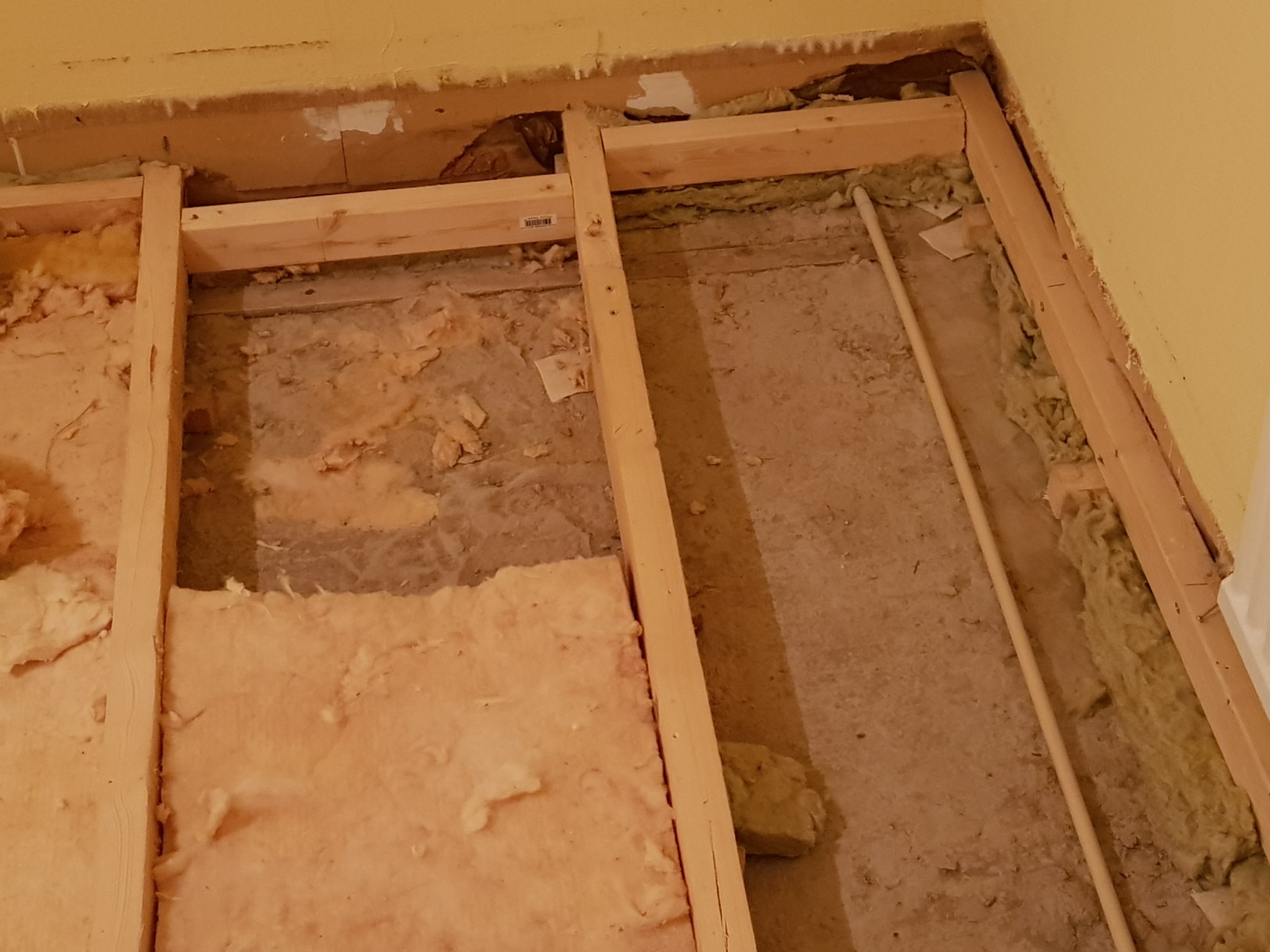
This is what the floors look like.
Also completely dry. There are traces of moisture on the wooden blocks that support the joists. Those wooden blocks have stood with end grain against the concrete slab. You can see there are moisture marks about 1cm up on the wood. I'm planning to redo the flooring. Nivell or Granab or equivalent. Hopefully, I won't need ventilation.
If the space is constantly heated, gypsum works perfectly fine. Lecastenen is better than concrete hollow blocks or concrete as basement wall material. There, the plastic does no harm but also no good. It's typical that the sill near the concrete is what has been most damaged.
But if plastic has worked well, why do you want to build open now?
Regarding the drywall, any paint or wallpaper might have a significant effect.
That plastic that's there goes all the way down to the floor and is unfolded on the concrete slab. In other words, the sill has been wrapped in plastic against concrete and wall. That doesn't feel right. So I thought I might as well remove the plastic at the bottom at least. And then it feels like it's just as well to remove it completely. Or? I'll install ventilated baseboards afterward. So my thought is that even the bottom part of the wall will be ventilated via the baseboards.
It's a typical risk construction, so to speak. But it can work.
Considering how fresh everything looks after almost 50 years, it would be strange if it couldn't last a few more decades if I now improve the ventilation in the structure. We have recently re-drained and insulated the outside of the wall as well.
I think there's almost a hysteria around such risk constructions. Just because some houses have major problems doesn't mean all houses do. So I think perhaps measures should be more adapted to current conditions rather than aligning with a national standard.
If you have drained and insulated, you have definitely improved the conditions. I'm just a bit questioning your conclusions that it would be better without a moisture barrier, when it obviously works well with a moisture barrier, but you don't know if it would work without.
I can't say it won't work, but I don't understand the reasoning.
If you have drained and insulated, you have clearly improved the conditions. I'm just a little questioning about your conclusions that it would be better without a moisture barrier when it obviously works well with a moisture barrier, but you don't know if it would have worked without it.
I can't say it won't work, but I don't understand the reasoning.
It's probably about the sill being wrapped in plastic. Maybe it's enough to cut the plastic about 20cm up from the concrete slab and keep the rest?
The reason for using vapor barriers is to prevent the water vapor in indoor air from condensing in the wall. This is particularly important when using mineral wool as insulation material, as it loses much of its insulating ability when damp. When the outer layer of the wall consists of some type of masonry or solid wood, the risk of condensation in the underlying mineral wool is small. The plastic in this case is of no use but represents a potential risk.
But the sill is more exposed. It is the coldest and most humid position.
That's exactly why I don't want the sill wrapped in plastic. Now I'm planning to remove the wooden sill. But I thought it would be just as well to increase air circulation where the concrete slab meets the leca wall.
Vi vill skicka notiser för ämnen du bevakar och händelser som berör dig.