
5,289 views ·
6 replies
5k views
6 replies
How to size/relieve small sleeping loft on the rafters/beams?
Hello,
Soon a smaller sleeping loft/storage space will be built that will not be used more than temporarily as an extra sleeping place during visits or similar, or perhaps only for storage. The size will be approximately: L:2400 x W:3500. The idea is to use the rafters/beams which are 70X170 with cc 120.
My question is how to relieve the loft? Posts against the floor construction or if the existing rafters/beams can be used as the primary structure or is a combination of these needed?
If you also have any cool ideas for solutions or anything else, feel free to share those as well...
Thanks in advance,
Best regards,
//H
Soon a smaller sleeping loft/storage space will be built that will not be used more than temporarily as an extra sleeping place during visits or similar, or perhaps only for storage. The size will be approximately: L:2400 x W:3500. The idea is to use the rafters/beams which are 70X170 with cc 120.
My question is how to relieve the loft? Posts against the floor construction or if the existing rafters/beams can be used as the primary structure or is a combination of these needed?
If you also have any cool ideas for solutions or anything else, feel free to share those as well...
Thanks in advance,
Best regards,
//H
Has no one done anything similar?
Or maybe I was unclear......let me clarify a bit :
:
It's open to the ridge on the second floor where I plan to build a small sleeping/storage loft against one gable and I'm wondering about the dimensions and if the beams (170x70) are sufficient to support the loft, in the style of laying a floor on the horizontal beams with cc 120, or if the loft or the beams should be unloaded since there will be weight on them!?
Or maybe I was unclear......let me clarify a bit
: It's open to the ridge on the second floor where I plan to build a small sleeping/storage loft against one gable and I'm wondering about the dimensions and if the beams (170x70) are sufficient to support the loft, in the style of laying a floor on the horizontal beams with cc 120, or if the loft or the beams should be unloaded since there will be weight on them!?

It's hard to answer. Normally, you only design roof trusses to support the roof plus the loads on it.
Despite that, everyone(?) has things in the attic.
In the summer, I would see it as chill to just lay a good floor there and then sleep soundly.
Despite that, everyone(?) has things in the attic.
In the summer, I would see it as chill to just lay a good floor there and then sleep soundly.
Thank you for the reply Mats_o.
Now, we don't have as much snow here in Skåne as in Västernorrland, but it is an older building (about 100 years old) and I'm someone who generally over-engineers and triple-secures everything, so it always becomes a bit extra tricky.
Now, we don't have as much snow here in Skåne as in Västernorrland, but it is an older building (about 100 years old) and I'm someone who generally over-engineers and triple-secures everything, so it always becomes a bit extra tricky.

With 2.4 x 3.5 meters of usable space, the load capacity should be dimensioned as approximately 1.7 tons of distributed load, plus the self-weight of the construction, i.e., studs, joists, boards, etc.på landet said:Hi,
Soon, a smaller loft/storage space will be built, which will not be used more than temporarily as an extra sleeping area during visits or similar, or perhaps only for storage. The size will be approximately: L:2400 x W:3500. The idea is to use the roof trusses/ceiling joists which are 70X170 with cc 120.
Determining how this load should be handled is completely impossible with the scant information you've provided.
I can also mention that I can't do the calculations for you anyway, as I don't know enough, especially regarding roof trusses. But maybe someone else can. For that, information about the current design and spans of the roof trusses and such is needed.
Hi,
Mikael, have I understood your calculation correctly if it means 200kg / m2?
If there's anyone who can help, it's traditional frameworks with about a 45-degree slope. About a 5m long side, a span of 2.5m on the beam. I have also added 95r on the rafters for extra insulation, and a collar beam at 3m height (from the floor). This got complicated; maybe I should upload a sketch???
Best regards,
//H
Mikael, have I understood your calculation correctly if it means 200kg / m2?
If there's anyone who can help, it's traditional frameworks with about a 45-degree slope. About a 5m long side, a span of 2.5m on the beam. I have also added 95
r on the rafters for extra insulation, and a collar beam at 3m height (from the floor). This got complicated; maybe I should upload a sketch???Best regards,
//H
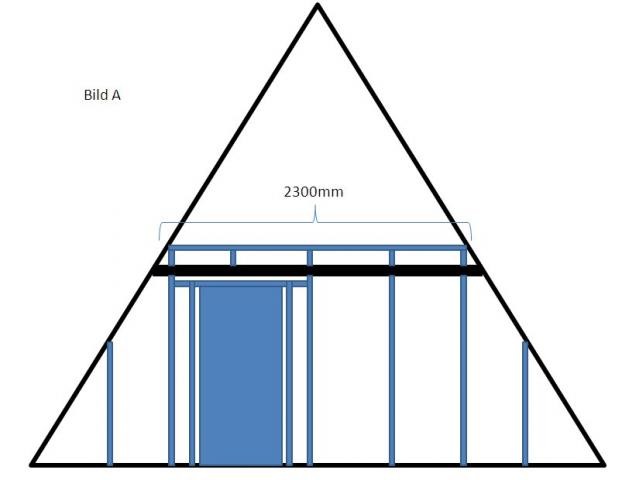
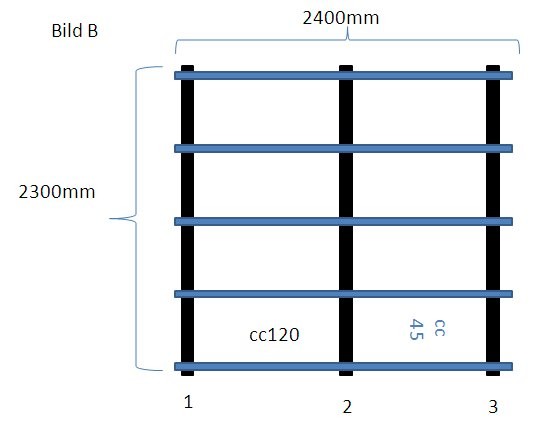
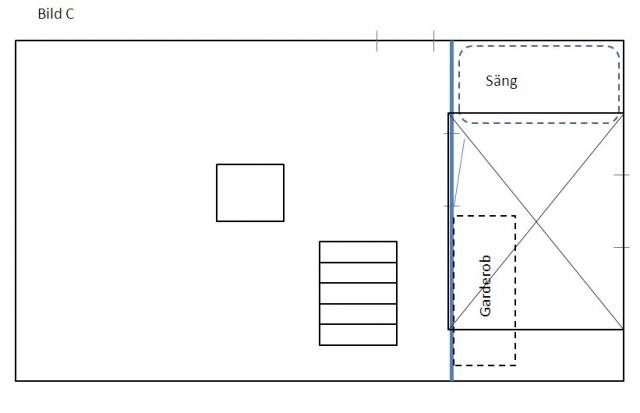
Here are some sketches. Unfortunately, I don't have a good drawing program so they are poor power points, but hopefully, they give a clearer picture of what I need help with
Image A: Cross-section of the construction with roof trusses, new interior wall
Image B: Example of the loft's floor structure
Image C: Overview floor plan of the room under the loft.
And some adjustments on the measurements after control measurement :blushing:,
*The loft will be 2300x2400,
*The beams are 140x70.
As I see it, there is no problem unloading Beam 1 and 3 as shown in image B, given that a new interior wall will be built for the room under the loft at beam 1 and that it can be unloaded at the gable/beam 3, but the loft's floor structure will then rest freely with cc 120 on beam 2 since there will be free floor space under in the room.
Is this a safe construction? If not, is there any smart solution to this?
I don't mind if it flexes since the loft will only be used as a sleeping place for guests occasionally and for minor storage.
Best regards,
//H
Image A: Cross-section of the construction with roof trusses, new interior wall
Image B: Example of the loft's floor structure
Image C: Overview floor plan of the room under the loft.
And some adjustments on the measurements after control measurement :blushing:,
*The loft will be 2300x2400,
*The beams are 140x70.
As I see it, there is no problem unloading Beam 1 and 3 as shown in image B, given that a new interior wall will be built for the room under the loft at beam 1 and that it can be unloaded at the gable/beam 3, but the loft's floor structure will then rest freely with cc 120 on beam 2 since there will be free floor space under in the room.
Is this a safe construction? If not, is there any smart solution to this?
I don't mind if it flexes since the loft will only be used as a sleeping place for guests occasionally and for minor storage.
Best regards,
//H
Click here to reply