
5,022 views ·
11 replies
5k views
11 replies
How to raise existing wall plate?
I am considering adding a sloped roof to an existing work shed that currently has a more or less flat roof.
I am thinking of creating a sloped roof with a 3-degree incline by raising the wall plate on one long side. According to my calculations , this would mean that the wall plate needs to be 22 cm higher on one long side, given that the roof's width is 4.2 meters. The current difference is 5 cm between the two wall plates.
Of course, I could tear down one long wall and replace the existing studs with longer ones to raise the wall plate. Naturally, I would like to make it as simple as possible if feasible, but it also needs to be done correctly.
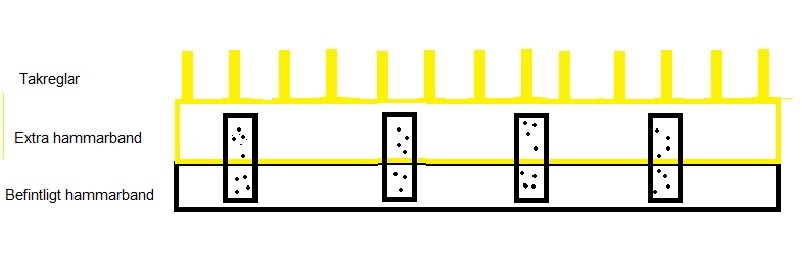
Could one alternative be to place an additional stud (45x170 or 45x195) on the existing wall plate to achieve the height increase? I am thinking that the new stud could be attached with nail plates that are screwed into both the existing wall plate and the new "upper" wall plate.
I attempted an illustration to clarify the whole thing. Is this a viable solution, or do you have any other suggestions on how the height increase could be achieved without tearing down the entire wall?
I am thinking of creating a sloped roof with a 3-degree incline by raising the wall plate on one long side. According to my calculations , this would mean that the wall plate needs to be 22 cm higher on one long side, given that the roof's width is 4.2 meters. The current difference is 5 cm between the two wall plates.
Of course, I could tear down one long wall and replace the existing studs with longer ones to raise the wall plate. Naturally, I would like to make it as simple as possible if feasible, but it also needs to be done correctly.
Could one alternative be to place an additional stud (45x170 or 45x195) on the existing wall plate to achieve the height increase? I am thinking that the new stud could be attached with nail plates that are screwed into both the existing wall plate and the new "upper" wall plate.
I attempted an illustration to clarify the whole thing. Is this a viable solution, or do you have any other suggestions on how the height increase could be achieved without tearing down the entire wall?

A common solution is to just build a new roof with a steeper pitch on top of the existing roof structure. In your case, when you want to go up as little as possible, it would mean placing a beam cut like a wedge with a new pitch on top of the existing rafters/beams, which is securely attached down into the rafter. Then you don’t have to mess with the old structure.
Thanks for the quick response to my post.Rickard.ag said:
A common solution is to simply build a new roof with a steeper pitch on top of the existing roof structure. In your case, since you want to go up so little, it would mean placing a beam cut as a wedge with the new pitch on top of the existing rafters/beams, attached securely to the rafter below. That way, you don't need to tamper with the old structure.
The outer roof is currently moisture-damaged, so it will need to be removed. What I’ll have left is the ceiling, roof beams, and insulation.
Thus, building on the existing roof is not an option, but the principle is the same, I suppose, if, when the roof is open, I build directly on the existing roof beams with new wedge-shaped beams on top—see picture.
Ideally, I would leave the existing roof beams in place so I don't have to tear down the ceiling.
What about my proposal to raise the hammer beam? Is that completely wrong thinking?

The job of the hammarbandet is to support the rafters, and it's not something you change as long as you place the new studs on top of the old ones. So you don't need to do anything with the hammarbandet, just let it be as it is.
The construction of the work shed is such that the wall plate is partly loaded by the roof beams, which are 45x145, but it also has a longitudinal beam running on both long sides. I've tried to illustrate this in the picture.
As I wrote in the first post, I need (if I've calculated correctly) a 22 cm difference between the front and rear to achieve a 3-degree slope over 4.2 meters.
Byggmax has beams that are 45x220, which would work. The problem, however, is that at the front, I have the longitudinal beam that is 5cm higher than the existing roof beam. If I don't remove/trim that beam, I need to get over it. To accomplish that, I would need a beam that is at least 45x270, or I would need to place two roof beams on top of each other to get over the front roof beam.
Does anyone have thoughts or comments on my original proposal to raise the rear longitudinal beam that rests on the wall plate, in order to mount new roof beams that way? Are there any flaws/risks in choosing to do so?

Exactly - 3-degree roofing felt is intended to be installed by myself.
As I see it, the easiest way is to raise one long side with a beam as I described in the first post. The question is whether it's considered okay to do that?
If I build it that way, then I can construct a new roof without needing to worry about the existing one. There are a number of roof beams that need replacing. I can then replace those later from the inside, especially since it looks like I will remove and replace the inner ceiling.
Right now, it feels like the priority is to get a new outer roof on before the real winter comes. The inner ceiling and other work can be done from the inside.
So, how about adding an extra batten and fastening it with nail plates to get the height up. Any input on that?
Last edited:
Do yourself a favor and give yourself more than 0% margin for error. The slightest miscut, settlement, deflection, and bend and you are on the wrong side of the limit (which, in my opinion, is already too low).
The rule you're referring to is not the hammarbandet but has a different non-load-bearing function. If you want to proceed as planned, you need to check if it is fastened and sized to support an entire roof.
The rule you're referring to is not the hammarbandet but has a different non-load-bearing function. If you want to proceed as planned, you need to check if it is fastened and sized to support an entire roof.
How big is the garage? Perhaps it's time to invest in a proper PVC tarp to serve as a roof for the winter and tear up and redo everything properly in the spring.
One idea then is to order ready-made lean-to roof trusses with the new slope and just place them on the existing wall plate. Probably a bit more expensive but very simple.
One idea then is to order ready-made lean-to roof trusses with the new slope and just place them on the existing wall plate. Probably a bit more expensive but very simple.
Last edited:
Regarding the slope, you are of course right about that. Margin is always good! Of course, I can go with a 45x220 to get a little margin. (3.68 degrees)
When I started looking into this, I got the impression that the beam was part of the load-bearing construction - see my first post and picture. However, after getting feedback here and checking both once and twice more, I've realized that what you're writing now is correct. It is not currently part of the load-bearing construction; the beam in question that I am considering raising lies on top of the hammer beam and shares the hammer beam with the existing roof beams, which I have also tried to illustrate.
The beam I intended to raise is generously sized as it is 50x240. The corresponding beam on the other long side is 50x190, which also rests on the hammer beam. Regarding the fastening of the beam, it has been used to nail panels from the outside. Previously, there were also attachment points for loops used when lifting the construction shed. So there should be no doubt that it's firmly attached to the hammer beam.
As I mentioned in a previous post, it is a construction shed, the type used on construction sites. It was lifted here by crane.
In this post, a user made a similar solution when he raised the hammer beam afterwards because he missed having different heights on the walls. It is the same principle that I have in mind, but I am using an existing beam and not placing new ones directly on the hammer beam.
I believe in doing it right; making mistakes and getting a lot of headaches is something I'm too old for. Unfortunately, for various reasons, waiting until spring with the work is not an option.
I also want to add that I am extremely grateful for the time and feedback this forum provides. Thank you, Rickard, for your feedback. For me, as a hobby carpenter, it is worth its weight in gold.

Why did I think it was a garage? Oh well, it's neither the first nor the last time I'm wrong
Stacking 2 studs on their edges can become prone to tipping, so it might be something you need to address, but otherwise, it will probably work.
Stacking 2 studs on their edges can become prone to tipping, so it might be something you need to address, but otherwise, it will probably work.
Click here to reply