I have previously built a single-story house, and now I am planning a 1.5-story house and am considering how to make the intermediate floor load-bearing.
The background is a house body measuring 10*12 m that will be constructed with loose timber. Gable roof with a 30-35 degree slope and a dormer along 1/3 of the roof's length on one side of the house.
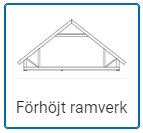
I have planned for the roof trusses to be framework with a raised wall height of 70 cm.
However, the truss supplier cannot dimension the trusses before I have decided on the floor plan for the ground floor since the intermediate floor needs to be relieved.
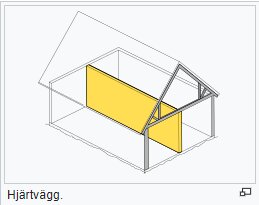
I have understood that one talks about load-bearing walls and core walls. But I don't quite understand how to place such a wall on the ground floor. I don't want a wall running across the middle of the house on the ground floor like in the picture on Wikipedia.
How should one think? Are 95mm studs enough for a load-bearing wall? I assume larger openings can be made in the load-bearing wall with the help of relief? Does the wall have to be in the middle of the house if the width is 10m? Will the intermediate floor need support at more than one point on a 10m span?
I have previously built a single-floor house, and now I'm planning a 1.5-story house and contemplating how to make the intermediate floor load-bearing.
Background is a house structure of 10*12 m to be constructed in loose timber. A gable roof with a 30-35 degree roof pitch and a dormer along 1/3 of the roof's length on one side of the house.
I have planned for the trusses to be framework with a raised wall height of 70 cm.
[image]
However, the truss supplier cannot dimension the trusses before I have decided on the floor plan for the ground floor as the intermediate floor needs to be supported.
I've understood that there is talk of load-bearing walls and heart walls. But I don't quite understand how to place such a wall on the ground floor. I don't want a wall running across the middle of the house on the ground floor as in the picture on Wikipedia.
[image]
How should one think? Is 95mm studs enough in a load-bearing wall? I assume you can make larger openings in the load-bearing wall with assistance? Does the wall have to be in the middle of the house if the width is 10m? Will the intermediate floor need to be supported at more than one point over a 10m span?
Yes, you can have large openings if these are supported with beams.
95mm studs are sufficient.
One wall is enough, the heart walls can be shifted from the center, at the cost of larger dimensions of floor joists.
If you manage to have two heart walls, you can have even smaller dimensions on the floor joists.
Need and need.......there's probably no problem dimensioning the trusses so they become self-supporting, but they might end up being thick and costly as a result. It's all about whether there's room for a load-bearing wall on the ground floor or not. If you don't want any, then they should proceed based on that.
Need and need......it's probably not a problem to dimension the trusses so they become self-supporting, but they might be bulky and cost accordingly. It's all about whether there's room for a load-bearing wall on the ground floor or not. If you don't want any, then they have to base it on that.
But the truss can't be self-supporting if the span is 10m if you want to be able to walk on the intermediate floor, right?
Well, it probably can, but it will look like it afterwards.............That's probably why they immediately say that you probably need some load-bearing wall.
But the roof truss can't be self-supporting with a span of 10m if you want to be able to walk on the intermediate floor, right?
Mine are 7m without a supporting wall underneath, walkable length is 5m.
The intermediate floor in the house has 5m beams without any supports at all.
If you use glulam, you'll get fantastic durability and stiffness, but it costs more. It's all just a question of how much you're willing to pay and how thick they should be (up to some sort of breaking point where it stops).
Mine are 7m without a load-bearing wall beneath, walkable length is 5m.
The mid-floor in the house has 5m beams without any supports at all.
If you use glulam, you will get fantastic durability and stiffness, but it does cost more. It’s just a question of how much you're willing to pay and how thick they need to be (up to a certain breaking point where it becomes impractical).
What is the dimension of your floor beams? Do you mean you can build a glulam beam in each truss or that the truss is supported by a cross-glulam beam below?
I have 8.4-meter self-supporting framework trusses cc 120 cm with an intermediate beam, so the joists will be cc 60 cm.
You should call/email truss manufacturers and ask for self-supporting framework trusses.
I forgot to mention that my joist height is 32 cm.
What prevents you from drawing the floor plan before ordering roof trusses?
10 m is long and may require a couple of extra steps in the stairs if you can't have support in the middle, the intermediate floor will be thick. (Pure guess, probably exaggerated)
So a wall approximately in the middle and beams at larger openings makes it much easier and provides a thinner intermediate floor. It is possible to place the beam on the upper floor and hide it in a wall there.
I would start by drawing the house I want, without considering loads, spans, and the like. Then get help from a structural engineer to assist with calculations, both on loads and material costs to solve the house's layout. After that, start thinking about compromise solutions with load-bearing walls, etc., if the costs or size of the framework become too large.
What dimensions are your floor joists? Do you mean building a glued laminated beam (glulam) in each rafter or that the rafter is held up by a cross-glulam beam underneath?
You shouldn't look at the dimensions of my joists; nothing in my conditions matches what you need to do.
It depends on how much load needs to be supported and how far it is. If you place the staircase in the middle of the house, you could have support via a post there, just to give an example.
The suggestion to first draw it how you want it is absolutely right. With a few minor adjustments afterward, you'll likely have a functional and cost-effective solution.
Thanks for the tips, have started looking at 1.5 story houses from the major house suppliers and in their floor plans, you can clearly see that they have a load-bearing wall throughout the entire house structure.
Thanks for the tips, I've started looking at 1.5-story houses from the major house suppliers, and their floor plans clearly show that they have a load-bearing wall through the entire structure.
And that wall can be removed with, for example, a steel beam or a glulam beam and a supporting post near the middle. The price determines the result/size of the beam.
My ground floor has an asymmetrical partition wall, it works if you have slightly stronger joists than if you place the partition wall in the middle. The upper floor has no partition wall at all, but then the floor is also thick (truss in the actual floor).
Click here to reply
Vi vill skicka notiser för ämnen du bevakar och händelser som berör dig.




pacman42 said:
Mine are 7m without a load-bearing wall beneath, walkable length is 5m.
