
10,282 views ·
9 replies
10k views
9 replies
How to "glue" renovation plasterboard to the ceiling and make it even?

I have concrete slab and a fairly smooth surface on the ceiling of the concrete. However, the concrete is cast in "sections" so it varies by a few millimeters here and there, especially where the corners of the panels in the casting mold have met.
My first thought was to plaster the ceiling, but the area I tested a bit on doesn't hold because the surface is too smooth. A painter I talked to said that if so, mesh netting must be attached and then plastered on it, but that would make it about 20 mm thick, he meant.
To save time (and money), I'm now thinking about gluing renovation plasterboard to the ceiling instead. The idea is to take some suitable glue (maybe plaster adhesive?), apply it to the back of a board, and press it up to the ceiling with a plasterboard lift.
Does that seem sensible or am I shooting myself in the foot here...?
My first thought was to plaster the ceiling, but the area I tested a bit on doesn't hold because the surface is too smooth. A painter I talked to said that if so, mesh netting must be attached and then plastered on it, but that would make it about 20 mm thick, he meant.
To save time (and money), I'm now thinking about gluing renovation plasterboard to the ceiling instead. The idea is to take some suitable glue (maybe plaster adhesive?), apply it to the back of a board, and press it up to the ceiling with a plasterboard lift.
Does that seem sensible or am I shooting myself in the foot here...?
I think you'll have just as much difficulty achieving an even ceiling anyway. It will be wavy, a characteristic that is clearly visible in sidelight.
Renovation plasterboard that is 6mm thick won't compensate for any unevenness more than within 300-400mm; over longer distances, it follows the substrate.
Possibly 13mm plasterboard could work, but it weighs quite a lot and you'll need many supports to be able to glue it up.
I believe that framing with battens and wedges that are leveled, and then regular ceiling plasterboard or another ceiling panel is more sensible.
I did framing and used 6mm plasterboard, which ended up wavy. Don't make the mistake of using renovation plasterboard again.
Renovation plasterboard that is 6mm thick won't compensate for any unevenness more than within 300-400mm; over longer distances, it follows the substrate.
Possibly 13mm plasterboard could work, but it weighs quite a lot and you'll need many supports to be able to glue it up.
I believe that framing with battens and wedges that are leveled, and then regular ceiling plasterboard or another ceiling panel is more sensible.
I did framing and used 6mm plasterboard, which ended up wavy. Don't make the mistake of using renovation plasterboard again.
Since the room already has limited ceiling height, I want to minimize what I put up, but I understand it might be tricky...
The surface is quite even, but there might be spots where it's uneven.
The mold they poured the concrete into appeared to consist of panels about 2x2 meters. Some seams stick out a bit, but I can remove them with a concrete grinding disc on the angle grinder, although at certain spots where the panels meet, there might be a difference of about a millimeter or so in height where one panel was slightly higher than the one it met.
I'm thinking of trying to level out the concrete as much as possible by grinding it down, but I'm willing to accept some small bumps or dips...
Dips would be preferable since then the surface would be solid, and I can apply filler to the panels.
The surface is quite even, but there might be spots where it's uneven.
The mold they poured the concrete into appeared to consist of panels about 2x2 meters. Some seams stick out a bit, but I can remove them with a concrete grinding disc on the angle grinder, although at certain spots where the panels meet, there might be a difference of about a millimeter or so in height where one panel was slightly higher than the one it met.
I'm thinking of trying to level out the concrete as much as possible by grinding it down, but I'm willing to accept some small bumps or dips...
Dips would be preferable since then the surface would be solid, and I can apply filler to the panels.

I think it will be difficult to get it good enough since there are large "boards" that differ slightly in level. If I apply putty directly, I think there's a greater risk of pits than with renovation plaster, which I still think/hope will be able to take up some of the height difference in the ceiling...nimhed said:
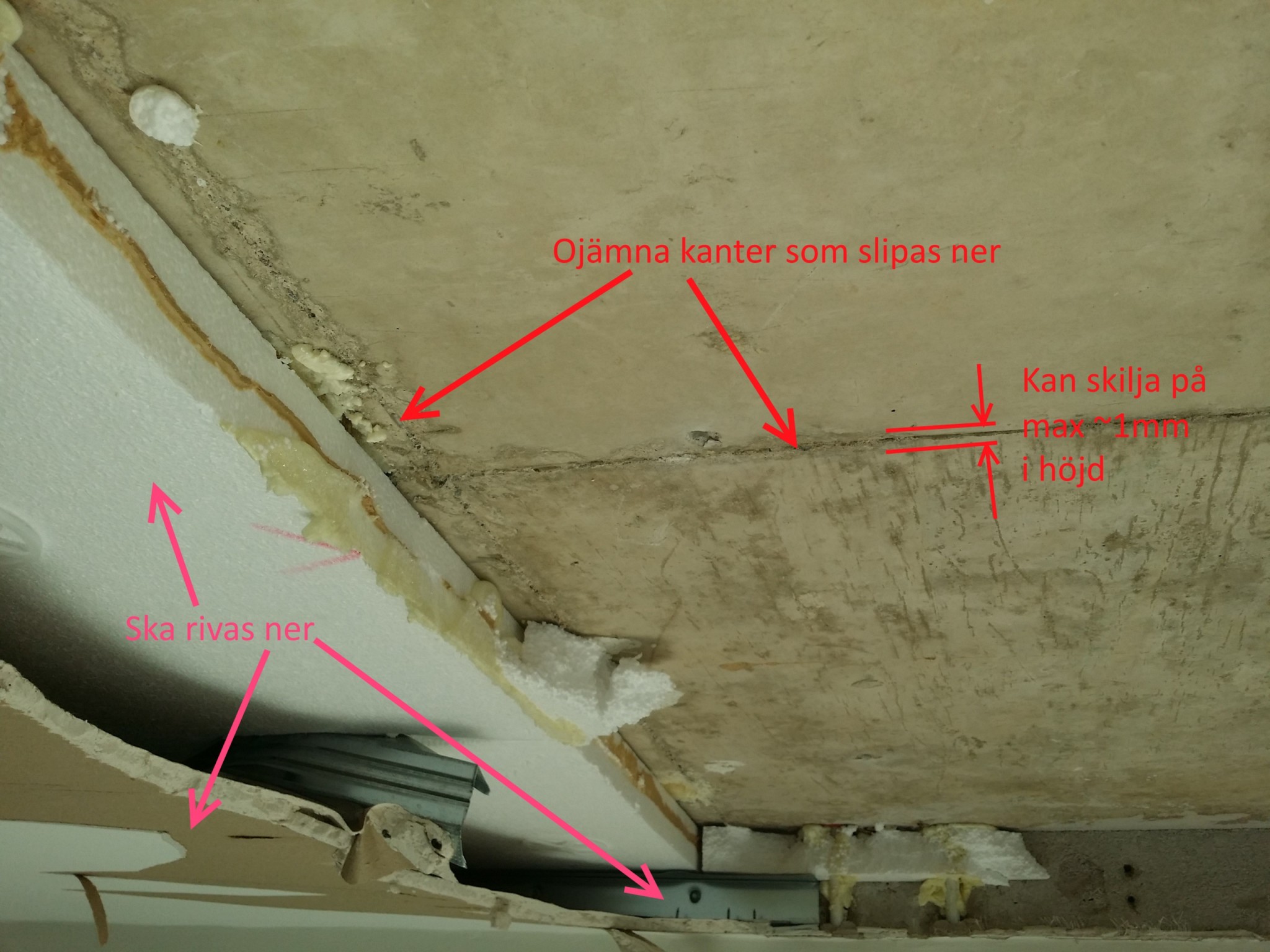
I haven't gotten much further with the roof other than removing all the old beams and insulation.
The "slabs" after casting the roof (concrete floor) differ by about 3 mm in a couple of spots, so the idea of 6mm renovation gypsum is out; it would result in too many waves.
Adjacent to the room is a closet about 1.6x0.8 meters, and the ceiling in it is "original" against the concrete (meaning there hasn't been an insulated ceiling inside the closet), and it seems to be "plastered" with gypsum (or is it some lime?). The plaster surface inside the closet is completely white and about 5-6 mm thick.
They've obviously managed to plaster the ceiling with just 5-6 mm thickness, which would be great compared to the mason's suggestion of plaster mesh and about 20 mm thickness.
The question, then, what could they have plastered with?
It is completely white, very fine-grained, and crumbles and colors just like gypsum.
I thought of gypsum plaster but am afraid the surface will be too rough with just 5-6 mm...
The "slabs" after casting the roof (concrete floor) differ by about 3 mm in a couple of spots, so the idea of 6mm renovation gypsum is out; it would result in too many waves.
Adjacent to the room is a closet about 1.6x0.8 meters, and the ceiling in it is "original" against the concrete (meaning there hasn't been an insulated ceiling inside the closet), and it seems to be "plastered" with gypsum (or is it some lime?). The plaster surface inside the closet is completely white and about 5-6 mm thick.
They've obviously managed to plaster the ceiling with just 5-6 mm thickness, which would be great compared to the mason's suggestion of plaster mesh and about 20 mm thickness.
The question, then, what could they have plastered with?
It is completely white, very fine-grained, and crumbles and colors just like gypsum.
I thought of gypsum plaster but am afraid the surface will be too rough with just 5-6 mm...
Now I'm thinking a bit freely and wildly, so take it for what it is but...
If the floor is smooth and nice, couldn't you use a panel lifter or something similar and instead of pressing the panels against the ceiling, lift them to a certain specific height with the floor as a reference. That is, where the ceiling section is 3 mm higher, the panel hangs 3 mm below the ceiling and in other places it is flush against (or maybe 1 mm below). It probably requires a glue that is both "tall" enough to bridge the gap and can also be compressed.
Maybe this foam glue: http://www.jula.se/catalog/bygg-och...kel/konstruktionslim/konstruktionslim-502074/
If the floor is smooth and nice, couldn't you use a panel lifter or something similar and instead of pressing the panels against the ceiling, lift them to a certain specific height with the floor as a reference. That is, where the ceiling section is 3 mm higher, the panel hangs 3 mm below the ceiling and in other places it is flush against (or maybe 1 mm below). It probably requires a glue that is both "tall" enough to bridge the gap and can also be compressed.
Maybe this foam glue: http://www.jula.se/catalog/bygg-och...kel/konstruktionslim/konstruktionslim-502074/
Yes, in the end, it became full surface application... :banghead:nimhed said:
The decision came when I was renting a concrete saw for another project and saw that the rental company had a Flex giraffe with a concrete grinder. On the way home from the rental company, I had the giraffe and a massive vacuum in the trunk and then sanded down the largest edges so they became more or less flat.
Wow, the Flex giraffe was really effective, the concrete in our 1977 villa is nothing to mess with, but the grinder cut through it like butter, well, maybe not butter but taffy at least...

After that, I took out the wide spatula and started applying... 45 liters of filler later, the ceiling is flat and nice and now even sanded... Let's not even start talking about how my shoulders and neck feel... :screwy:
Click here to reply