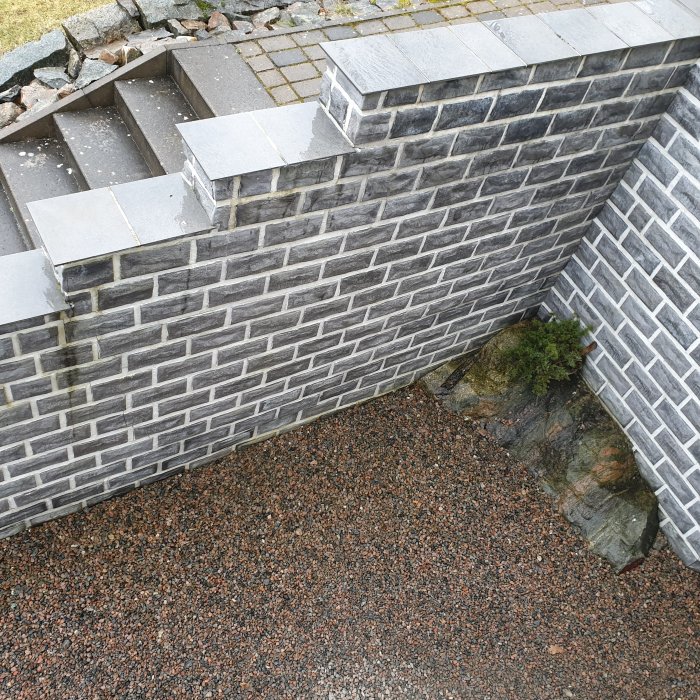
The subject has been inactive for 11 years but still not trouble-free. I want stylish tips on how you cover the top of the wall. I have had several walls for 10 years and covered them with granite slabs with joints in between, but the joints loosen and become ugly over the years. Going to build a new leca wall now. Need tips.
The subject has been inactive for 11 years but still not problem-free. I want some stylish tips on how you cover the top of the wall. I've had several walls for 10 years and covered them with granite slabs with grout in between, but the grout comes loose and becomes ugly over the years. I'm going to build a new Leca wall now. Need tips.
[image]
You need something that directs water away from the wall. The solution with horizontal slabs causes the water to run down along the wall.
Crown covering of sheet metal or roof tiles with a slope. In your case, a sheet metal worker probably gives the best result.
You need something that diverts water away from the wall. The solution with horizontal plates causes the water to run down along the wall.
Crowning coverage of metal or roof tiles with a slope. In your case, a sheet metal worker probably gives the best result.
page 52 below
[link]
Hi yes on the wall you see I have a slope on each plate. The water drainage works. It's the granite slabs on top I want to replace with a more attractive solution.
Hi yes on the wall you see I have a slope on each tile. The water drainage works. It's the granite slabs on top that I want to replace with a nicer solution.
But you can see that the water runs along the wall and doesn't drip from the edge.
It doesn't work with water drainage on your wall, flat roof, the roof must slope slightly, protrude about 3 cm on the slope side. The stone must be notched on the underside so the water doesn't go around and onto the leca. Water has a surface tension so it can go around a long distance, see my simple sketch and think about how you want it.
Rdit I notched my tiles with a grinder and diamond blade
It doesn't work with water drainage on your wall, flat roof, the roof must slope a bit, protrude about 3 cm on the fall side. The stone must be notched on the underside so that the water doesn't go around and get onto the leca. Water has a surface tension so it can go around a long distance, see my simple sketch and think about how you want it.
Rdit I cut notches on my slabs with an angle grinder and diamond blade
Hi yes thank you for your help but what you don't see in the picture is that I have a slope, I have cast a slope of about 2cm per section. What tips do you have for what material I should put on top? But I don't have the notch underneath so that could definitely help.
The tiles you have are OK and the slope is fine, but the water going around and into the leca is due to its surface tension. So, to avoid this, there's only one way to break the loop, which is to create a break in the slope with some form of notch. How you do it depends on the rest of the installation. Usually, it can only be fixed with a notch. In the middle, there will be a strip on the ground about 3 - 5 cm outside the wall, showing that the water is draining down without going around towards the leca wall. It's just the law of nature with water.
But you can see the water running along the wall and not dripping from the edge
Absolutely, it runs along the joint on every ledge, and a notch is needed to make it easier to drip off, as jonaserik suggested. Again, I would like some tips on stylish solutions on how you've dressed the top of the wall?
Will return tomorrow with a photo of how I've done it, but essentially no difference from what I've mentioned earlier-
Great. The point of my post is that I want good tips on how you've covered the top of the wall, not what issues there are with the wall in the picture, the fact is that it doesn't have any problems with frost damage and it has lasted for 10 years now. But there's always room for improvement.
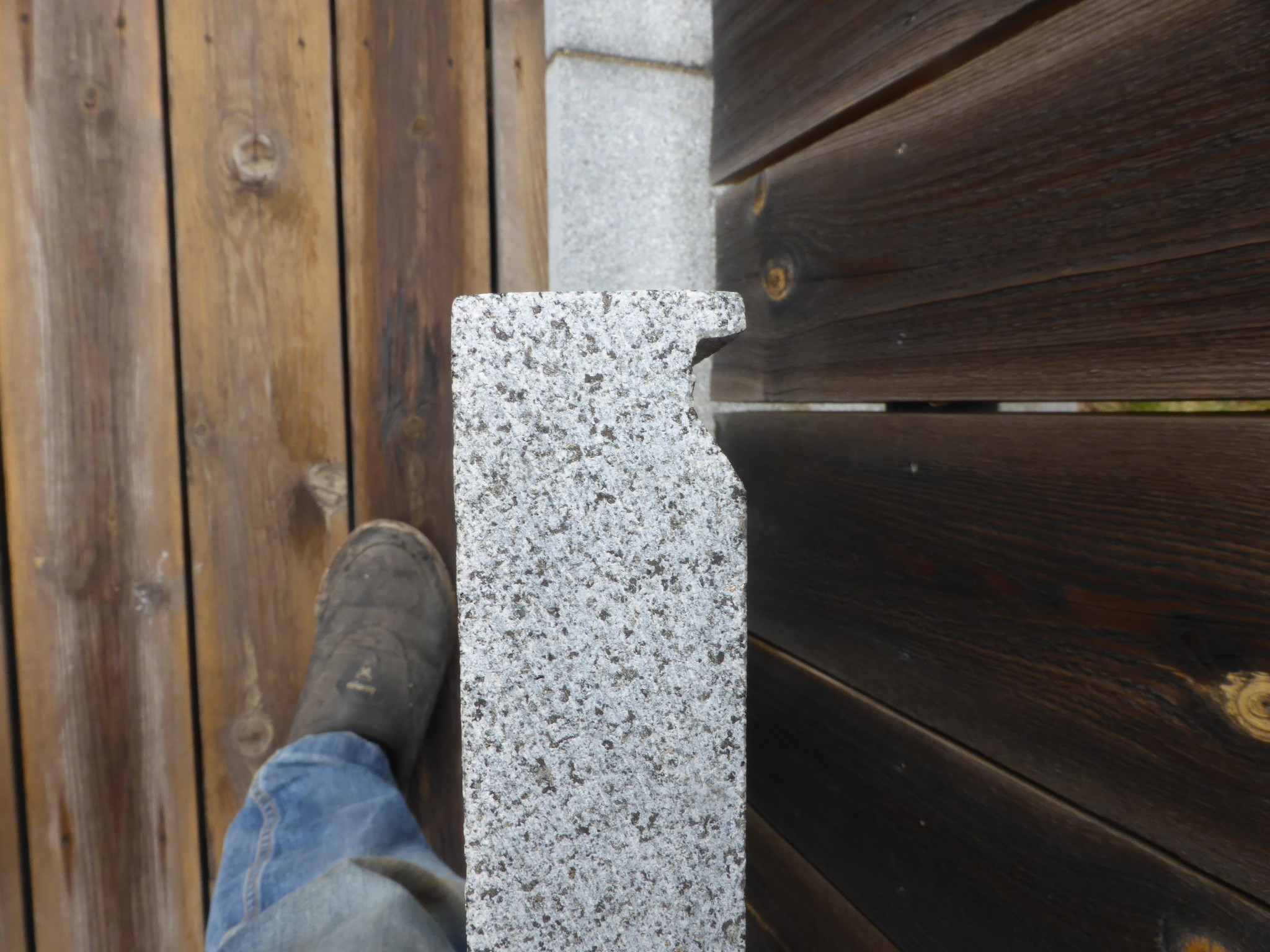
Excuse the interruption. Here's how I've managed to divert water away from the wall. During the cut-out, I used a board secured with clamps to ensure a straight line, and at the edge, one must be cautious to avoid any impacts that could knock out the edge. A grinder with a diamond blade works well for this, with a slope of about 2 cm. The concrete cap is on another wall with a triangular strip about 1 cm in from the edge, and both will create a line on the ground from the drips.
Sorry, something else came up in between. But here's how I've done it to get water away from the wall. For the cut, I placed a board with clamps to guide a straight line, and at the outer edge, you need to be careful not to chip the edge. A grinder with a diamond blade works well, slope about 2 cm. The concrete cap is on another wall and with a triangular strip about 1 cm from the edge, both create a line from the drip
Perfect, thanks.
My granite slabs are only 10mm thick so I will look for other thicker stone material to put on top.
Were the blocks you have there expensive?
Mine are 30 mm and it's probably needed if you want to track the drip edge underneath. No clue what they cost, the receipt is buried far back in the binders.
Click here to reply
Vi vill skicka notiser för ämnen du bevakar och händelser som berör dig.