
2,148 views ·
11 replies
2k views
11 replies
How to extend studs above interior door?
Hello everyone!
I'm better at renovating than doing it well, but now it might be a bit tricky?
1. Basic question: Is it possible to extend studs above the door without support underneath??
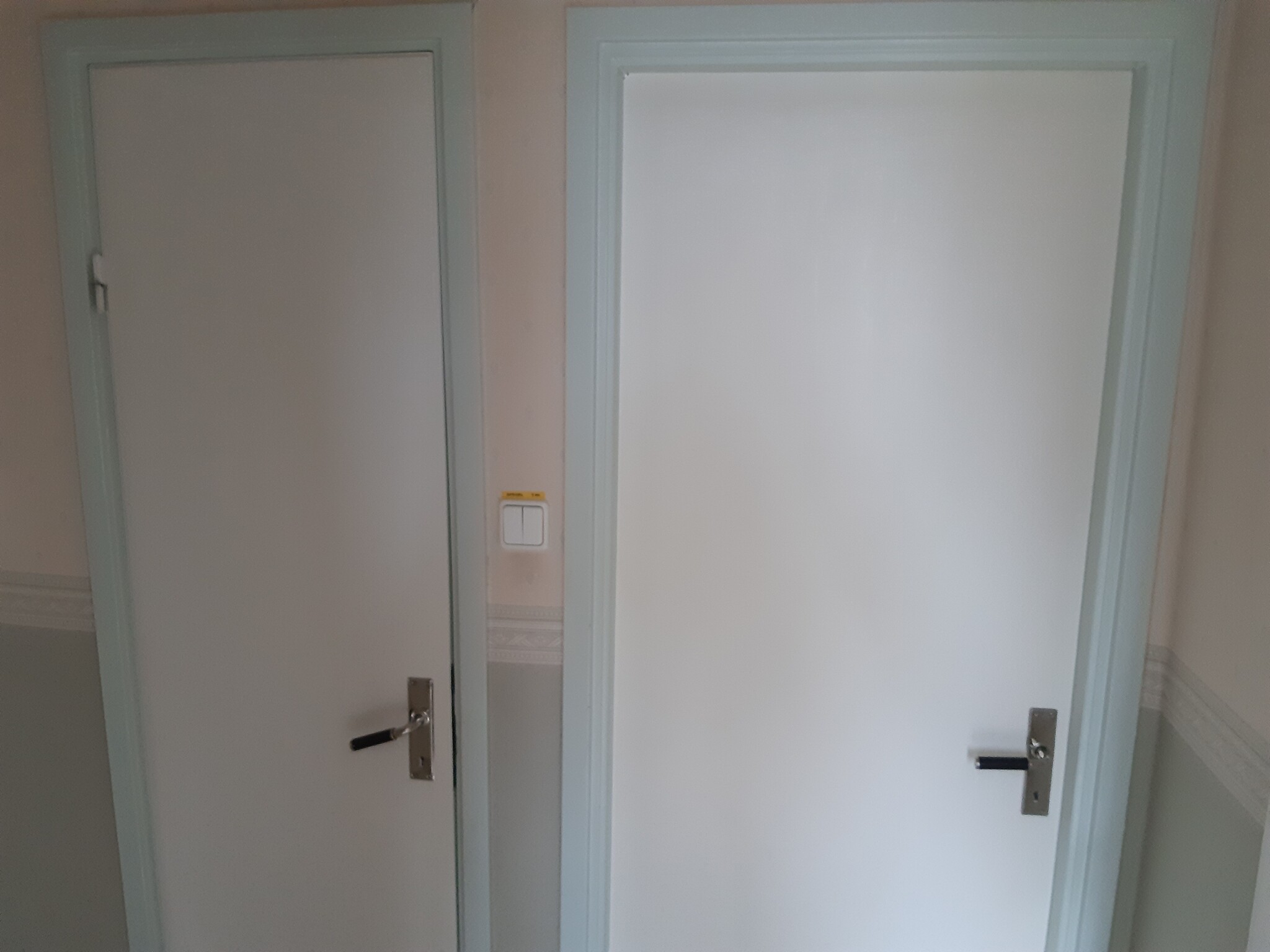
The bathroom door is to be replaced with a wider one (it's apparently called M8). Currently, it's only about 500 mm.
The bathroom adjoins the bedroom with a wider door.
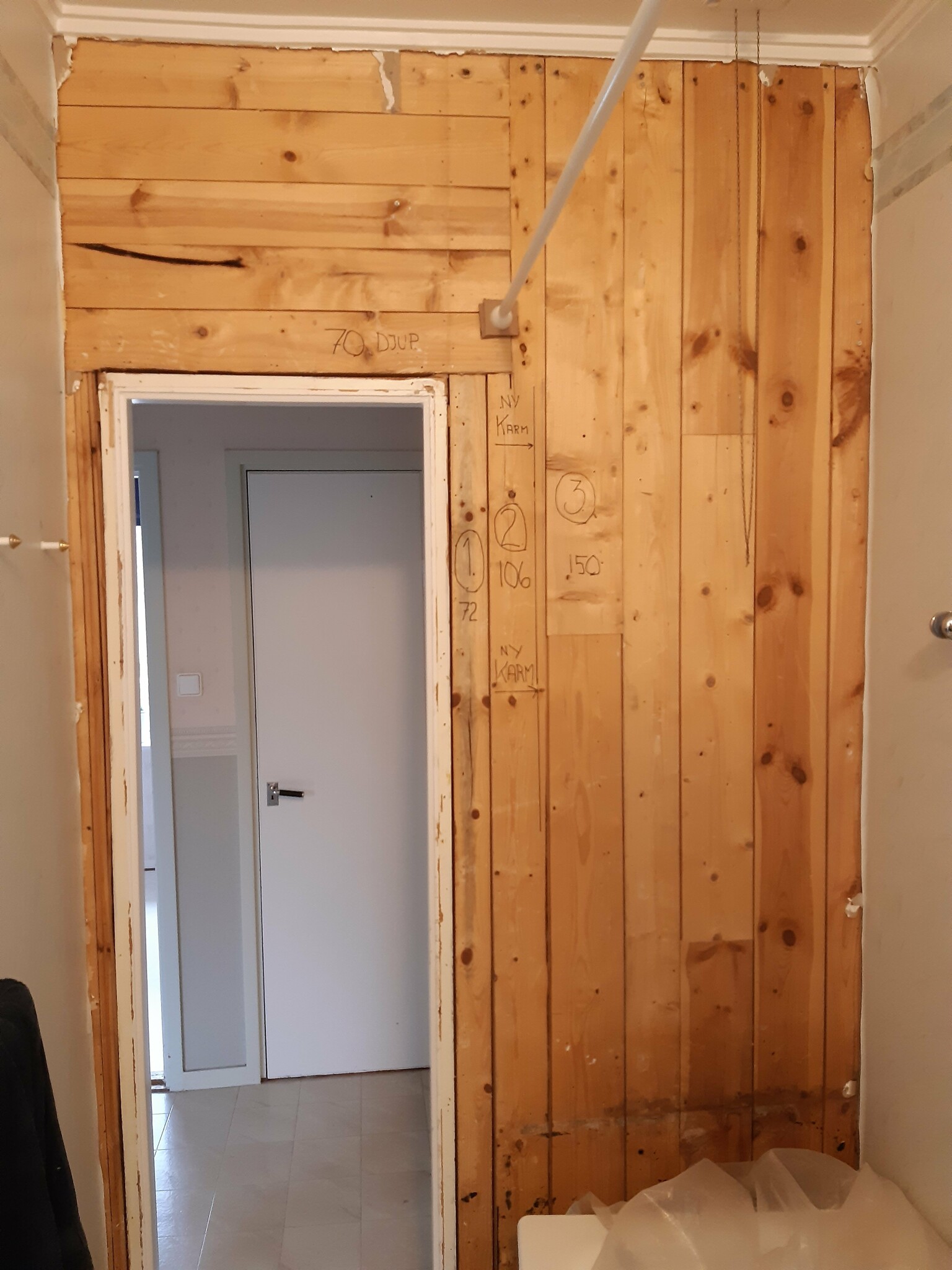
The studs above the door measure 70 mm deep (substantial pieces).
2. Is the ceiling that heavy?
(A cast concrete floor with reinforcement should be there, about 80 mm thick above the basement)
The vertical boards are tongued and grooved. To make room for a new door frame, studs 1+2 need to be removed.
3. A similar notch in stud 3 must be made, right?
4. How do I support the ceiling during the time the operation takes place?
5. Where do I place the support (so the operation can take place)?
Even partial answers to the questions are appreciated.
I'm better at renovating than doing it well, but now it might be a bit tricky?
1. Basic question: Is it possible to extend studs above the door without support underneath??
The bathroom door is to be replaced with a wider one (it's apparently called M8). Currently, it's only about 500 mm.
The bathroom adjoins the bedroom with a wider door.
The studs above the door measure 70 mm deep (substantial pieces).
2. Is the ceiling that heavy?
(A cast concrete floor with reinforcement should be there, about 80 mm thick above the basement)
The vertical boards are tongued and grooved. To make room for a new door frame, studs 1+2 need to be removed.
3. A similar notch in stud 3 must be made, right?
4. How do I support the ceiling during the time the operation takes place?
5. Where do I place the support (so the operation can take place)?
Even partial answers to the questions are appreciated.
Last edited:
The question is whether it is a load-bearing wall and how the roof trusses look? Is there a truss right above the door?
That there is a concrete slab on which the interior walls stand is good, and then you should be able to notch into plank 3 in the picture to place a new load-bearing beam above the door.
How far to the "left in the picture do the crosspieces continue? It looks like there is more plank wall to the left of the door, so somehow you need to support the horizontal pieces you cut.
I would think that the horizontal wood is made with the same as the other walls (the vertical) and it was not uncommon to use 2 1/2-3 inch wood for it.
If there is a truss right above the door, I guess you need to support it while you open up and add new support underneath, and then maybe it is possible to place a brace just under the truss on one side or the other of the door opening.
Maybe there is an upper floor, and then it's the slab that needs to be supported. If there is no upper floor but an attic, and you can access the trusses there, maybe you can lift that truss temporarily instead?
That there is a concrete slab on which the interior walls stand is good, and then you should be able to notch into plank 3 in the picture to place a new load-bearing beam above the door.
How far to the "left in the picture do the crosspieces continue? It looks like there is more plank wall to the left of the door, so somehow you need to support the horizontal pieces you cut.
I would think that the horizontal wood is made with the same as the other walls (the vertical) and it was not uncommon to use 2 1/2-3 inch wood for it.
If there is a truss right above the door, I guess you need to support it while you open up and add new support underneath, and then maybe it is possible to place a brace just under the truss on one side or the other of the door opening.
Maybe there is an upper floor, and then it's the slab that needs to be supported. If there is no upper floor but an attic, and you can access the trusses there, maybe you can lift that truss temporarily instead?
If the trusses are so closely spaced, it's unlikely that no truss is above any part of the door opening, and then it might be good to support it during the renovation. As mentioned, this can be done from above by building something that rests on the adjacent trusses and a tension strap that lifts the one you need to work under.
Then it's still a question of whether the wall is load-bearing to know how strong you need to build the new wall section above the door.
Then it's still a question of whether the wall is load-bearing to know how strong you need to build the new wall section above the door.
Good tips about the trusses. Complicating matters is that there are 45 cm of loose fill insulation in the attic. Hmm
I also believe that the planning continues to the left. Needs investigation.
If I cannot reinforce the truss from above, would a stämp be the remaining option?
Where can it be placed, and how to proceed with the interventions?
I also believe that the planning continues to the left. Needs investigation.
If I cannot reinforce the truss from above, would a stämp be the remaining option?
Where can it be placed, and how to proceed with the interventions?
It will be difficult to set the stämp in the door opening if you are going to remove what's above and replace it, or am I misunderstanding something?J Johan456 said:
Haha - I understand that it's not fun to dig into the loose fill insulation... had to do that when I had a ventilation pipe that came apart and lost a ring... it took a couple of hours to very carefully vacuum up the loose fill insulation, empty into a sack repeatedly until I managed to find it.S Småfixren said:Good tips on the roof trusses. Complicating matters is that there is 45 cm of loose fill insulation in the attic. Hmm
I also believe that the plan extends to the left. Needs to be investigated.
If I can't reinforce the truss from above, is a prop the only option?
Where can it be placed, and how, to be able to make the interventions?
Yes, to place a prop, you probably need to follow the lower chord of the truss and place a post on this side or beyond the doorway so you have room to work. Then it depends on what the ceiling looks like to know what’s best and whether you need to redo the ceiling in the hall or bathroom.
If it's an old house, there might be tongued-and-grooved boards under the truss and it’s been stretched with fabric? Has it been replaced with gypsum board today? Repairing a hole in a gypsum ceiling and painting is considerably easier than cutting up fabric/paper and restoring it.
Hmm.. so you mean that one should make a continuous support in one of the upper cross planks and then just replace the bottom one that is cut into standing plank 3 in the picture?J Johan456 said:
Then you should leave the upper parts of plank 1 and 2?
As it is now, the entire plank row over the door is hanging on standing 1 and half of 2.
Good idea, but as a fixer writes. How do I stamp when I simultaneously want to remove 1 or more studs from underneath? I was thinking of installing double 45x145 at the bottom up to plank 3. Use the replaced ones and extend the ones above so they reach up to 3. Crazy
Click here to reply