I've gotten a bit lost in my thoughts, and there are surely much more experienced fixers here who can set me straight.
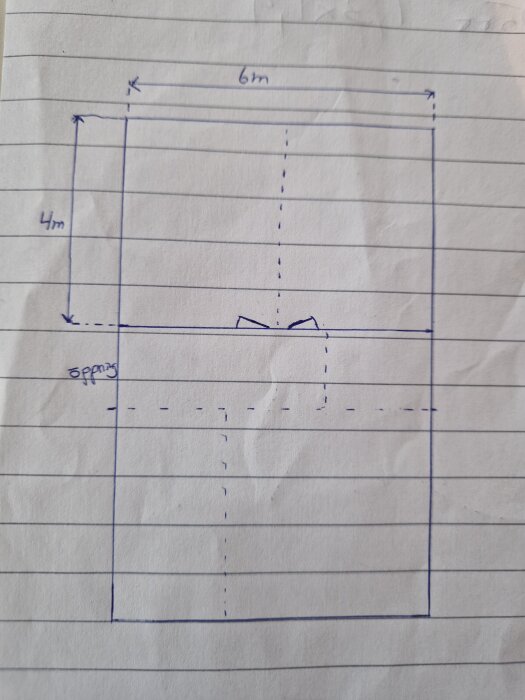
Attaching an image of the area I'm building.
Unfortunately, it's a paper sketch.
It's the top section that is to become two bedrooms.
The dashed section is to be built later and is other rooms currently in use.
The original idea was to put up furring strips, ceiling, and then interior walls.
But how do you proceed when the furring strip cannot end evenly at the rafter?
Plan to build the top rooms first, measuring 4m.
The dashed interior wall I want to build after the ceiling, so I can remove it in the future if needed.
The interior wall will be at 4m, and the rafters are 4.8m.
I want to spread out the joints (since you're not supposed to place all joints in the same spot), but it ends up in the middle of the room or in the section I'll be building on next if I spread out the joints.
How should I think?
Build the wall first and joint below it?
Place all joints at 4.8m (feels wrong, but it's in the middle of the corridor which will be 1.5m, so not much load)?
How are the roof trusses oriented? From left to right according to the sketch or from top to bottom?
Will the entire surface get a new roof at the same time?
I would have no problem splicing all the spars on the same truss - they will be screwed into it, so it will be strong enough to hold the roof covering and insulation. Not splicing in the same place can be a question of appearance or strength, but in this case, it doesn't matter much.
If you're going to redo the entire roof at the same time and then build walls, do the entire roof first and then the interior walls, which you attach to the spars.
The trusses run from left to right sparsely from top to bottom.
The entire surface will get a gypsum ceiling at the same time.
then I should be able to joint all at 4.8m
Then I don't need to build the inner ceiling before the wall that goes from left to right but it's nice to be able to continue into the next area as it may result in less work.
What might be good to consider is the wall that will divide the small rooms at the top. Where it will go, you need to add an extra frame sparsely to have something to screw the top rail against if it doesn't align with the "regular" frame. Otherwise, it will be difficult to attach it to just drywall
Yes, it would indeed be unfortunate to have built the entire roof and then realize that there's nothing to attach the wall to .
Most of the walls in our new upper floor are across the sparse paneling, but we have a rather long wall that goes along the sparse/across the roof trusses, so I just added an extra sparse panel there to attach the wall. Be sure to measure carefully and mark on the wall below where it goes so you know when you need to build the wall.