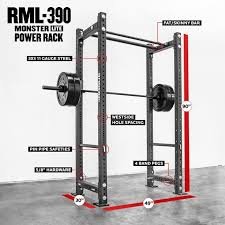
I have a small gym in the basement that has been very useful during these Corona times. Now I want to buy a so-called Power Cage according to the picture at the bottom and set it up. Since I don't have unlimited space, I need a model with limited depth. This means that the unit must be bolted to the floor to stand securely. (I have looked at all the available models of larger cages that don't need to be bolted, but have concluded that they take up too much space, so that route is uninteresting. The same applies to so-called half racks - all units that don't require bolting and meet my other requirements become too deep.)
The problem now is that I have water-based underfloor heating in the basement. In the rest of the areas, which have concrete floors, my thermal camera works perfectly and I can see exactly where the loops are. However, in the gym, the previous owner glued an anti-slip mat to the floor, which makes the thermal camera ineffective as the rubber mat evenly distributes the heat. One might think about removing a square somewhere and checking, but the risk is that adhesive residues still contribute to smearing the image, resulting in uncertain results. I asked a handyman how he would solve this and got the answer that he would drill at random and then repair the damage if it occurred. I don't plan to go that route since the total amount of water in the basement's underfloor heating system is 1.2 m3.
So: how do I solve this problem? Questions I am grappling with myself are:
Approximately how far below the floor surface does water-based underfloor heating typically lie in a concrete floor?
Is it practically feasible to use a larger Metabo hammer drill to drill just one millimeter at a time to see if you encounter a loop? We’re not talking about a precision tool, after all.
Is there any type of concrete anchor that does not require a large installation depth, and if so, what might such an anchor be called?
Is it feasible/serious to consider using some kind of extremely strong construction adhesive instead, and what would this be called? I am fully aware that this is not ideal for large lateral forces applied at the top of the rack, so it's noted that I won't be doing chin-ups, etc., in the cage. The only scenario where this might occur is if I literally fall forward or backward during a squat, and thankfully, that has only happened once in my life (blackout).
Why not attach it to the ceiling in 4 places, it can be done with a little imagination by using adjustable joist hangers and pressing the frame down towards the floor. Then it might be good to place a rubber mat between the floor and the frame, so it doesn't slip. Otherwise, I wouldn't drill. The cords can be anywhere from 5 cm to 10 cm down in the concrete.
I would tear up the carpet and try the thermal camera again, possibly with a temporary shutdown of the underfloor heating long enough for the floor to cool down first so the contrasts are better (if you haven't already done so, cooling down with the carpet still on might be worth a try first if it's okay for it to be a little cooler for a while).
I personally wouldn't like to drill based on feel, even if very carefully.
@jonaserik - constructive idea with the ceiling mounting! Thumbs up for that. Unfortunately, it won't work because I have a gypsum ceiling and after having hung up a lot of other things, I know that the underlying framework is a bit iffy.
@ullberg - I probably don't want to tear out the whole carpet but more try to remove a few squares where the rack will stand. Do you think it could work in combination with cooling down the floor to increase the contrast as you suggest?
Optionally, you might have the outer edges with a coarser rule or sparse paneling, usually 28X70, which can be attached across the ceiling and with adjustable beam plinths press up so it pinches tight. Just a thought in the whole, then no fasteners are needed in the plaster.
I think I understand what you mean, but do you happen to have a picture of such an adjustable beam foundation pad? The only ones I find online are those used for outdoor terraces, and I guess that's not what you have in mind.
Maybe one like this https://www.bauhaus.se/stolpsko-2-t...QkVM4ThK_cL-PxoCRJsQAvD_BwE#go-to-description
But then you would have to drill a new hole in your frame, and I'm not sure about the distance between the frame and the ceiling, but there are longer ones available.
Perhaps you'll get an idea of how it can be done. It's possible to use a slightly thicker vantskruv used in reverse, but it's a bit harder to apply since they are made for pulling.
Rent a ground scanner, it shows you where rebar, water pipes, etc. are located. Most people lay the heating pipes against the insulation, i.e., under the rebar. But there are also those (like us) who lay them against the rebar, then it's only about 2-3cm down to the pipes.
@ullberg - I probably don't want to remove the entire carpet but rather try to remove some squares where the racket is supposed to stand. Do you think that could work in combination with cooling down the floor to increase the contrast as you suggest?
Well, it kind of depends on how deep they are (which, conversely, seems to be to your advantage), but if I can see my pipes through 28mm wooden flooring fairly well without contrast (at least I can see the difference between warm/cold, and since it's a regular pattern, I would probably say that I can point them out with reasonable precision) and clearly with prior shutdown, I would say it’s worth a try...
Thank you ullberg and xLnT. If it is to be bolted downwards, that will be the way I go.
jonaserik - I have thought quite a bit about your solution and believe it might work. I wonder if this should be done like this:
1. Screw two stumps of appropriate beams into the ceiling across the joists. I have already done this with a 4x4 across the entire length of the room to have mounts for rings, pull machine, sandbag, etc., so I know it works. These beams will then be parallel to the short uprights in the cage's gables.
2. Use this post bracket: https://www.beijerbygg.se/privat/sv/stolpsko-uniflex-4justerbar-004621841
3. Turn the post bracket upside-down so that the threaded rod goes into a hole in the ceiling beam stump and the "fork" embraces the cage's uprights on either side. With some adjustments, you might even be able to put a bolt through both the post bracket and the existing holes in the cage uprights.
That construction should have good potential to fixate the cage to the floor while also handling load in both longitudinal and lateral directions. What do you/you all think?
What can happen if you turn the thread upward is that it's a bit thin with the rule, so the bolt itself goes through the plasterboard, hence the shoe should be attached to the ceiling joist and the bolt goes down if there is a hole that fits or drill/file something that exists. Whatever way you proceed, don't forget a rubber piece between the frame and the floor.
Click here to reply
Vi vill skicka notiser för ämnen du bevakar och händelser som berör dig.




Herr Hysteres said: