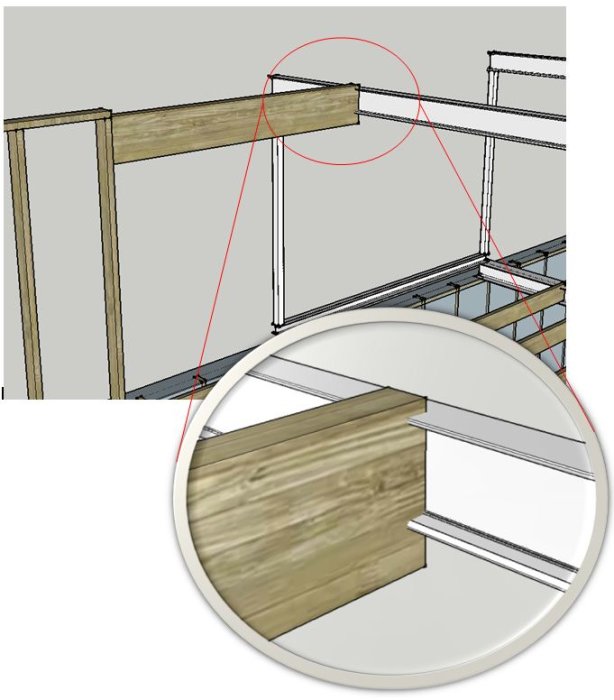
The steel frame is already there. It is an INP 100 (steel beam, I-beam, 100 mm)
Now I am extending the house a bit and need to connect a glulam beam to this.
On the glulam beam, 1 or 2 rafters will rest (23-degree roof slope - 6.6 meters span)
The glulam beam is approximately 2.3 meters long. Dimension probably 66x315 or 90x315.
Question: How should I best connect this glulam beam to the I-beam? The idea is that the I-beam should support the load carried by the glulam beam.
Unfortunately, I cannot place the glulam beam higher up (on top of the I-beam); it doesn't work with the overall design of the house.
Long threaded screw through the web of the I-beam into the end grain of the glulam beam.
Or
Construction angles on each side of the glulam screwed into the web.
Oh my God.
Be glad you're not asking how to install a junction box, then you'd have the entire forum's electricians pointing out that only authorized personnel are allowed to touch junction boxes.
Construction can be handled by anyone.
Is the I-beam dimensioned to handle the new extra load?
Is it tipping?
As Matti says, you should have a "bracket" at the bottom (can be folded in to be flush). However, you might encounter issues with the I-beam twisting when the load comes in "off-center". The prototype's solution prevents this, so a combination and you're safe.
Goodness.
Be glad you're not asking how to attach a junction box; otherwise, you'd have the entire forum's electricians pointing out that only qualified individuals are allowed to handle those.
Construction can be handled by anyone.
Is the I-beam dimensioned to handle the new extra load?
Will it tip?
Yes, it is dimensioned for the extra load, I have checked this with a structural engineer. However, I have not received a good suggestion for the attachment.
As Matti says, you should have a "suspender" at the bottom (can be folded in to be flush). However, you may have problems with the I-beam twisting when the load comes in "off-center". The prototype's solution prevents this, so a combination, and you are safe.
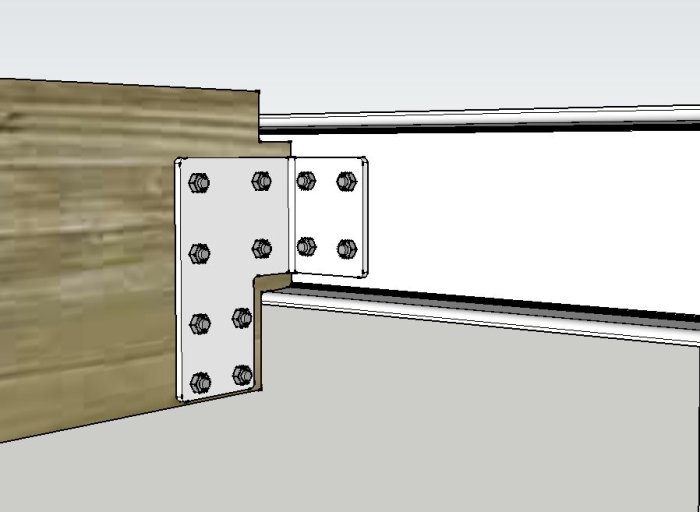
OK, is this sufficient as a suspender, or does the suspender also need to hang over the I-beam? I'm thinking of 8 mm steel plate and M10 threaded rod or similar.
Combined with two screws through the web of the I-beam straight into the end grain of the glue-laminated beam.
Well, it's a bit like trying to lift yourself by your hair, I thought about hanging on the I-beam but realize it will be a bit trickier to achieve. On the other hand, you prevent the wood from splintering, which might be enough, the wooden beam looks sturdy.
Another option is to keep the wooden beam as mentioned above and place steel plates on the sides with a number of through-threaded rods, at least 2 of them should be positioned low. The steel plate should then go into the I-beam in the same way as the wooden beam. Just be careful that the screws into the end grain don't collide with a threaded rod.
It could actually be possible to make a combination if you want double security, i.e., both clamp attachment from the side and from above.. Both braces and belt!
Try to attach a plate in the middle of the beam and then connect the wooden beam to this plate. This way, you get the load directly into the beam and avoid twisting. If you only place it on the lower flange, you might get local deflection of the flange.
The proportions in the image are incorrect; the steel beam is 100 high and the glulam is 315, i.e., 3 times as high. Redraw to see if it makes sense.
I wouldn't use through bolts through wood, it will become loose over time (and hitting the metal on the other side isn't easy). Use wood screws or anchor screws.
Then, remember that a glulam that is 66 thick needs lateral bracing both at the top and bottom so it doesn't "tip over."
There is a wrong proportion in the picture, the steel beam is 100 high and the glulam 315, i.e. 3 times as high. Redraw so one can see if it makes sense.
I wouldn't use through bolts through wood, it will become loose over time (and finding the metal sheet on the other side is not easy). Use wood screws or anchor screws.
Also remember that a glulam that is 66 thick needs lateral bracing both at the top and bottom so it doesn't "tip over."
Protte
Good point. I stated incorrectly above - the beam is an INP 200, i.e. 200 high and 100 wide. The drawing is correct.
French wood screws or anchor screws sound more sensible, I also thought about the problem of drilling straight. You should still be able to achieve a strong clamping joint.
Last edited:
Vi vill skicka notiser för ämnen du bevakar och händelser som berör dig.