
1,697 views ·
5 replies
2k views
5 replies
How should I update my interior wall with an air gap?
I have an interior wall between a future office and the bedroom in our recently acquired house from the 60s. Over the weekend, I removed the wall panels from the office side and discovered that the interior wall is built with an air gap; it seems like they were quite smart here and optimized for sound insulation against the bedroom. My intention is to further optimize the sound insulation and also install OSB to get better load-bearing capacity to mount things on the wall, both on the bedroom side and in the office.
The construction of the wall consists of
12 MDF - 35x45 stud - 3 masonite - 10 air gap - 3 masonite - 35x45 stud - 12 MDF (mm)
So it's a mirrored framing on both sides of the air gap in the middle. However, the framing is quite odd and the distances vary from CC400 to CC250 (though the variation might also be to break sound in the wall), and the timber is very flexible, so it's not really possible to mount new panels without setting up new studs at the correct distances.
So finally to my actual question; what should I do with this wall? I have two immediate options I'm considering:
1. Remove the entire construction with the air gap and install Gypsum - OSB - 75mm stone wool - OSB - Gypsum. However, I guess this would worsen the sound insulation in the wall and at the same time mean more work.
2. Install new studs 45x45 or 75x45 (with the wide side out) at CC600, place 45mm glass wool/stone wool between the studs and keep the air gap in the middle. Then install OSB + gypsum on both sides of the wall.
I'm leaning towards option 2 since it should provide really good sound insulation as it would be the same construction as before but with more insulation and double panels. I'll also get the OSB, so the load-bearing capacity is achieved. What's a bit tricky is that the old studs are 35mm deep, and new studs will be 45mm, but this basically just means that the new studs will solely support the wall panels while the old ones support the masonite panels in the middle.
The construction of the wall consists of
12 MDF - 35x45 stud - 3 masonite - 10 air gap - 3 masonite - 35x45 stud - 12 MDF (mm)
So it's a mirrored framing on both sides of the air gap in the middle. However, the framing is quite odd and the distances vary from CC400 to CC250 (though the variation might also be to break sound in the wall), and the timber is very flexible, so it's not really possible to mount new panels without setting up new studs at the correct distances.
So finally to my actual question; what should I do with this wall? I have two immediate options I'm considering:
1. Remove the entire construction with the air gap and install Gypsum - OSB - 75mm stone wool - OSB - Gypsum. However, I guess this would worsen the sound insulation in the wall and at the same time mean more work.
2. Install new studs 45x45 or 75x45 (with the wide side out) at CC600, place 45mm glass wool/stone wool between the studs and keep the air gap in the middle. Then install OSB + gypsum on both sides of the wall.
I'm leaning towards option 2 since it should provide really good sound insulation as it would be the same construction as before but with more insulation and double panels. I'll also get the OSB, so the load-bearing capacity is achieved. What's a bit tricky is that the old studs are 35mm deep, and new studs will be 45mm, but this basically just means that the new studs will solely support the wall panels while the old ones support the masonite panels in the middle.
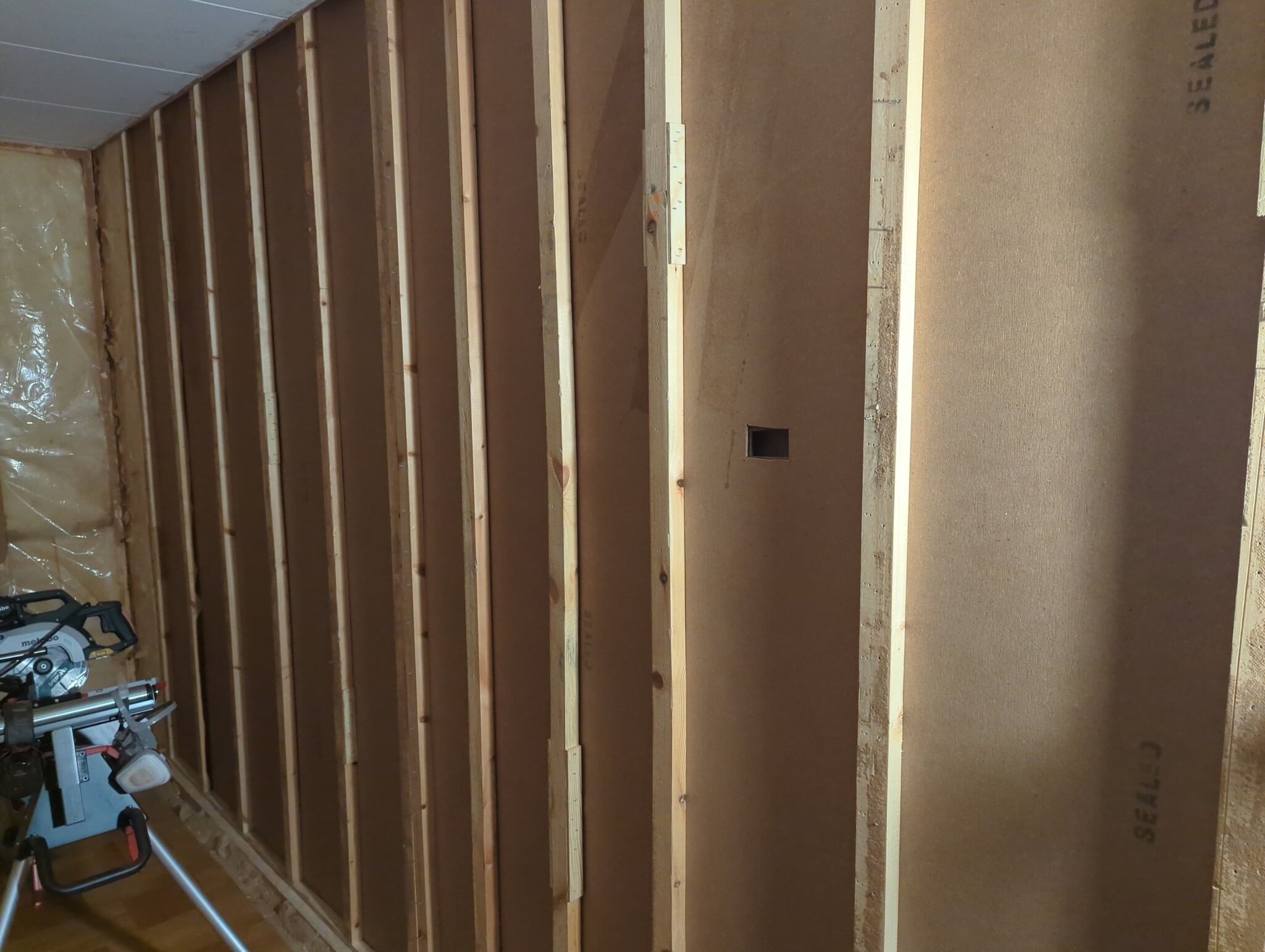
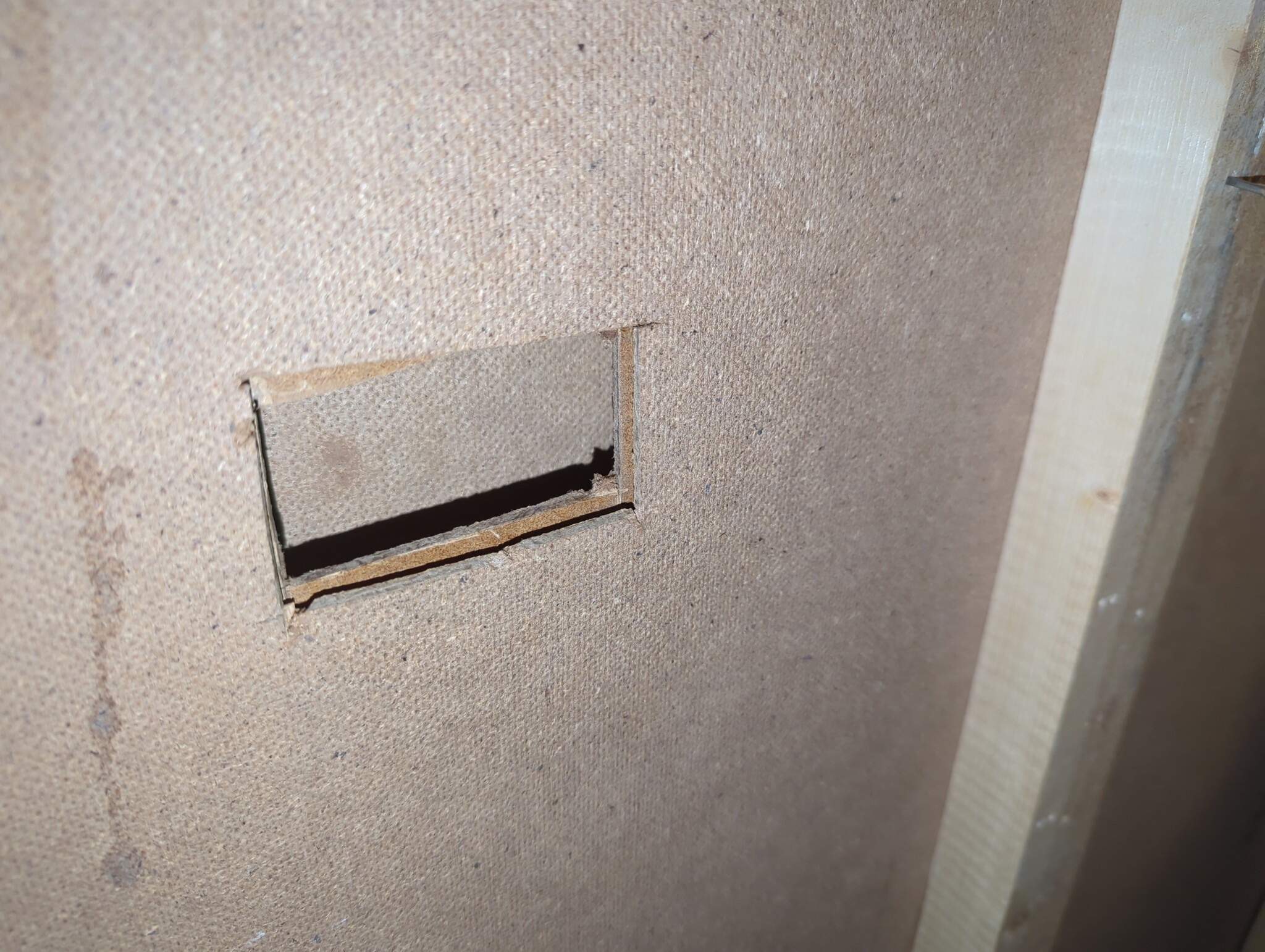
Hello,O octomore said:I have an interior wall between a future workspace and the bedroom in our recently acquired house from the 1960s.
This weekend, I tore down the wall panels from the workspace side and discovered that the interior wall is built with an air gap—it seems they were quite smart here and optimized for sound insulation against the bedroom. My intention is to further optimize for sound insulation and at the same time add OSB to allow for better support to mount things on the wall, both on the bedroom side and in the workspace.
The wall's construction consists of
12 MDF - 35x45 frames - 3 hardboard - 10 air gap - 3 hardboard - 35x45 frames - 12 MDF (mm)
So there is a similar mirror-image framing on both sides of the air gap in the middle. The framing is quite odd, and the distances vary from CC400 to CC250 (the variation might also be for breaking sound in the wall), and the timber is very flexible, so it's not really possible to put up new panels without fixing new frames at correct distances.
So finally to my actual question; what should I do with this wall?
I spontaneously have two options that I'm considering:
1. Remove the entire construction with the air gap and add Gypsum - OSB - 75mm stone wool - OSB - Gypsum. However, I guess this would worsen the sound insulation in the wall and at the same time mean more work.
2. Put up new frames 45x45 or 75x45 (with the wide side outward) at CC600, insert 45mm glass wool/stone wool between the frames and keep the air gap in the middle. Then put up OSB + gypsum on both sides of the wall.
I'm leaning towards option 2 since it should provide really good sound insulation because it will be the same construction as before, but with more insulation and double panels. I'll also have the OSB to achieve the support. The tricky part is that the old frames are 35mm deep, and new frames will be 45mm, but that probably just means that the new frames will solely carry the wall panels while the old ones support the hardboard panels in the middle.
The air gap itself does not insulate sound. However, it eliminates vibrations that would otherwise go straight through the wall, for example. If you have beds against that wall and you turn at night and happen to hit the wall lightly, the vibrations are noticeably dampened.
I think option No. 2 seems sensible, though I would insulate both walls fully—70mm in the new one you create and 45mm in the old wall you have. It does not matter if the insulation is in contact, but the wood needs to be separated by the air gap, as you call it…
Hope you understand🙃
Exactly, I completely understand that it's the disconnection of contact that achieves sound properties, not that the air itself insulates. My initial post was so long that it was inevitable for something unclear to slip in.Rejäl said:Hello,
The air gap itself does not soundproof anything. However, it does eliminate vibrations that would otherwise go straight through the wall, for example. If you have beds against that wall and turn over at night, you might accidentally hit the wall lightly, the vibrations are noticeably dampened.
I think option number 2 seems sensible, though I would insulate both walls fully—70mm in the new one you're building and 45mm in the existing wall. It doesn't matter if the insulation makes contact; it's the wood that needs to be separated by the air gap, as you call it...
I hope you understand🙃
However, I think you might have misunderstood, or I'm misunderstanding you when you mention 70mm insulation in the new one and 45mm in the old one—there's only one wall, and the question is where I should have it
 My fundamental consideration was really whether I should tear out the old construction and replace it with 75mm insulation, or improve the old one instead.
You write:O octomore said:No, exactly, I fully understand that it's the disconnection of contact that achieves the sound properties, not that the air itself insulates. My initial post was long enough that it was inevitable something unclear slipped in.
However, I think you misunderstood, or I am misunderstanding you when you mention 70mm insulation in the new and 45mm in the old - there is only one wall, and the question is where should I put it in
2. Put up new studs 45x45 or 75x45 (with the broad side outward) at CC600, insert 45mm glass wool/rock wool between the studs and keep the air gap in the middle. Then put OSB + plasterboard on both sides of the wall.
Then I understood it as if you would keep the wall you show in the picture and build a new one with an air gap in between…🙃
Oh, no, my thought was to put new studs between the existing ones to achieve the correct CC measurementRejäl said:You write:
2. Set up new studs 45x45 or 75x45 (with the wide side facing outward) at CC600, insert 45mm glass wool/stone wool between the studs and maintain the air gap in the middle. Then put up OSB + plasterboard on both sides of the wall.
I understood it as you would keep the wall shown in the picture and build a new one with an air gap in between…🙃
Click here to reply
Similar threads
-
Yttervägg blir innervägg, bjälklagsanslutning och luftspalt
Utbyggnad och tillbyggnad -
Luftspalt mellan timmerstomme och innervägg?
Isolering -
Air gap between interior birch plywood wall and insulation (with moisture barrier against the plywood)
Building Materials and Construction Technology -
Interior wall in basement 90° to outer wall - air gap?
Building Materials and Construction Technology -
Luftspalt i tegelvägg som blir innervägg
Fasad