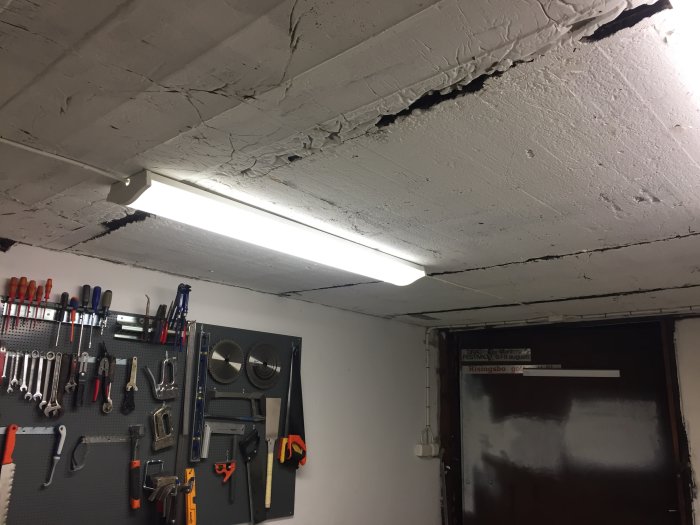
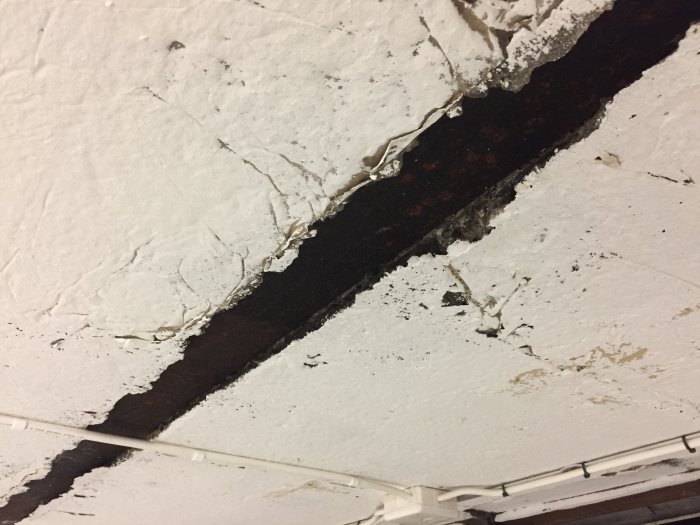
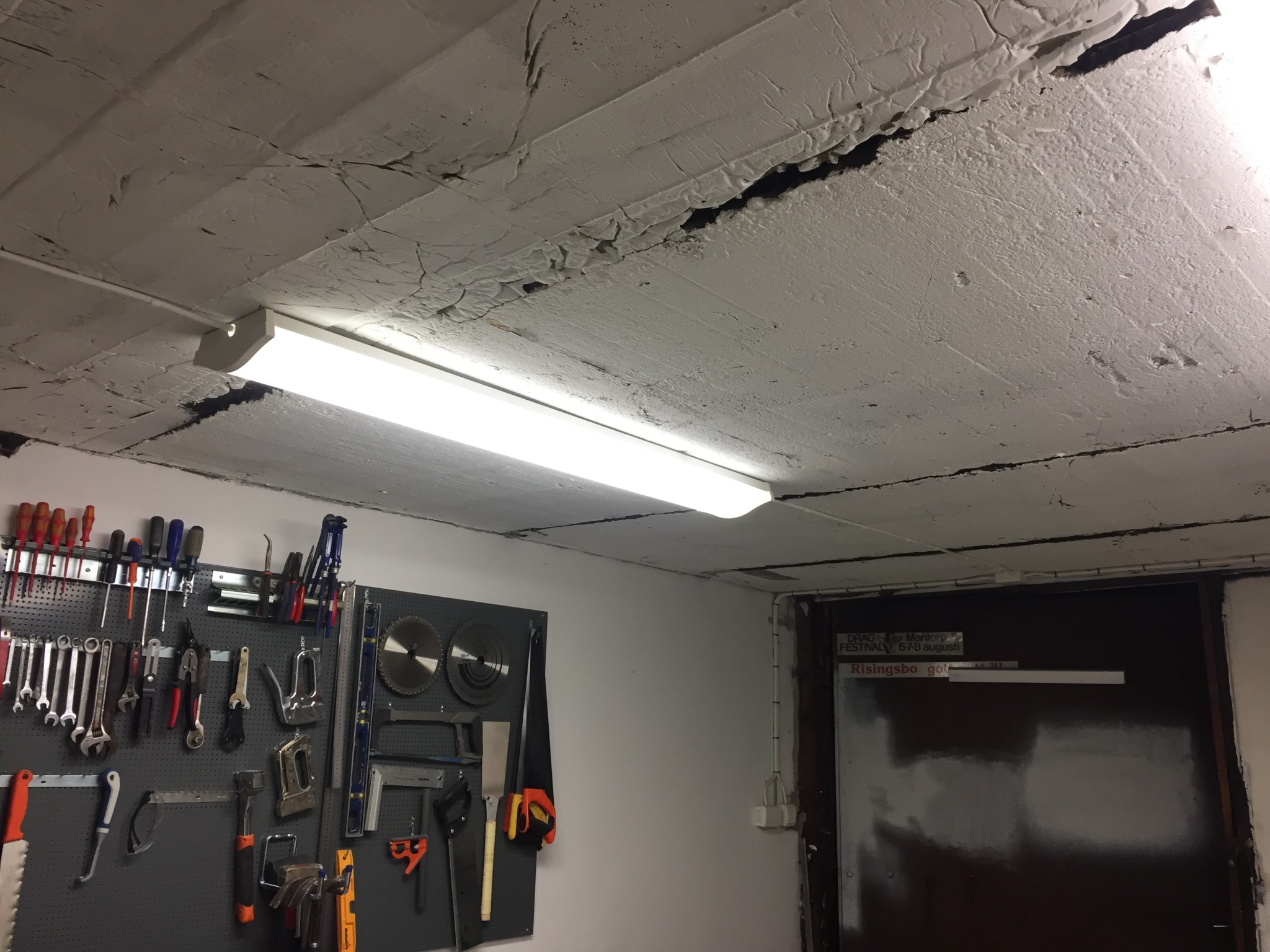
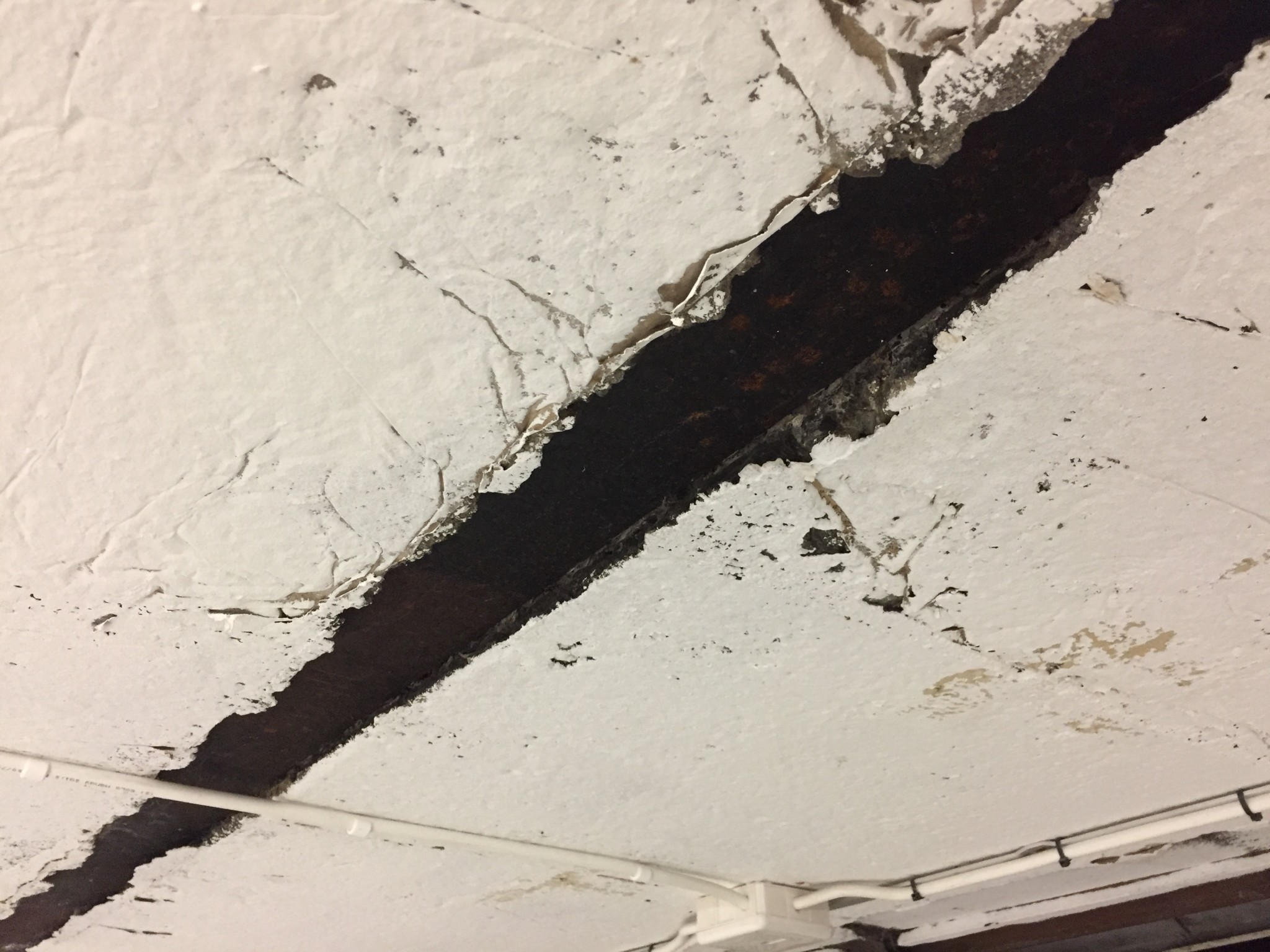
I have a major headache about how to deal with the basement ceiling. The ceiling is cast in concrete and the form was lined with old newspapers. This has resulted in the entire ceiling being full of paper that is either stuck or coming off. The ceiling is painted white today and it doesn't look good at all.
The reinforcement consists of railway tracks at cc 120. These are visible because the concrete hasn't flowed under them. The entire ceiling sags about 30mm in the middle.
Underside of the railway tracks.
I can either use a wire brush on the angle grinder over the entire ceiling (35 sqm) to remove all loose paper. Then fill in the voids under the tracks with mortar and apply a full coat of filler on the ceiling before painting.
I think this solution seems most sensible, but it will be extremely time-consuming.
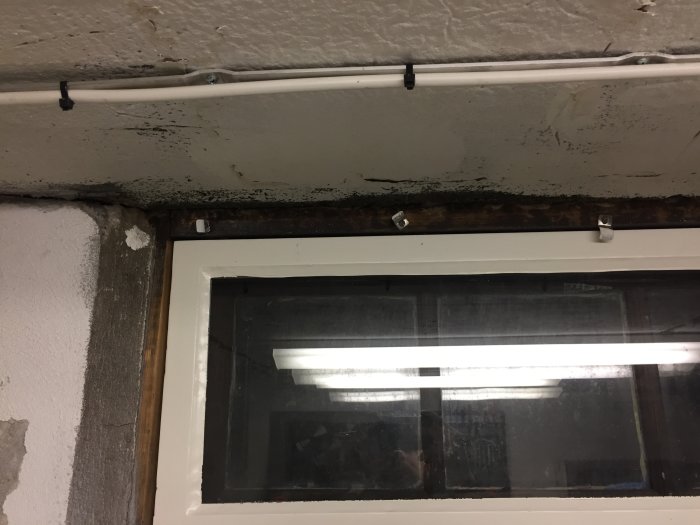
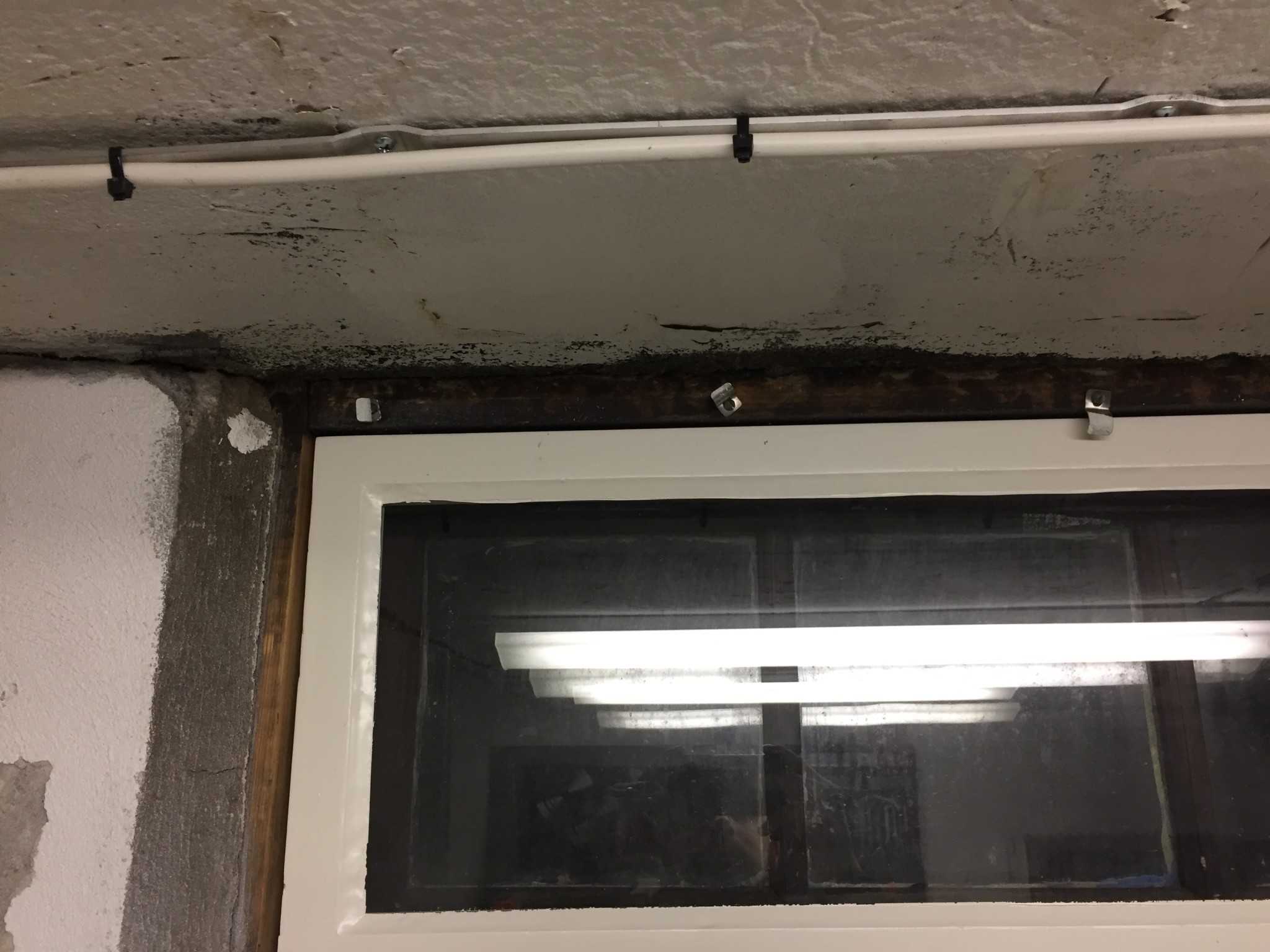
The alternative is to attach battens to lower the ceiling and install drywall. The problem then arises with the windows that are placed so high that the ceiling would build below them.
Hardly any space above the window...
How would you do it? Perhaps there is a smarter solution that is not incredibly time-consuming or expensive...
(The space is heated and a dehumidifier is installed)
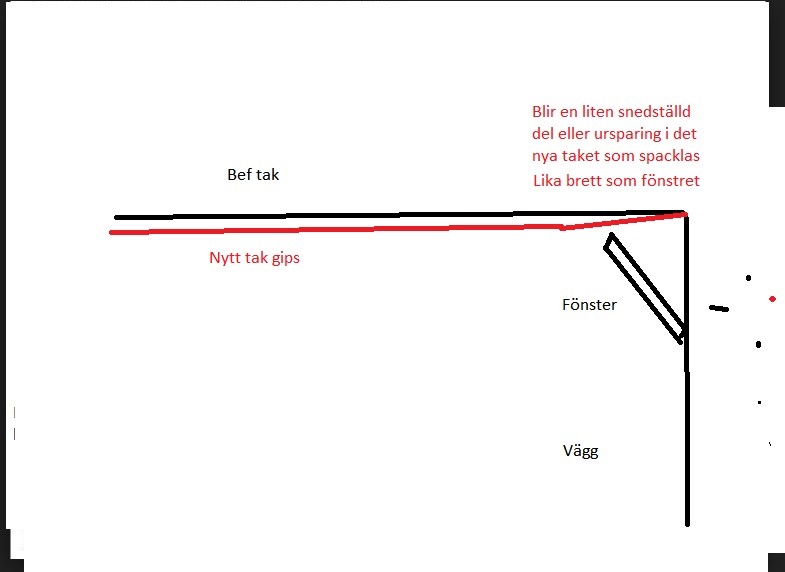
From what I see, the windows are openable, it's possible to put plasterboard on the ceiling, but then you need to do it according to the sketch, with a cutout completely if it's not possible to go diagonally up the frame (due to space constraints) I have seen it before in basements and it works
It will only require filling about 0.5 m2 per window, maybe.
As I see it, the windows are openable, it is possible to put gypsum in the ceiling, but then you have to do according to the sketch, a recess completely if it is not possible to go diagonally up the frame (lack of space) have seen it before in basements and it works. It will only be a matter of plastering 0.5 m2 per window perhaps,
The windows are not actually openable. The inner panes are just placed there for now.
TThomas_Blekinge said:
Do you want a smooth appearance on the ceiling or can you consider a rustic uneven look? This difference makes a lot for your decisions.
In that case, it's just a cosmetic issue. Plasterboard or render. The bump remains regardless of the method.
Yes, the bump isn't the end of the world. However, it can be straightened with frames before plasterboard. But then the windows are in the way. I definitely don't want to stand and sand the entire ceiling by hand with the angle grinder
I am not the right person to answer this. Personally, I dislike glue on principle even if it's necessary, it's so definitive. I would use nail plugs, but others probably know this better. Use extra thin so-called renovation plaster.
I studded with 22mm regular planks which I screwed up, and into this, I placed huntonit/gypsum. I even got room for hidealite Spots in LED! This was when I was renovating in the basement.
I applied drywall sheets using adhesive (fix) on a similar surface. I hadn't painted, so you'll need to start by brushing away any loose material with a wire brush. I applied the adhesive with a 12mm trowel and pressed the sheets up using a lift. I applied the adhesive while the sheet was on the lift.
I would use a framework with sparsely placed panels and then drywall. The solution for the windows, I would do some type of solution as "liteavvarje" suggests in their sketch.
I would frame up with sparse paneling and then plasterboard. The solution at the window, I would make some type of solution as "liteavvarje" suggests in their sketch.
I also think it feels like a pretty good solution. Regular drywall or fiberboard? Pros and cons?
Vi vill skicka notiser för ämnen du bevakar och händelser som berör dig.