

We don't understand how the chimney is constructed in the house we've bought. From the 2nd floor and upwards, it is a nice square (or rectangular, haven't measured). But on the 1st floor and especially in the basement, it is irregularly shaped and there are brick walls extending from the core.
Could it be that it was built this way for stability or as firewalls? Those of you who have demolished or built chimneys, how is it actually constructed? The house is from '36.
We are considering exposing parts of the core and are, of course, wondering what it might look like beneath the surface.
Could it be that it was built this way for stability or as firewalls? Those of you who have demolished or built chimneys, how is it actually constructed? The house is from '36.
We are considering exposing parts of the core and are, of course, wondering what it might look like beneath the surface.
Hello
We have a house from '34 with a similar solution. We have 8 chimneys that on floors 1 and 2 are in a row, so the chimney stack is about 50x150cm. In the attic and upwards, the chimney stack changes shape and becomes perhaps 80x100cm. Now the chimneys are in 2 parallel rows with 4 chimneys per row. Hope you understand. There is also a short brick wall about 50cm coming out perpendicular from the chimney stack on floors 1 and 2, probably for stability reasons.
We have a house from '34 with a similar solution. We have 8 chimneys that on floors 1 and 2 are in a row, so the chimney stack is about 50x150cm. In the attic and upwards, the chimney stack changes shape and becomes perhaps 80x100cm. Now the chimneys are in 2 parallel rows with 4 chimneys per row. Hope you understand. There is also a short brick wall about 50cm coming out perpendicular from the chimney stack on floors 1 and 2, probably for stability reasons.
I continue my thread as we have now entered the house and started thinking. The chimney seems to be constructed as ante75 describes above. I don't know the number of flues yet, as I haven't dared to go up on the roof.
The thing is now that from the wall there are brick walls extending out on all sides, including in the kitchen. In the kitchen, one wall forms the cleaning closet that is opposite the built-in cabinet in the serving passage. I like the solution with a spacious cleaning closet. But my partner had plans for that wall with baking surface etc. And I can agree that we could have created a much more practical kitchen if we could just remove the brick wall.
What do those of you who know this think? Is it vital for the load-bearing of the chimney, or does it receive sufficient support from the remaining brick walls?
The thing is now that from the wall there are brick walls extending out on all sides, including in the kitchen. In the kitchen, one wall forms the cleaning closet that is opposite the built-in cabinet in the serving passage. I like the solution with a spacious cleaning closet. But my partner had plans for that wall with baking surface etc. And I can agree that we could have created a much more practical kitchen if we could just remove the brick wall.
What do those of you who know this think? Is it vital for the load-bearing of the chimney, or does it receive sufficient support from the remaining brick walls?
Good evening, I have an unrenovated house from 28 (marking on the chimney in the attic) with 2 floors (no basement). The walls are "protruding" from the chimney in all directions in the house; the ground floor has 4 rooms, one in each corner of the house, and the chimney is "visible" (easy to connect stoves) in all rooms as the walls connect asymmetrically. The walls extending from the chimney to the outer walls (90 degrees against the roof ridge) are partly made of wood and brick but with a lot of cement/plaster applied. The 2 walls that run along the roof ridge from the chimney (heart wall) are entirely made of brick about 80 cm out, where a whole brick is placed horizontally, making that part of the wall about 30 cm thick (the wall continuing towards the gable is only 15 to 20 cm thick). These walls, of course, withstand heat very well! But compared to the other 2 walls, there is almost as much heat in all 4 directions, so I have a theory here that the "wings" have a load-bearing structure for the upper floor. As there was, in connection to the chimney, a stove (gone at purchase) towards the south. And towards the north, a kitchen stove was built directly on the wooden floor. I tore this down, and I estimate the weight to be at least 250 kg with stove and bricks on less than 1 m2. I believe these loads were/are somewhat too heavy for the existing wooden structure, so with a "brick wing," they got both strength and a fire-safe wall. I estimate the height of my chimney to be 8 m and it is at the base level 80 by 150, on the second floor 80 by 105. Here, you get a difference of about 2 by 20 cm towards each direction against the outer wall; these ledges are hidden in the joists, so I don't know if they support any floor beams or not, but the likelihood is quite high, of course.
Regards, Hans O
Regards, Hans O
Those brick projections in the walls from the chimney breast are more the rule than the exception in houses from the 1910s to 1920s and earlier, right? I don't think they necessarily mean there were tiled stoves. Not that I know if it's the main purpose, but these kinds of projections quite often seem to support joist framing above (common around the breast because it is often wider than a joist bay), and one should be cautious with that when tearing down these walls.
Sitting in Paris and writing in case anyone wonders if I've suddenly lost my Swedish alphabet.
As far as I know, old kakalugnar are usually indicated by floorboards marking the location (crosswise planks). We've just uncovered the floor and there is no evidence of anything other than what we see today. I know there should be at least 4 flues; the pellet boiler in the basement, the fireplace on the ground floor, the duct from the kitchen, and the duct from the laundry room in the basement.
I also guess that it's a load-bearing part of the house and I'm not too keen on demolishing it. Maybe I should bring in a construction expert.
As far as I know, old kakalugnar are usually indicated by floorboards marking the location (crosswise planks). We've just uncovered the floor and there is no evidence of anything other than what we see today. I know there should be at least 4 flues; the pellet boiler in the basement, the fireplace on the ground floor, the duct from the kitchen, and the duct from the laundry room in the basement.
I also guess that it's a load-bearing part of the house and I'm not too keen on demolishing it. Maybe I should bring in a construction expert.
Back in lovely Sweden and the demolition continues...
I continued uncovering the floor yesterday and what do I see if not a marked spot where some heat source once stood. A plank "rounds" a plastered area where perhaps a tiled stove once stood. But I'm a bit concerned about the floor's load-bearing capacity because it would have to stand on wooden beams, and such a piece weighs quite a bit.
Does anyone know what it might look like under the plastered area? Could it possibly be mortar through the entire floor? How is it usually constructed? And does anyone here have a good idea on how we can make this look nice?
I would like to install some sort of stove (maybe a new tiled stove! :wow and of course, make the floor look nice. Tiles? A custom-fit metal plate?
I continued uncovering the floor yesterday and what do I see if not a marked spot where some heat source once stood. A plank "rounds" a plastered area where perhaps a tiled stove once stood. But I'm a bit concerned about the floor's load-bearing capacity because it would have to stand on wooden beams, and such a piece weighs quite a bit.
Does anyone know what it might look like under the plastered area? Could it possibly be mortar through the entire floor? How is it usually constructed? And does anyone here have a good idea on how we can make this look nice?
I would like to install some sort of stove (maybe a new tiled stove! :wow
and of course, make the floor look nice. Tiles? A custom-fit metal plate?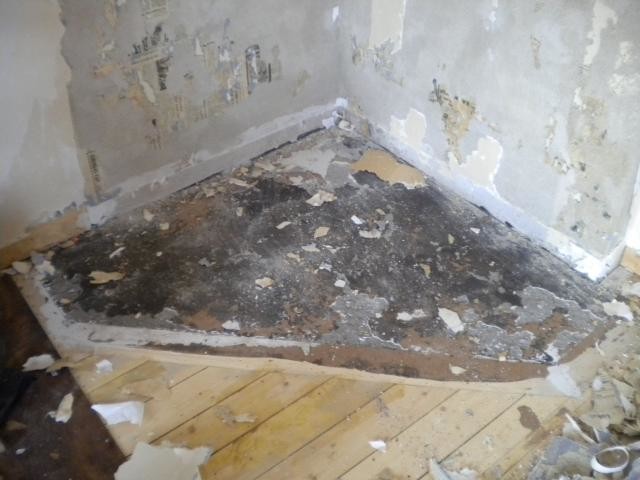
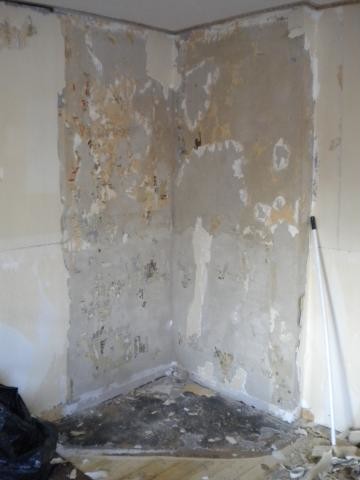
Need help. Our chimney, after the snow-rich winter, collapsed and landed in my wife's garden. It's built as an extension of the outer wall and had the entire snow pressure on its boarded side. It is dual-flued and now to my problem. The size of the chimney is 80cm x 40cm including joints. Now I'm wondering how I should connect between the wall between the flues to the outer wall. I hope you understand what I mean.
It's not so certain that it was a tiled stove that stood there. It could have been a completely ordinary, small, and lightweight cast iron stove in that corner. The plastered area might have been covered with a spark-proof stone slab that was removed to lay a new floor over it.cederbusch said:Continued to uncover the floor yesterday and what do my eyes behold if not a marked spot where some heat source once stood. A plank "curves" around a plastered area where perhaps a tiled stove once stood. But I'm a bit concerned about the floor's ability to support the weight because if it did stand there, it would have been on wooden beams and such a piece weighs quite a bit.
It all depends on how grand your house is, how large the rooms are, and what the builder could afford. The finest and most expensive fireplace was usually in the large room on the ground floor, and other rooms had to settle for something smaller
.I wouldn't touch any load-bearing walls to avoid risking cracks in the old chimney. It costs a fortune to repair such a structure to a usable state again when the balance is upset.
Bear in mind that the walls were meant to be plastered, so the mason rarely focused on aesthetics when choosing bricks. The main concern was that the smoke channels were even and smooth inside, so all the uneven parts were placed towards the outside of the chimney and in walls that were later plastered. They didn’t discard a half-brick if it could be used somewhere, so you can imagine what it looks like under the plaster. Does that sound logical?
And what's wrong with a nicely plastered wall?
However, perhaps a wall that looks like sloppy half-finished masonry suits your house better? What do I know?
gaia
Gaia: it's probably like you said that there was a stove there. However, I don't see anything that indicates a re-plastered connection, so either there has never been anything connected there or the entire chimney has been meticulously plastered before the nice newspaper wallpaper.
The house is not particularly grand (check out the blog and you'll see) but well-built and substantial.
No, we shouldn't touch the brick wall, it feels too risky. We'll have to adapt the kitchen to the space available. Besides, I like the cleaning closet, though my partner doesn't.
I was thinking of trying to chip away some of the brick in the basement to take a look, but it's probably as you say regarding the quality. It's what I would have done myself if I were building a chimney and didn't plan to have the brick exposed (or imagine that some future owners in about 70 years will want it either). The exposure would be in the kitchen unless it's already revealed. I've seen a colleague's kitchen where the brick was exposed and protected with a glass panel above the stove and sink. Very stylish. But I've read that if it's a hard plaster, it's pointless to try to expose the brick anyway.
In the living room and other rooms with an adjoining chimney, there will be plaster or wallpaper. Otherwise, it becomes a bit too much like a rec room.
The house is not particularly grand (check out the blog and you'll see) but well-built and substantial.
No, we shouldn't touch the brick wall, it feels too risky. We'll have to adapt the kitchen to the space available. Besides, I like the cleaning closet, though my partner doesn't.
I was thinking of trying to chip away some of the brick in the basement to take a look, but it's probably as you say regarding the quality. It's what I would have done myself if I were building a chimney and didn't plan to have the brick exposed (or imagine that some future owners in about 70 years will want it either). The exposure would be in the kitchen unless it's already revealed. I've seen a colleague's kitchen where the brick was exposed and protected with a glass panel above the stove and sink. Very stylish. But I've read that if it's a hard plaster, it's pointless to try to expose the brick anyway.
In the living room and other rooms with an adjoining chimney, there will be plaster or wallpaper. Otherwise, it becomes a bit too much like a rec room.
Now I've been up on the roof and had a look. Scary to have only the chimney to hold onto.
Anyway, it turns out there are 8 flues. Now the question is how to find the others inside the house. I would like to bring all of them out and install vents where there is no fireplace for the sake of ventilation.
Can I assume that all the flues go all the way down to the basement, or could some of them have been built from the first or even second floor? Is there any "standard" for how the flues might twist further down and formed a row, meaning can I figure out where each flue should be?
Who can I get here who knows about this?
Anyway, it turns out there are 8 flues. Now the question is how to find the others inside the house. I would like to bring all of them out and install vents where there is no fireplace for the sake of ventilation.
Can I assume that all the flues go all the way down to the basement, or could some of them have been built from the first or even second floor? Is there any "standard" for how the flues might twist further down and formed a row, meaning can I figure out where each flue should be?
Who can I get here who knows about this?
Hi C, pretty sure that the pipes for both smoke channels and ventilation go only to one "user" and stop at the respective floor. Googled chimney when the thread was created and got two or three links that were interesting (too rushed to link now), so unfortunately, there isn't much technical info about older chimneys. To find the right pipes, I would use a plumb line and string; that way, you can get the possible height level for the channel. Regarding ventilation through the chimney, it is only on these older chimneys that it existed, i.e., houses before 1950. It can probably become a bit "uneconomical ventilation" since wind over the roof ridge can create significant negative pressure in the house. When windless, ventilation is nearly zero, and then a warm chimney is "needed" to help with the draft. These are my novice thoughts on the subject, regards Hans
Click here to reply