
17,421 views ·
27 replies
17k views
27 replies
How does a staircase work?

Hello everyone!
It is now time in our renovation of the house from '79 to tackle the hallway and upstairs. Between these floors, there is a staircase that needs to be painted, getting a new railing, etc. BUT, I have a little problem. The staircase has twisted a bit, and the part against the wall has sunk down a bit, and that's what I'm wondering how to fix.
As can be seen in the pictures, it seems both parts against the wall have sunk a bit, and then I ask myself the questions:
Why has it done that?
How should/can I fix it?
How is the staircase attached to the wall? I can only assume that it was screwed in, and then the holes were filled with wood plugs.
Should the steps be glued into the side pieces? Now they have come loose, at least on one side.
Is it easiest to take down the whole thing and start from scratch? This way, it will be easy to paint at least..
The plan is to paint everything white and replace the lovely green carpet with some black rubber mat.
It is now time in our renovation of the house from '79 to tackle the hallway and upstairs. Between these floors, there is a staircase that needs to be painted, getting a new railing, etc. BUT, I have a little problem. The staircase has twisted a bit, and the part against the wall has sunk down a bit, and that's what I'm wondering how to fix.
As can be seen in the pictures, it seems both parts against the wall have sunk a bit, and then I ask myself the questions:
Why has it done that?
How should/can I fix it?
How is the staircase attached to the wall? I can only assume that it was screwed in, and then the holes were filled with wood plugs.
Should the steps be glued into the side pieces? Now they have come loose, at least on one side.
Is it easiest to take down the whole thing and start from scratch? This way, it will be easy to paint at least..
The plan is to paint everything white and replace the lovely green carpet with some black rubber mat.
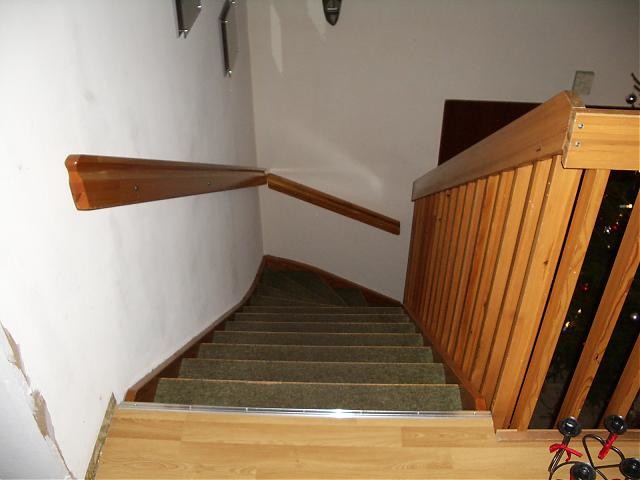
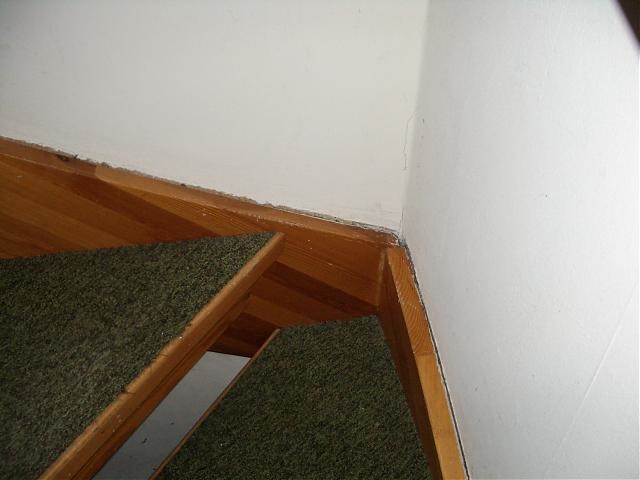
that staircase looks like the one I had in my 70s house... except I had a straight staircase and you have an L-shaped one... and yours is longer.
my staircase consisted of stringers (side pieces) with screws in the first step, the middle one, and the last. the others "just lay there" and were held in place because the others were screwed in and thus held the staircase together.
then the stringer against the wall was screwed with two screws at the start and the same amount at the end of the staircase. the screws were aligned with the underlying wall studs. lousy screws for flat-head screwdrivers too, and a real hassle when they're stuck tight. hgnfff...! replace them with something resembling a French wood screw instead, and it will be easier to screw in/out without damaging the screw.
your "situation" is peculiar. is the stringer against the wall split somewhere? if so, maybe you can locate where the actual "break" is and which screw(s) have failed.
attach something to the staircase to give you a "sturdy" flat surface underneath. use a jack, a beam that you have between the staircase (the flat part) and the jack. raise it until the staircase is straight. now you can put in new nice screws.
otherwise, you could perhaps do as I did, buy an (L-)staircase from Arké. "my" model is called compact, and I think it looks quite okay. takes a couple of hours to put together... cost me 18k...
my staircase consisted of stringers (side pieces) with screws in the first step, the middle one, and the last. the others "just lay there" and were held in place because the others were screwed in and thus held the staircase together.
then the stringer against the wall was screwed with two screws at the start and the same amount at the end of the staircase. the screws were aligned with the underlying wall studs. lousy screws for flat-head screwdrivers too, and a real hassle when they're stuck tight. hgnfff...! replace them with something resembling a French wood screw instead, and it will be easier to screw in/out without damaging the screw.
your "situation" is peculiar. is the stringer against the wall split somewhere? if so, maybe you can locate where the actual "break" is and which screw(s) have failed.
attach something to the staircase to give you a "sturdy" flat surface underneath. use a jack, a beam that you have between the staircase (the flat part) and the jack. raise it until the staircase is straight. now you can put in new nice screws.
otherwise, you could perhaps do as I did, buy an (L-)staircase from Arké. "my" model is called compact, and I think it looks quite okay. takes a couple of hours to put together... cost me 18k...
Thanks for the responses, but the problem persists: No, the stringers are intact, and I can't find any screws, so they're probably doweled into the wall as described. Could the dowels have broken?
Seems like I have to take down the whole staircase anyway. Does anyone have tips on how to install a staircase once it's going back up? How do you get the stringers at the right height/angle, etc.?
By the way, I've been considering a new staircase model that "moddha" bought, but I don't think it will look much better; I haven't seen any with nice railings in my opinion.
/ Fredrik
Seems like I have to take down the whole staircase anyway. Does anyone have tips on how to install a staircase once it's going back up? How do you get the stringers at the right height/angle, etc.?
By the way, I've been considering a new staircase model that "moddha" bought, but I don't think it will look much better; I haven't seen any with nice railings in my opinion.
/ Fredrik
I removed my old staircase to sand and repaint it. Not so difficult technically... but it weighs a lot. We were two to remove/reinstall mine and, as mentioned, it was smaller.
You probably just have wooden plugs covering the actual holes where the screws are. At least that was the case for me.
You can try using the jack and see what happens. A long straight edge or alternatively a laser might be good to ensure the staircase is straight. Also, locate where you have (standing) studs in the wall to attach the stringer.
I agree that the railing on arké isn't that nice... that's why I haven't put it up either and plan to have a much nicer one welded instead.
You probably just have wooden plugs covering the actual holes where the screws are. At least that was the case for me.
You can try using the jack and see what happens. A long straight edge or alternatively a laser might be good to ensure the staircase is straight. Also, locate where you have (standing) studs in the wall to attach the stringer.
I agree that the railing on arké isn't that nice... that's why I haven't put it up either and plan to have a much nicer one welded instead.
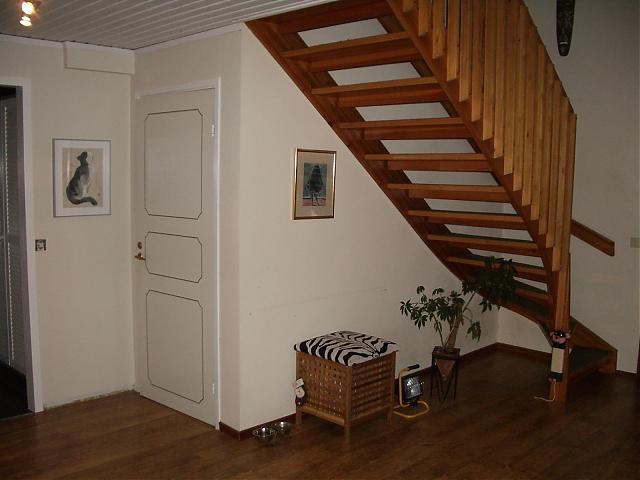

Fresve, considering you intend to paint the staircase, I recommend you dismantle it. Sanding and painting will be considerably easier then. Given the settling, it wouldn't surprise me if it's nailed to the wall.
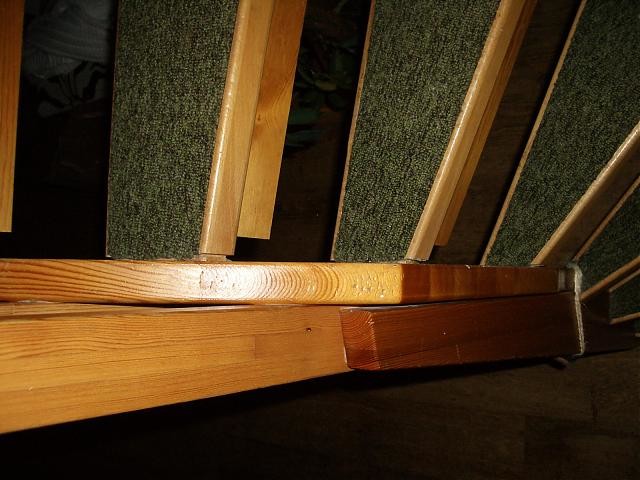
In one of the pictures, I also see that the steps have come loose from the free stringer. This too could be because it's nailed together.
Anyway, once you are done with the varnishing, you assemble the staircase before putting it in place. First, fasten the steps with Torx screws. When the staircase is raised and the steps are adjusted to be level, secure the stringers along the wall with Torx screws. The best thing is if you find the studs to screw into. If you find studs c/c 600, it will be great.
In one of the pictures, I also see that the steps have come loose from the free stringer. This too could be because it's nailed together.
Anyway, once you are done with the varnishing, you assemble the staircase before putting it in place. First, fasten the steps with Torx screws. When the staircase is raised and the steps are adjusted to be level, secure the stringers along the wall with Torx screws. The best thing is if you find the studs to screw into. If you find studs c/c 600, it will be great.
No, okay...
I was just wondering because we have an identical staircase (apart from the railing) in our house built in '73.
We removed the balusters that were against the "open" stringer to make the hall more open. We thought it was much better—until my partner almost killed herself a few years later when she stepped on a step that completely fell off!
It turned out that it was the balusters that held the staircase together, and a few years of walking on it had slowly pushed apart the stringers so that the steps— they were unglued and were not embedded by many millimeters—could slide out. Now the staircase is compressed and secured again, though without balusters.
I saw in one of your pictures that some of the steps have started to slide out of the stringer, it's probably best that you check and address that as soon as possible to avoid accidents.
The reason why your staircase has sunk by the wall/corner I interpret as it being too "flexible," and it's where you can see the steps are on their way out. Could the "foot," meaning one or both ends of the stringers that rest against the hall floor, have moved outward, you think? Then maybe the inner corner can sink and simultaneously pull out the steps?
Feel free to share what happens with your staircase.
Good luck!
Ronnie
I was just wondering because we have an identical staircase (apart from the railing) in our house built in '73.
We removed the balusters that were against the "open" stringer to make the hall more open. We thought it was much better—until my partner almost killed herself a few years later when she stepped on a step that completely fell off!
It turned out that it was the balusters that held the staircase together, and a few years of walking on it had slowly pushed apart the stringers so that the steps— they were unglued and were not embedded by many millimeters—could slide out. Now the staircase is compressed and secured again, though without balusters.
I saw in one of your pictures that some of the steps have started to slide out of the stringer, it's probably best that you check and address that as soon as possible to avoid accidents.
The reason why your staircase has sunk by the wall/corner I interpret as it being too "flexible," and it's where you can see the steps are on their way out. Could the "foot," meaning one or both ends of the stringers that rest against the hall floor, have moved outward, you think? Then maybe the inner corner can sink and simultaneously pull out the steps?
Feel free to share what happens with your staircase.
Good luck!
Ronnie
I will tinker a bit with the stairs, and then get back with the results. I suspect, just as Immobil says, that it is how the stairs are attached to the wall that is causing the problems. However, I don't think it's nailed, that sounds a bit poor to nail and then plug the holes. They have probably just attached it to the chipboard and missed the studs.
However, I have a lot to do now beforehand; the entire upper floor and the hall downstairs need to be renovated. I will start with painting all the ceilings and frames, then move onto the walls, and finally, when everything is done, tackle the stairs and the walls where the stairs are.
I was restless over the weekend and have at least torn down all the seagrass wallpaper on the upper floor... This is what everything looked like before I started:
http://www.fresus.se/thumbnails.php?album=15
Thanks a lot for now!
I suspect, just as Immobil says, that it is how the stairs are attached to the wall that is causing the problems. However, I don't think it's nailed, that sounds a bit poor to nail and then plug the holes. They have probably just attached it to the chipboard and missed the studs.However, I have a lot to do now beforehand; the entire upper floor and the hall downstairs need to be renovated. I will start with painting all the ceilings and frames, then move onto the walls, and finally, when everything is done, tackle the stairs and the walls where the stairs are.
I was restless over the weekend and have at least torn down all the seagrass wallpaper on the upper floor...
This is what everything looked like before I started:http://www.fresus.se/thumbnails.php?album=15
Thanks a lot for now!
Hmm, it's getting close with the stairs..
So you assemble it Before you get it where it is supposed to be?
I suppose for my part everything will fall apart like a pick-up sticks game when I start to take it down.
/ Fredrik
So you assemble it Before you get it where it is supposed to be?
I suppose for my part everything will fall apart like a pick-up sticks game when I start to take it down.
/ Fredrik