Yes, that's the question.
I know the principles, but how should one think to get the correct cc-measurements everywhere?
I will build the frame with 45x145 and add insulation on both sides with 45mm.
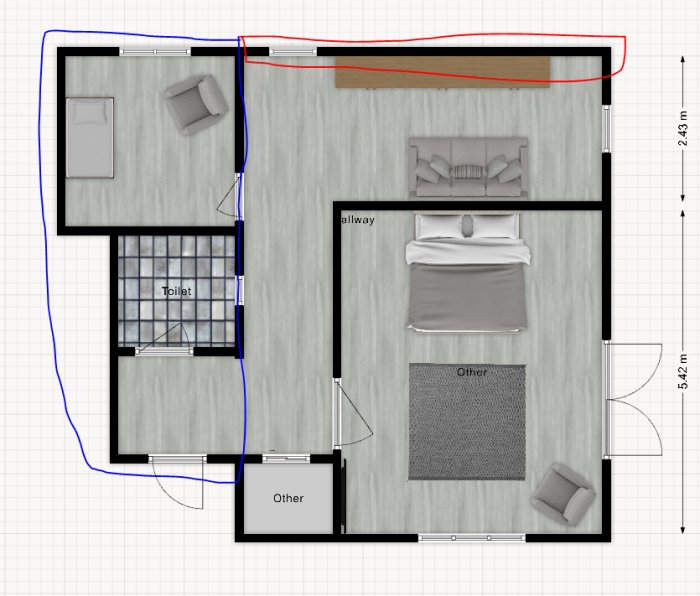
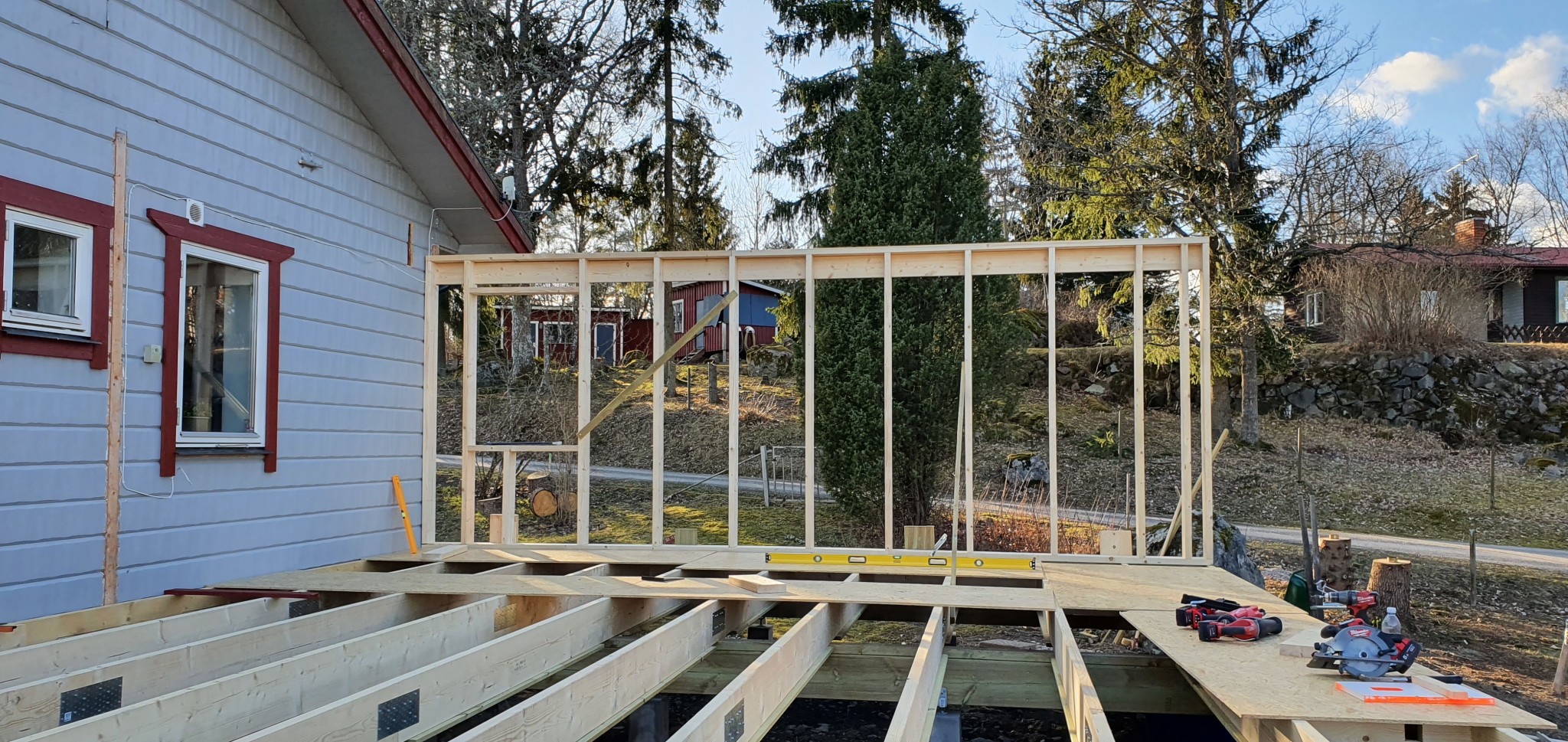
The first wall I will build is the one marked in red on the picture. The part marked in blue is part of the existing house.
There will be an 80cm wide window 35cm in on the wall.
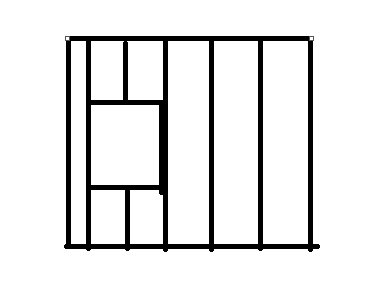
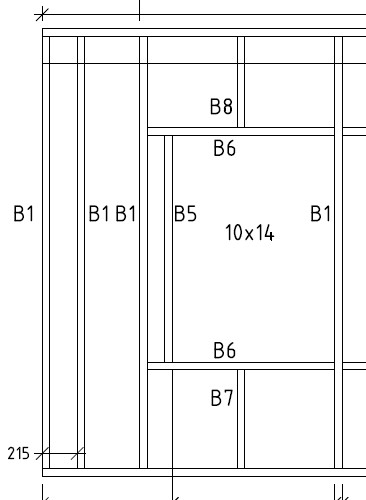
Should I start spacing cc-60 directly from the left, or should I start spacing cc-60 from the stud to the right of the window?
This is how I usually do it, s600 everywhere and at windows, let the top and bottom plates extend to the nearest vertical stud and then place a vertical stud between these for the correct width.
Hello, how did it go? You mentioned that you would build the frame with 45x145 and add insulation on both sides with 45mm. Thus, the total insulation thickness is 235 mm.
How well insulated is it? Is it suitable for year-round use?
Are there any advantages/disadvantages to building with 145 studs and then adding 45 mm studs on both sides compared to building with a 220-stud from the start?
Hi, how did it go? You mentioned you would build the frame with 45x145 and add extra insulation on both sides with 45mm. So the total insulation thickness would be 235 mm.
How well insulated is it? Is it suitable for year-round use?
Are there any advantages/disadvantages to building with 145 studs and then adding extra insulation with 45 mm studs on both sides compared to building with a 220 stud from the start?
If you lay 45mm flat on both sides, you eliminate the thermal bridge that would otherwise occur if you only use 220mm.
If you place 45mm lying on both sides, you remove the thermal bridge that would otherwise form if you only use 220mm.
Aha! Do you need multiple layers of windproof paper as well, or is one layer on the outside lying 45-rule enough?
What is considered "okay" insulation for year-round use? Could 235 mm suffice? Building a guesthouse on Gotland (i.e., relatively mild climate), with a 5-year economic perspective.
Aha! Do you need several layers of wind protection paper as well, or is one layer enough on the outside-facing 45-rule?
What is considered "ok" insulation for year-round use? Could 235 mm suffice? Building a guesthouse in Gotland (i.e., relatively mild climate), 5-year perspective economically.
One layer of wind protection paper on the outside is enough.
235 with broken thermal bridges is sufficient for year-round use.
Ok! So the total thickness for an acceptable year-round outer wall is approximately 20 mm (outer panel) + vindpapp + 235 mm insulation + vapor barrier + 10 mm (OSB) + 12 mm (gypsum) = 277 mm. Or have I forgotten a layer?
I will soon start building frames. I aim to build as mentioned above, i.e. 145 frames + horizontal 45 battens internally to avoid thermal bridges and simplify the installation of electricity, etc. Then I suppose I should also have 45 battens horizontally externally, to attach vertical panels to them.
- Should the wind barrier / fabric be on top of this outermost 45, or on top of the 145?
- What do I do with the underside of the external 45, i.e. the side that is open and facing the ground? I have seen some people groove here with a hand saw to improve air circulation while being too small a space for mice to get through. Should this surface be treated in any way? Just the same color as the panel, or something else to consider??