I have a construction drawing for a garage with a roof according to the top part of the image below.
However, I would like to have the beams visible, partly because it looks nice, and partly because it's easier to make attachments to the interior ceiling. (The beams are dimensioned to support an additional 200 kg in the middle.)
Can I do as depicted in the image below, or could I have moisture issues on the "cold side" of the beams? That is, moisture might travel up into the beams and then get trapped by the plastic (blue line in the image) on the top side?
There is definitely a risk of condensation when the vapor barrier ends up on the cold side, just as you say. Achieving an airtight seal can also become problematic as you're likely to encounter tricky joints when you have to splice it to the wall's vapor barrier. Then I don't know what one might plan to hang that weighs 200kg on each ceiling beam, but such an attachment detail has to be adapted to what is to be hung; it's difficult to make a general, convenient solution that can handle such a point load. It seems to be relatively long beams; are the ceiling beams across the roof slope?
Are the rafters relatively long, are the roof rafters laid across the roof slope?
Yes, they span over 4 meters, across. It's so that I get good ceiling height in the garage.
It would have been convenient to make attachments on the side of the rafter instead of underneath; there is a bit of a difference in strength. (And attachments that didn't puncture the vapor barrier.)
It's a garage, so the attachments were more important than appearance perhaps. Well, I guess I'll have to stick to the k-drawing.
Hehe, for the amount of insulation you should ask the construction engineer and building committee, but it should reach a certain k-value. I will have heating in the winter.
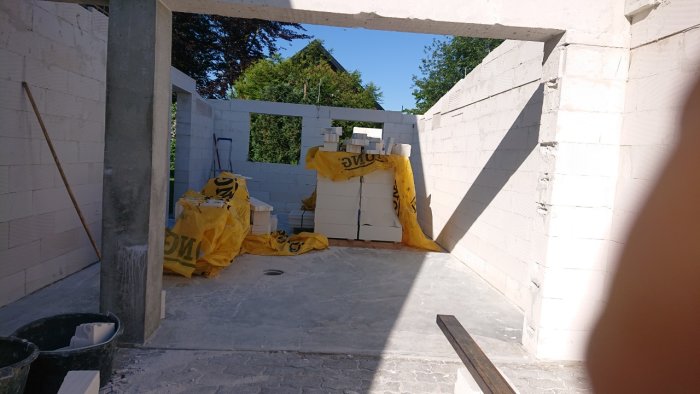
I'm almost done with the walls now (siporex), had an inspection by the person responsible for control and the municipality yesterday.
I have a construction drawing for a garage with a roof as in the top part of the image below.
However, I would like to have the beams visible, partly because it's aesthetically pleasing and partly because it's easier to make attachments in the ceiling. (The beams are dimensioned to carry an additional 200 kg in the middle.)
Can I do it like in the image below, or could I have moisture problems on the "cold side" of the beams? Meaning, would moisture travel up into the beams and then be trapped by the plastic (blue line in the image) on the top side?
You can do it like in image no. 2 if you simply avoid pulling up the plastic on the top side of the beams. You need to cut and attach the vapor barrier in the "middle" of each glulam beam. Perhaps tape it up loosely at first, then put a batten on top to firmly secure the barrier against the beam all the way.
You can do like in picture no. 2 if you just ignore pulling up the plastic on the top side of the beams. You must cut and attach the vapor barrier to the "middle" of each glulam beam. Maybe tape it up a bit poorly, then put a batten on that presses the foil tightly against the beam, all the way.
Mmm, do you dare to do that? You think any moisture that travels up the timber beam will still come out on the top? Feels like I might be introducing more risk for something to go wrong compared to what I get, so I don't dare... Maybe it's not worth it after all.
I myself would probably just build as usual, completely traditional. Simpler and safer.
But if I had very strong motives for such a solution, that's how I would have done it.
There won't actually be much steam transport through the glued laminated timber, less than solid wood even since the glue layers are a bit more steam tight.
And if you paint or treat the surface of the beams, they probably become even more tight. No, the critical part is making it airtight between the plastic and the beams, that's where the difficulty and problem lie.
Yes, I agree. Now I'm trying to build everything so that it lasts at least 40 years, so I don't have to rebuild when I'm 70+. So it's best to go with a full vapor barrier.
If it only lasts until I'm 80, then you're probably old enough not to care if it rains in here and there. But until then, it should hold.
Mmm, is it safe? You think that any moisture traveling upwards in the wooden beam will still come out on the top side? It feels like I might be introducing more risks for something to go wrong relative to what I gain, so I'm hesitant... Maybe it's not worth it after all.
I would primarily go with the first option (it also allows for a bit more insulation). It's not that difficult to find out where the joists are if you need to attach something heavy.
If I went with the second alternative, I would cut the plastic to size, lay it in each compartment, and clamp it against the rafter with the nail battens that are needed anyway to attach the sparse paneling.
The moisture load in a garage isn't that significant, right? If you paint the beams with some covering paint, they definitely won't absorb any moisture that migrates to the cold side.
I would probably do as Mikael L suggests; it's the same principle as when you tape the vapor barrier to a window frame, for example, as it also goes "straight through" the wall.
But then I wonder if you shouldn't think about fire protection? I'm a bit unsure about the rules for auxiliary buildings offhand, but the fire protection of the load-bearing structure disappears since you are not enclosing it with gypsum, and that could be a problem. Now I'm just drawing parallels to other types of buildings where laminated timber is used as a load-bearing structure, but it might be worth double-checking
But then I wonder if you shouldn't consider fire protection? I'm a bit unsure about the rules for accessory buildings off the top of my head, but the fire protection of the load-bearing structure disappears as you're not enclosing it with plasterboard, and that could be a problem. I'm just drawing parallels to other types of buildings where you have glued-laminated timber as the load-bearing frame, but it might be worth double-checking.
It depends on the fire-resistance rating that needs to be met. If it's EI, it's only protection against smoke, flames, and heat radiation; if it's REI, then load-bearing capacity must also withstand the specified time.
So, first and foremost, you need to assess whether it's a fire compartment at all, and then if load-bearing capacity must be maintained, finally, the duration that must be withstood.
But it's definitely tough to meet R on exposed wooden beams if needed. Paint with intumescent fire-protection paint and/or oversize.
I, for one, have exposed glued-laminated timber across the house and have honestly not even considered it. The house is the same fire compartment, so the only fire rating I can imagine applying here is R30 in that case. Since everything around the beam is the same fire compartment, there are no E or I requirements.
It depends on which fire protection class needs to be fulfilled. If it's EI, then it's just protection against smoke, flames, and heat radiation; if it's REI, then the load-bearing capacity must also be maintained for the specified time.
So first and foremost, you have to assess if it's a fire compartment at all, and then if the load-bearing capacity needs to be maintained, and finally what duration has to be met.
But clearly, it will be tough to meet R on exposed wooden beams if needed. Paint with intumescent fire protection paint and/or over-dimension.
I at least have exposed glue-laminated beams across the house, and frankly, I haven't even considered it. The house is the same fire compartment, so the only fire class I can think of that would apply here is R30 in that case. Since everything around the beam is the same fire compartment, there will be no E or I requirements.
Yes, you're probably right about that. The existence of one or more fire compartments doesn't necessarily have to be decisive, but garages are classified as building class Br3, and there are no general requirements for fire protection of load-bearing structures, so it should be free to do as one pleases I've mostly built schools, offices, etc., where other requirements apply.
Vi vill skicka notiser för ämnen du bevakar och händelser som berör dig.



Andreas Lundgren said:

Mikael_L said:


Haggärde said:
But then I wonder if you shouldn't consider fire protection? I'm a bit unsure about the rules for accessory buildings off the top of my head, but the fire protection of the load-bearing structure disappears as you're not enclosing it with plasterboard, and that could be a problem. I'm just drawing parallels to other types of buildings where you have glued-laminated timber as the load-bearing frame, but it might be worth double-checking.