
11,767 views ·
21 replies
12k views
21 replies
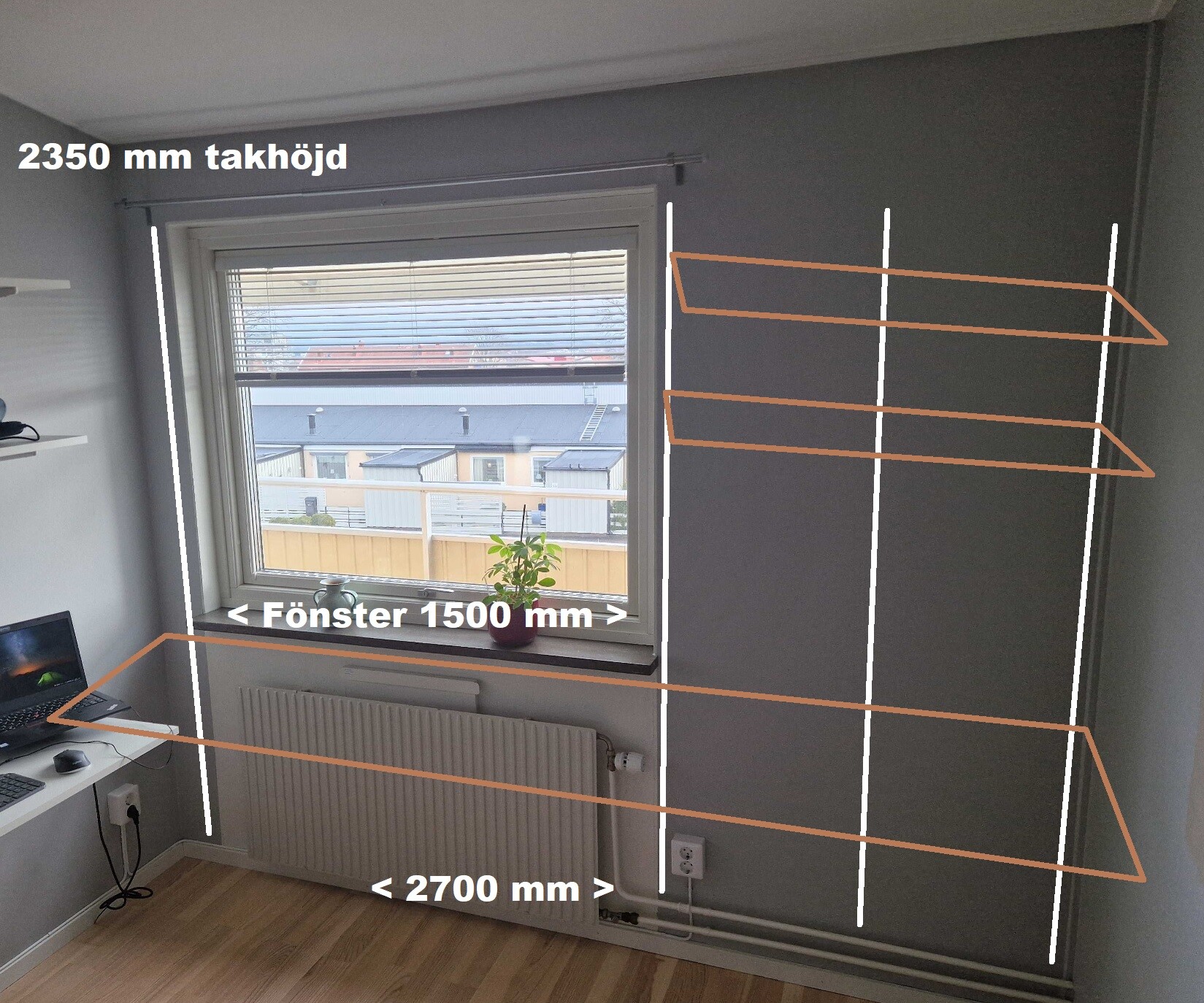
How do I build a large desk with Elfa and a countertop? Approx. 2700 x 650.
Hello!
I'm going to redesign my home office and want to make room for two workstations. My idea is to set up Elfa systems and then place a countertop (Pine or Oak on 57 cm brackets at about 85 cm height). I want to cover almost the entire wall and the workspace should be about 2700 mm x 6500. In addition to the countertop, I’m also thinking of having two smaller shelves on the right side.
On the countertop, there will be two monitors, two computers, and sometimes a sewing machine. So around 30 kg load should not be a problem.
My uncertainty right now lies in the durability and how much the Elfa system can handle, and potential sagging of the countertop. On Elfa's website, I read that if I attach the rails 45 cm apart, the shelves can handle 40 kg.
The easiest way is probably to look at the picture to understand what I want to achieve.
Concrete questions so far are:
1. Thickness of the countertop? 18 or 27 mm are the ones I’m looking at now. 18 is likely to sag a bit and need reinforcement underneath, and 27 mm will be relatively heavy. I plan to slightly bevel the edges for a softer impression.
2. Is an extra bracket needed under the window to reinforce the construction?
3. Does the Elfa rail to the left of the window need to be as long as the others? Does it benefit the construction?
I’m including a picture without lines so you can draw yourselves if needed.
Grateful for tips, input, and ideas!
All the best.
I'm going to redesign my home office and want to make room for two workstations. My idea is to set up Elfa systems and then place a countertop (Pine or Oak on 57 cm brackets at about 85 cm height). I want to cover almost the entire wall and the workspace should be about 2700 mm x 6500. In addition to the countertop, I’m also thinking of having two smaller shelves on the right side.
On the countertop, there will be two monitors, two computers, and sometimes a sewing machine. So around 30 kg load should not be a problem.
My uncertainty right now lies in the durability and how much the Elfa system can handle, and potential sagging of the countertop. On Elfa's website, I read that if I attach the rails 45 cm apart, the shelves can handle 40 kg.
The easiest way is probably to look at the picture to understand what I want to achieve.
Concrete questions so far are:
1. Thickness of the countertop? 18 or 27 mm are the ones I’m looking at now. 18 is likely to sag a bit and need reinforcement underneath, and 27 mm will be relatively heavy. I plan to slightly bevel the edges for a softer impression.
2. Is an extra bracket needed under the window to reinforce the construction?
3. Does the Elfa rail to the left of the window need to be as long as the others? Does it benefit the construction?
I’m including a picture without lines so you can draw yourselves if needed.
Grateful for tips, input, and ideas!
All the best.


Diversearbetare
· Göteborg
· 11 362 posts
Skip Elfakonsoller for the countertop and go for proper fixed brackets for this. Otherwise, it becomes far too shaky. This is because the wall rail itself flexes no matter what you do. The bracket itself is not a problem. No problem with shelves, but it's troublesome with a workspace that constantly moves. However, this doesn't stop you from having long wall rails that you can push the countertop against.
Thanks for the reply @Johan Gunverth!
I have a similar solution today but a bit more compact (see image). I don't feel that the rails flex, but that might change with more weight..?
The current rails are attached with 5 screws each, at approximately 30 cm intervals.
I have a similar solution today but a bit more compact (see image). I don't feel that the rails flex, but that might change with more weight..?
The current rails are attached with 5 screws each, at approximately 30 cm intervals.

It might be if you have ELFAs "hängskena" that it bends. The rails are only attached to the hanging rail at the top and then with small screwed clamps further down. I also believe that the rail itself is weaker than the one intended to screw into the wall.
I would put a leg in the middle or maybe a drawer unit to increase stability.
/M
I would put a leg in the middle or maybe a drawer unit to increase stability.
/M
Diversearbetare
· Göteborg
· 11 362 posts
It's the other way around. The hanging rails are stiffer precisely because they only have one point to hang from. The regular rails have also received a new consumer range with a sparser hole pattern.M mgranbom said:Maybe it's if you have ELFA's "hanging rail" that it flexes. Then the rails are only attached to the hanging rail at the top and then with small screwed clamps further down. I also think that the rail itself is weaker than the one intended to screw into the wall.
I would put a leg in the middle or maybe a drawer unit to increase stability
/M
Diversearbetare
· Göteborg
· 11 362 posts
If you think the solution you already have works, there shouldn't be any problem with a larger table. I would personally have adjusted the larger desktop so that it spans from wall to wall and rests on a support along three sides (red). Then mounted a slightly sturdier bracket roughly in the middle aligned with the right edge of the window frame (green). In that wall, you are guaranteed to have a standing stud to screw into.B Banansvenne said:

Last edited:
Elfa has two systems for wall mounting.
1 The older system where you screw the rails directly into the wall. This is what is shown in the picture and is still available for purchase.
2 You hang the rails on a track and can screw the rails into the wall.
If you also screw the rails in variant 2 into the wall, it becomes at least as sturdy as the first variant.
Then if you fasten shelves and the table top, it becomes really sturdy in both variants.
I haven't measured the thickness but I don't notice any difference in the material thickness between the different systems.
I wouldn't hesitate to have a 27 mm desktop on an Elfa system. Under the window, I would reinforce the top to avoid sagging.
1 The older system where you screw the rails directly into the wall. This is what is shown in the picture and is still available for purchase.
2 You hang the rails on a track and can screw the rails into the wall.
If you also screw the rails in variant 2 into the wall, it becomes at least as sturdy as the first variant.
Then if you fasten shelves and the table top, it becomes really sturdy in both variants.
I haven't measured the thickness but I don't notice any difference in the material thickness between the different systems.
I wouldn't hesitate to have a 27 mm desktop on an Elfa system. Under the window, I would reinforce the top to avoid sagging.

They also have a heavier-duty variant of hanging rails that are not U-rails but square tubes. It's perfectly fine for hanging shelves on and, for example, a 5-meter long 27mm oak top loaded with a Bosch PBD40, a GDL 12 GCM, some bench grinder, small bandsaw, socket wrench set, and to work on. It does sag a few mm, but it's as stable as can be! If I needed more stability, I would mount a leg or two at the front.Z z_bumbi said:Elfa has two systems for wall mounting.
1 The older one where you screw the rails directly into the wall. This is the one in the picture and it is still available for purchase.
2 You hang the rails on a strip and can screw the rails into the wall.
If you also screw the rails in variant 2 into the wall, it becomes at least as sturdy as the first variant.
If you then attach shelves and a tabletop, the whole thing becomes really sturdy in both variants.
I haven't measured the thickness, but I don't notice any difference in material thickness between the different systems.
I wouldn't hesitate to have a 27 mm desktop on an Elfa system. Under the window, I would reinforce the top to avoid sagging.
It mostly depends on the wall you mount the things on, I would say. If you're just going to have normal desk items, there's absolutely no problem as long as the wall is of decent quality.
Of course, it is also fine to combine with Johan's suggestion if you want to strengthen a bit. However, I would make sure to keep 100mm free above the radiator, so it doesn't work so well to combine with a rule on the wall. But rather on the right side.
I would say use ELFA tracks and brackets. Check to ensure you get the right height, etc. When you are completely satisfied, screw in a couple of rules or support legs if you feel the need exists.
If you have tracks all the way down, it might also work to put a small shelf under the desk for some router/switch or maybe for a comfy pillow to rest your legs on.
Diversearbetare
· Göteborg
· 11 362 posts
That Elfaskenor would flex was new to me. Since I'm reading this in the workshop where I store lumber, I tested hanging myself on one of the shelves. At one bracket, it's rigid. The fact that it sags between brackets is another matter since it's the shelf itself that can't handle my fat old man's body.
Edit. I realized it might depend on whether the brackets are close to a wall screw or in between two. My shelves that are close to a screw don't sag, but if I had a shelf between two screws, perhaps it would be different.
Edit. I realized it might depend on whether the brackets are close to a wall screw or in between two. My shelves that are close to a screw don't sag, but if I had a shelf between two screws, perhaps it would be different.
Regardless of any sagging and such, this is a more stylish solution.If you think the solution you already have works, there should be no problem with a larger table. I would have customized the larger tabletop to go from wall to wall and rest on a support beam along three sides (red). Then, I would mount a slightly sturdier bracket approximately in the middle in line with the right edge of the window frame (green). There's definitely a vertical beam to screw into in that wall.
[image]

I would have bought a sturdy height-adjustable chassis instead. Then you can set the perfect working height (which should not be underestimated). They are surprisingly cheap on Amazon. Then you choose whichever tabletop you want for it. If it wobbles, you glue and screw reinforcements underneath, but a good chassis stabilizes very well.
Diversearbetare
· Göteborg
· 11 362 posts
That's what I meant. If the bracket ends up between wall screws, it flexes. It's best if the top edge of the bracket in the wall rail is just under a wall screw.Hep said:
That Elfaskenor would flex was news to me. Since I'm reading this in the workshop where I store lumber, I tested hanging on one of those shelves. By a bracket, it's rigid. That it flexes between the brackets is another matter, as it's the shelf itself that can't handle my heavy old man body.
Edit. I realized it likely depends on whether the brackets are near a wall screw or midway between two. My shelves near a screw don't flex, but if I had a shelf between two screws, it might have been different.
But as mentioned: it all depends on what one tolerates regarding flex on a workbench.
Great input! If I go with Elfa, I can control that when I put up the rails so that it ends up.
Thanks!