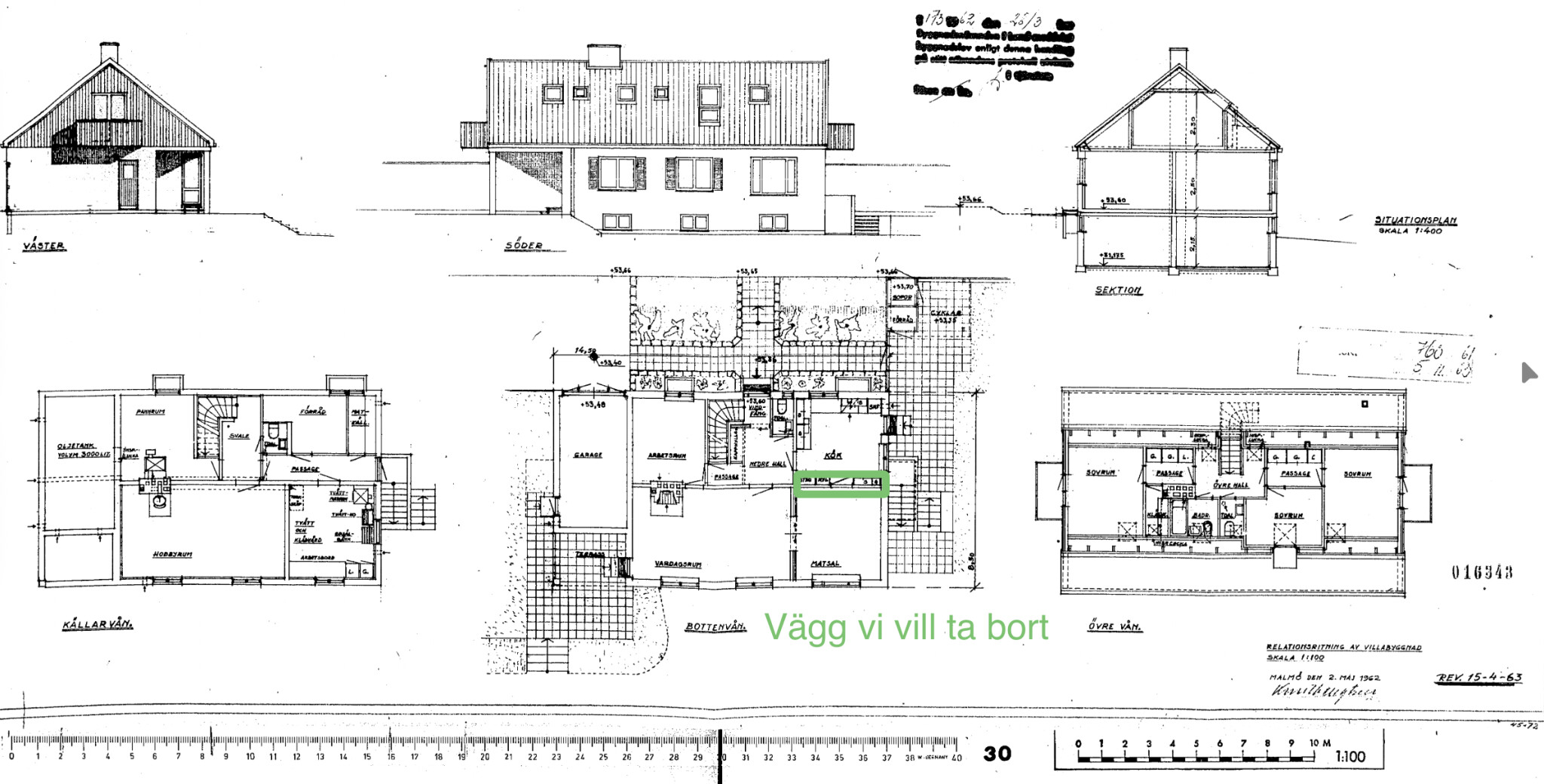
I have bought a house where we intend to take down a wall to open up between the kitchen and dining room on the entrance floor. It's a stone/concrete house from the 60s.
I have spoken a bit with a craftsman, and he didn't think it was load-bearing while an engineer who glanced at the drawing thought it might be.
The wall in question is located under the cast floor above the ground floor "f1."
I was wondering if there's anyone kind enough to give me a second opinion, or alternatively give me some information on how to interpret it myself.
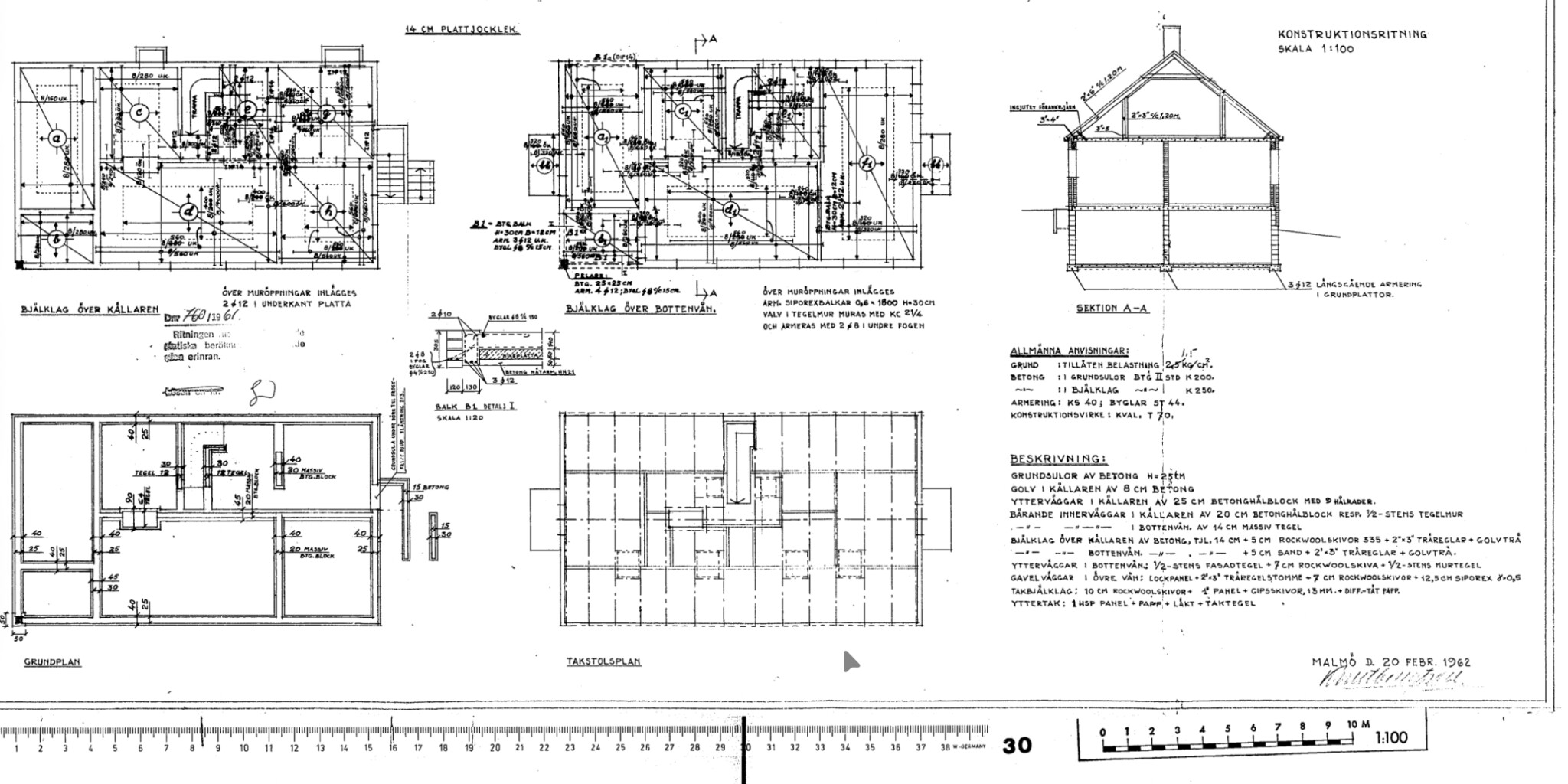
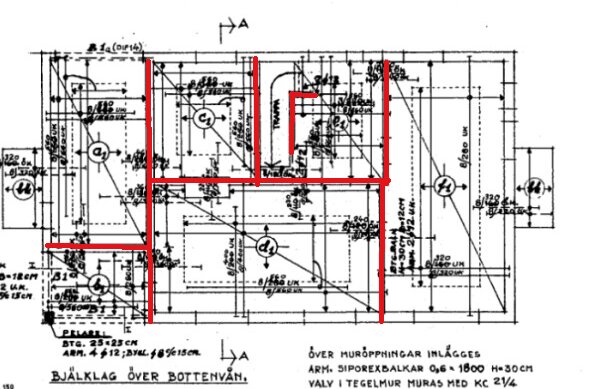
If you look at the construction drawing and floor structure over the ground floor. All the walls that are drawn on it are load-bearing. So your wall is load-bearing.
Is the highlighted wall masonry? If not, you can remove it because the drawing states that load-bearing walls on the ground floor are constructed with 140mm solid bricks.
This is probably the first time I've seen an attic floor in concrete.
Agree with Matti
Same here, had to zoom in on all sorts of things to be convinced, but that's how it's drawn. 140 mm two-way reinforced slabs - the current one with a decent span
What makes me a bit suspicious, though, is that the a-drawing clearly shows a middle wall in that position, paired with the note "rev15-4-64". A much later date than the attached k-drawing, which is not necessarily the latest.
If it's just a late addition, light infill, then it's still calm, but if this wall is built, there is a risk that it was desired before the construction - which then made the designer make it load-bearing and save some reinforcement if there was going to be a wall there anyway. They might even have concluded that deflections would be a bit on the edge over the long span?
Conclusion: check what the wall is made of. If it's brick, be cautious with the demolition - you need a designer to calculate a proper support beam, and preferably limit the width of the opening. It can help to look for the latest k-drawing, but that's no guarantee.
Yes, I was surprised myself when I saw that it was a concrete attic floor.
Thank you so much for all the responses! It feels like I got a certain breadth in the answers.
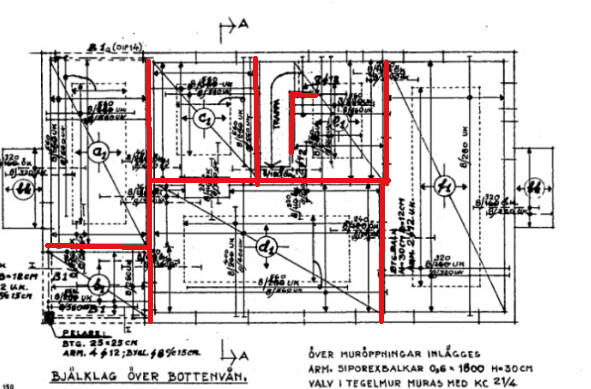
Just as some of you mentioned, the reason I wanted to raise the question was because I couldn't see the wall on the reinforcement drawing. In other words, the cast slab "f1" does not reinforce against it. "f1" corresponds to the slab on the far right in the drawing for floors above the ground floor (as kindly drawn by 13th marine above).
What I primarily take with me is to check what the wall is made of (load-bearing walls are according to the Construction plan built of solid brick).
If I remember correctly, it felt a little different when knocked on compared to the other more massive walls. Unfortunately, I haven't been granted access to the house yet, so I can't open it up and check the interior.
In any case, I also have an ongoing discussion with an engineer who was sure it was load-bearing, without needing to come out and look at the wall. I became a bit skeptical and suspect that there has been a communication error on my part.
I'll try to remember to send an update here when we have made progress so maybe it can help someone else reading.
Thanks again!
Click here to reply
Vi vill skicka notiser för ämnen du bevakar och händelser som berör dig.