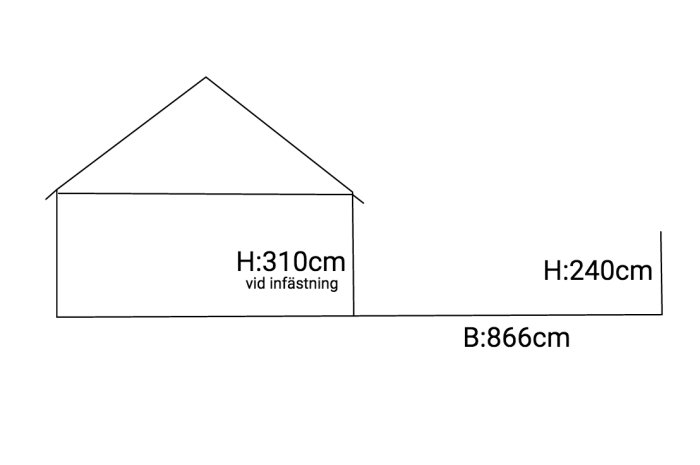
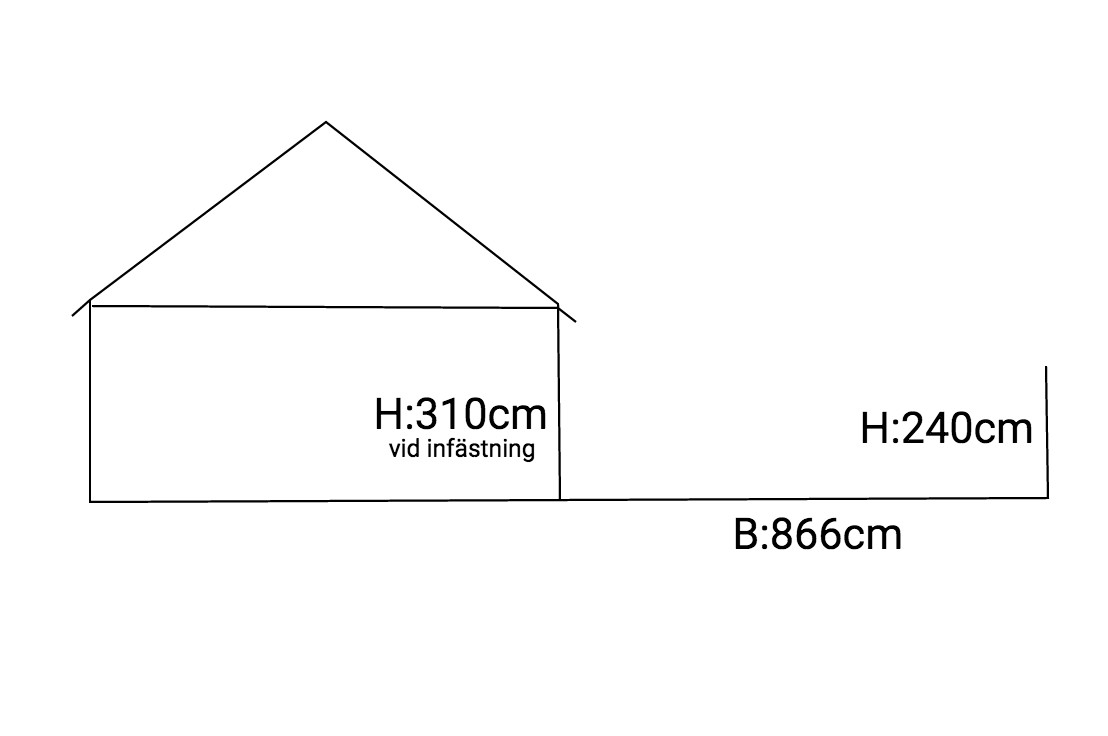
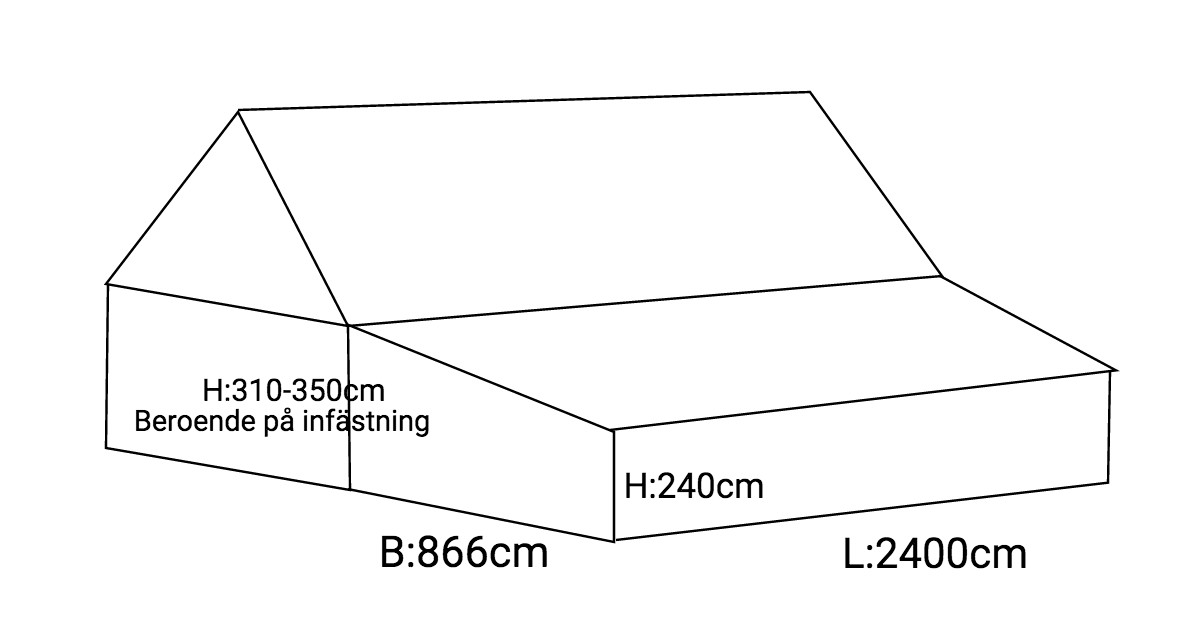
I am considering putting a roof on a former silo, as it would be convenient and economical since it already has three concrete walls and a cast slab.
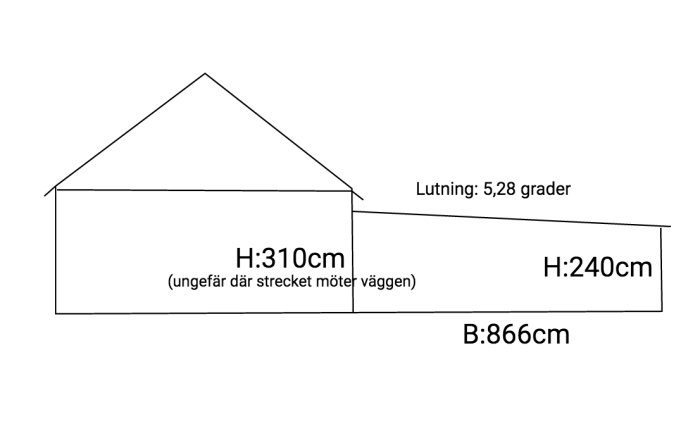
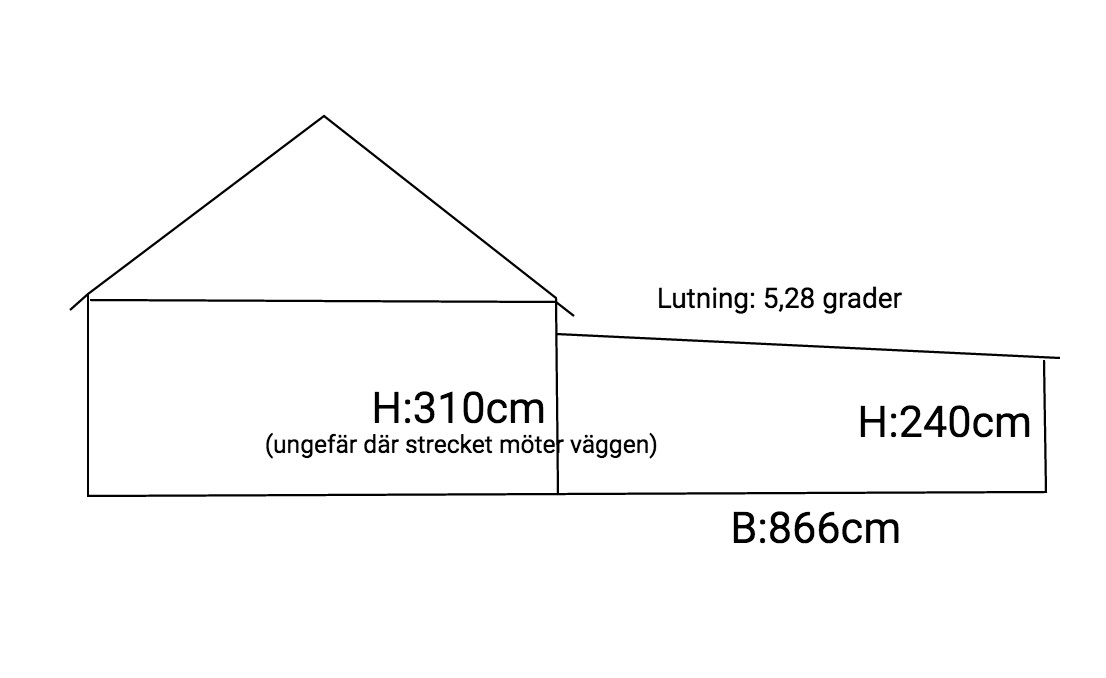
The problem, however, is that it is adjacent to another building with a gable roof, so putting a gable roof on this one as well becomes problematic. Therefore, I thought that a lean-to roof that goes under the existing one would be the best theoretical solution. The issue, however, is the low roof pitch (approximately 5.28 degrees), which means that the dimension of the glulam beams, even with a support beam in the middle, becomes very thick.
The roof would then only be covered with felted TRP-20 sheet metal, without any sheathing or insulation.
I am attaching a simple drawing of how it looks currently and how I am thinking in my example.
If anyone can think of how I should solve this in the best way, I would be very grateful!
It depends a bit on how long the "silo building" would be. It is not impossible to place two buildings with gable roofs next to each other if it involves a limited distance. A shed roof with an 866 cm span and a 5-degree roof pitch requires quite substantial materials (glulam).
It depends a bit on how long the "silo building" would be. It's not impossible to place two buildings with gable roofs next to each other if it concerns a limited distance. Shed roofs with an 866 cm span and a 5-degree slope require quite substantial structures (glulam).
Hello and thanks for the reply! The building next door is 25m long, and the new one is intended to be 24m, so it's probably unfortunately too long to have a gable roof.
What do you think about IPE steel beams? They don't take up as much space, but maybe cost significantly more than glulam?
Hi and thanks for the response! The building next door is 25m long, and the new one is intended to be 24m, so it's unfortunately too long to lay a pitched roof.
Yes, it is too long.
If you have space for glulam in terms of height, it's almost always cheaper than steel, so I would probably recommend that.
If you have space for glulam in terms of height, it is almost always cheaper than steel, so I would probably recommend it.
The higher the ceiling height, the better, of course, but I'll have to make a compromise. Do you think spacing the beams closer than 120cm will have any significant effect on the dimensions?
The higher the ceiling height, the better, of course, but I guess I'll have to make a compromise. Do you think that spacing the beams closer than 120cm will have any significant effect on the dimensions?
Of course! Tell me where in the country you are building, and I can make some examples.
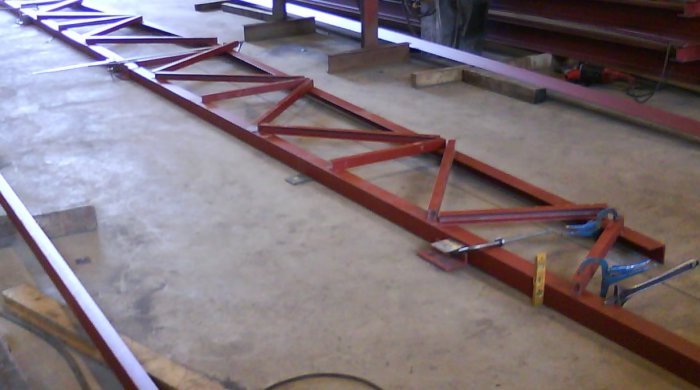
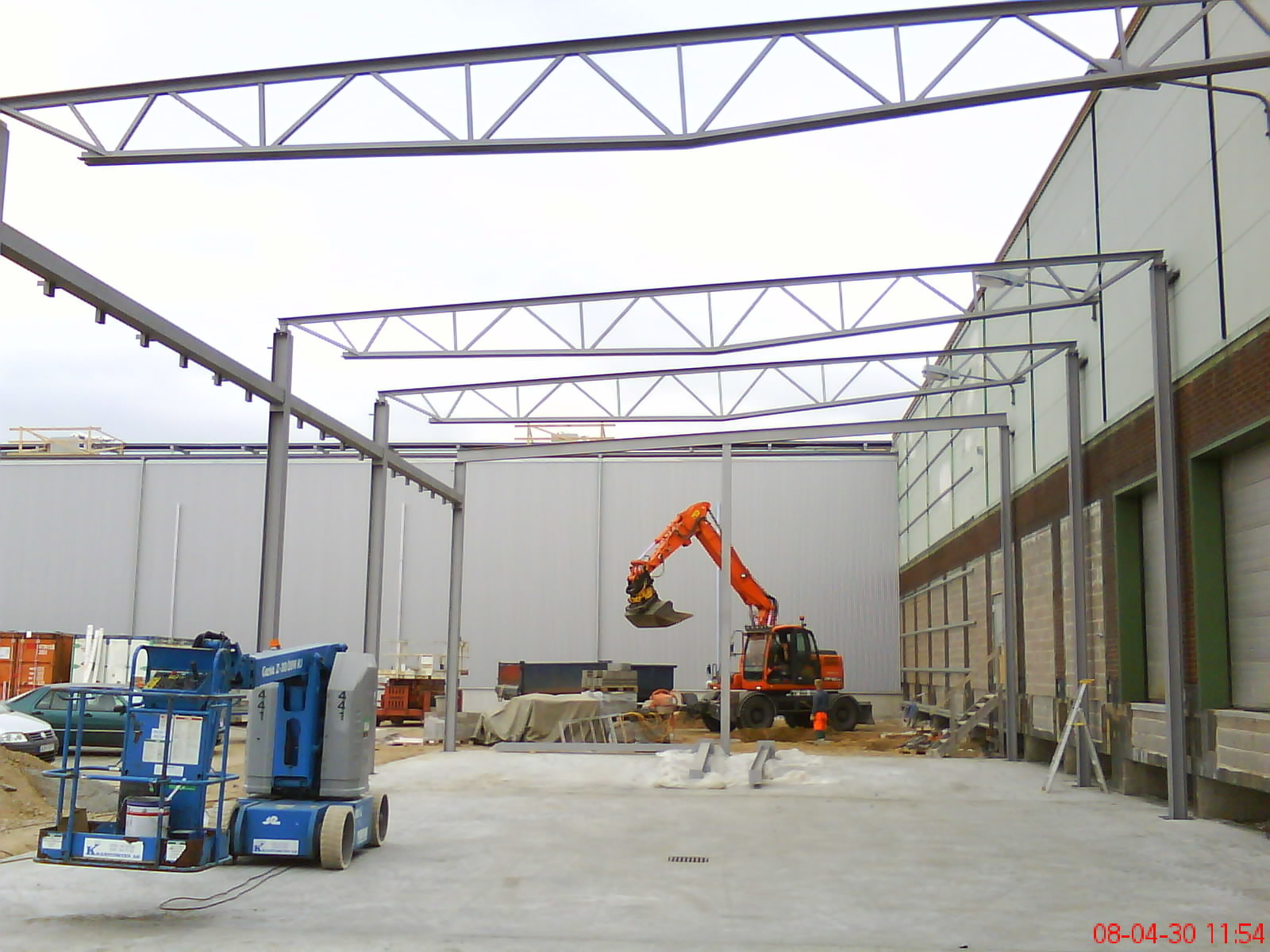
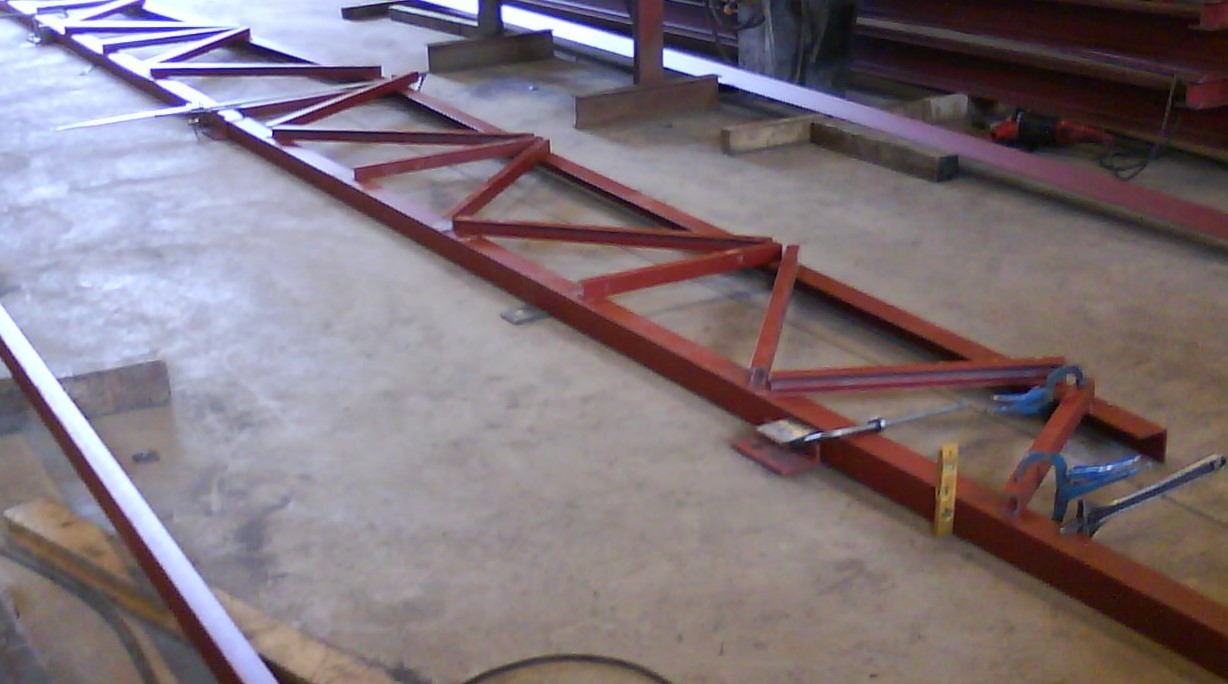
Interesting, truss beams weren't something I had thought about! Thanks for the good answer.
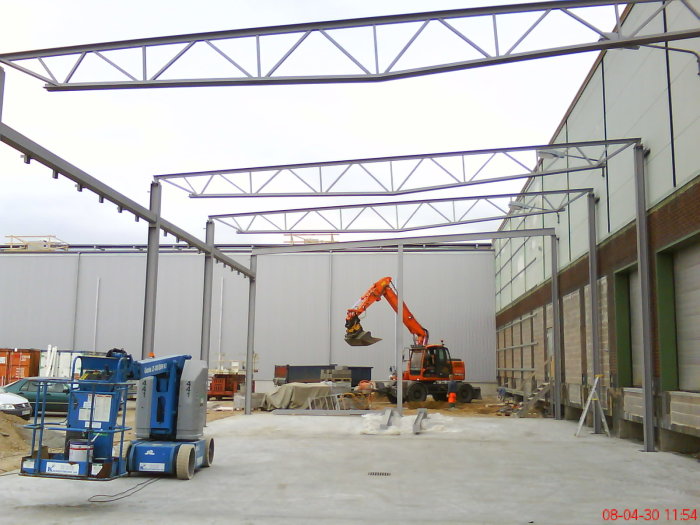
I contacted Maku Steel, and they had quite a long delivery time for trusses, but thought IPE-beams would suffice for the relatively short span. Any tips on where to turn for calculation of the dimensions needed?
Jjustusandersson said:
Of course! Let me know where in the country you are going to build so I can make some examples.
Great, thanks! In Borgholm municipality on Öland, snow zone 2.
I have calculated with the following conditions: width 8.7 meters, length 24 meters, snow load + dead weight 2.5 kN/sqm, 10,000 SEK/cubic meter for glulam and 3,500 SEK/cubic meter for construction timber class C24.
Material costs for the roof structure:
Option 1: Glulam 90x225 c/c 600 mm, Usage 7.22 cubic meters, i.e. 72,200 SEK.
Option 2: Glulam 90x315 c/c 1200 mm. Usage 5.18 cubic meters, i.e. 51,800 SEK.
Option 3: Glulam 90x450 c/c 2400 mm + construction timber 45x145 c/c 1200 mm. Usage 3.87 + 1.25 cubic meters, i.e. 43,075 SEK.
Comments: For such a large building, one must somehow consider material consumption, as the difference is significant between different options. There are alternative glulam dimensions if one wants to prioritize as low a height as possible. These are for option 1: 140x180, option 2: 165x225, and option 3: 165x315. All lead to greater material consumption.
The low roof pitch is a problem, among other things because it limits choices in terms of roofing materials. There are different ways to get around this, but for a meaningful discussion you need to tell more about the intended use and different requirements for the execution in terms of insulation, surface finish, ventilation, etc.
I have calculated with the following conditions: width 8.7 meters, length 24 meters, snow load + dead weight 2.5 kN/sqm, 10,000 SEK per cubic meter for glulam and 3,500 SEK per cubic meter for...
Very detailed response, thank you!
Option 2 looks like the best choice, economically mixed with functionality. The lower height of the beams also means that the installation can be done slightly higher up. On the drawing, I've measured about 40–50 cm below the eaves of the existing building. The higher you can go there, the more favorable the roof slope.
Got this proposal from a manufacturer of glulam:
21 pcs 90x405 L=8647mm
2 pcs 140x810 L=12000mm (bearing beam)
4 pcs 140x180 L=3000mm (pillars)
=8.28 cubic meters of timber
I am not a constructor, but I think a 81 cm bearing beam and 4 pillars sounds somewhat over-dimensioned together with 90x405 at cc1200.
In the summertime, the building is currently used sparingly, a bit like storage and garage for own smaller vehicles. In winter, it will be used for winter storage of caravans/motorhomes and other vehicles. A caravan is approx. 2.5m wide and 270-290cm high, which means that it might only fit caravans on the far left, where the roof is highest. If the roof beams are smaller in height, it is possible that one can fit in the middle as well. The remaining width should then be used for lower vehicles such as cars or trailers.
The surface layer is therefore the simplest possible to block out weather and wind. I am thinking only of trp20 sheet metal with a felted underside, which is already on the adjoining building. No requirements for insulation or special ventilation beyond natural ventilation.
With optimal use of space, it would bring in approx. 20,000 SEK per year in rental income. Then you might have to deduct approx. 3,000 SEK per year for maintenance. Therefore, a total construction cost of 80-100,000 SEK (excluding VAT) would be fully acceptable, which might be reasonable since the concrete slab and three of the walls already exist? I have also calculated with 6 days of help from a carpenter, approx. 20,000 SEK.
Attaching some more (not to scale) images to clarify.
The use as a warehouse simplifies matters considerably. I was a bit worried that you had planned it as an animal stable.
The proposal from the glulam manufacturer seems completely out of the blue. I don't understand that calculation. With the light roof structure you have in mind, you can probably refine the dimensions a bit. Note that you can always replace a glulam profile with one that is wider and slightly lower. You will then lose a bit of efficiency in material utilization at the cost of a slightly larger volume and price.
The roof slope is actually too low for Tp20 and similar sheet metal, but you can perhaps compensate for it with larger overlaps. The requirement for watertightness is not super high.
I have now consulted with a builder, and it seems possible to enter at the eaves of the other building (also storage), cut away excess sheet metal, and slide the new one underneath. This would provide a roof slope of 7.8-8 degrees instead.
No, there is not a high demand for water tightness, as long as it doesn't seep in often enough to damage the timber. But with slightly larger overlap as you mentioned, it should work quite well!
Click here to reply
Vi vill skicka notiser för ämnen du bevakar och händelser som berör dig.